
Gorilla row
Also called kettlebell gorilla row.
What is a gorilla row?
A gorilla row is an alternating kettlebell row from the floor. You hinge over two bells between your feet, keeping one hand on the grounded bell while the other arm rows. Each bell returns to the floor before you change sides.
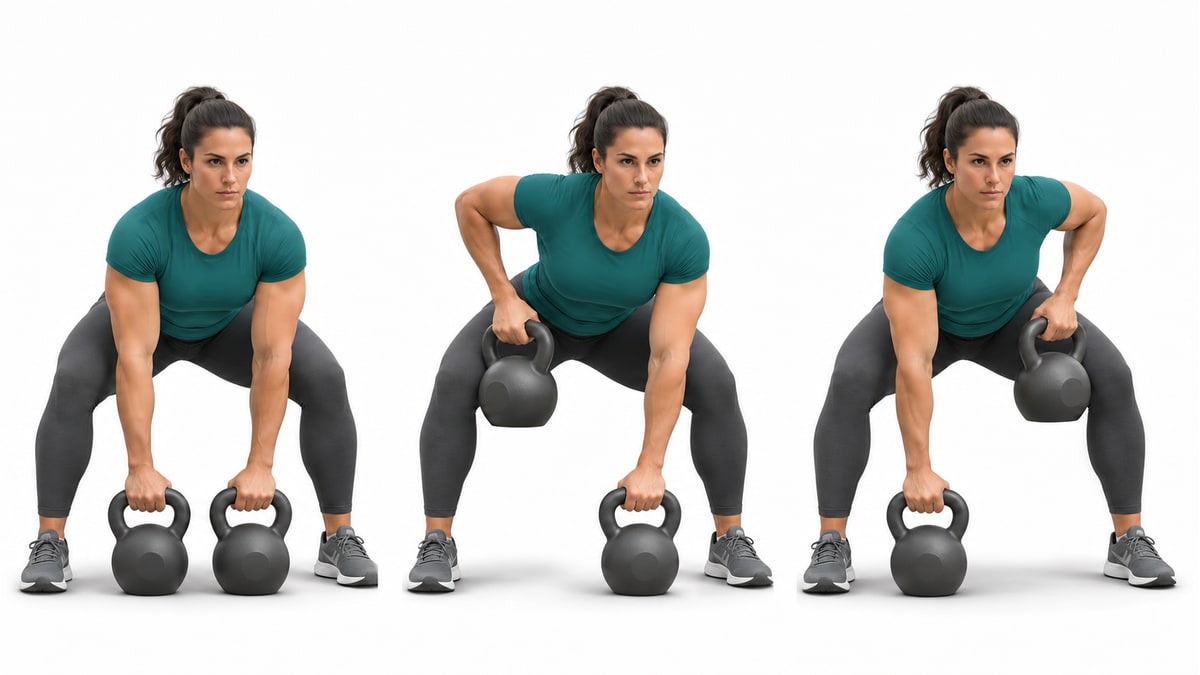
How do you perform a gorilla row?
Set up
- Put two matching, flat-bottomed kettlebells side by side on a firm, level floor. Stand outside the bells with your feet about shoulder width or wider and room for each bell to pass inside your legs.
- Push your hips back and bend your knees until you can grip both handles with your palms facing each other. Keep your feet flat, back long and abdomen braced.
Execution
- Keep your left hand on its grounded bell and press down into the handle as you draw your right elbow back beside your ribs. Bring the right bell toward your waist without raising your hips.
- Lower the right bell under control until its base rests on the floor and your arm is long again.
- Keep the right bell grounded, row the left bell, then return it to the floor. Continue alternating without standing up between pulls.
- Finish with both bells on the floor. Let go of the handles, then stand up.
Common mistakes
Lifting both bells at once
The grounded bell is your hand support in this version. Set one bell down before lifting the other; a simultaneous two-bell row uses a different setup.
Standing higher to finish each pull
Keep the hinge at the same height. Use lighter bells if you need to lift your chest or drive through your legs to bring the weight up.
Crowding the bells with your knees
Adjust your stance so the handles and bells have a clear path inside your legs. Keep your knees pointing in the same direction as your toes.
Where it fits in a session
Use it where your session calls for a kettlebell rowing exercise.
Start with bells you can lower quietly while holding the same hinge. Count repetitions per arm, and keep that convention and the floor reset consistent when comparing sets.
Muscles worked
Primary
Secondary
Schematic surface view. Some muscles are partly visible or not shown.
The back muscles draw the upper arm and shoulder blade backward. The elbow flexors help bend the arm during the pull.
Variations
- One-arm kettlebell rowUses one bell and a staggered stance, with the free forearm resting on the front thigh. The gorilla row uses the second floor bell as hand support instead.
Frequently asked questions
Do I need two kettlebells?
This version uses two so one can stay on the floor as hand support. With one bell, use the one-arm kettlebell row and support your free forearm on your front thigh instead.
Should both kettlebells leave the floor together?
No. Alternate arms and put each bell down before lifting the other. A simultaneous two-kettlebell row has no grounded bell supporting the free hand.
How wide should I stand?
Start around shoulder width and widen enough to make room for the bells. You should be able to reach both handles with your feet flat and your back held steady. If you cannot reach the floor comfortably, choose a supported row from a higher starting position.
Does my torso have to stay completely motionless?
A little rotation of the upper back can happen as the shoulder blade moves. Keep your hips steady and avoid turning your whole chest upward or heaving the bell higher. This guide uses a controlled pull rather than a deliberate body swing.
Sources
- J. Gordon Betts et al. Anatomy and Physiology 2e, section 11.5: Muscles of the pectoral girdle and upper limbs. OpenStax, 2022. https://openstax.org/books/anatomy-and-physiology-2e/pages/11-5-muscles-of-the-pectoral-girdle-and-upper-limbs