
Heel touches
Also called alternating heel touches, heel touchers, alternate heel touchers.
What are heel touches?
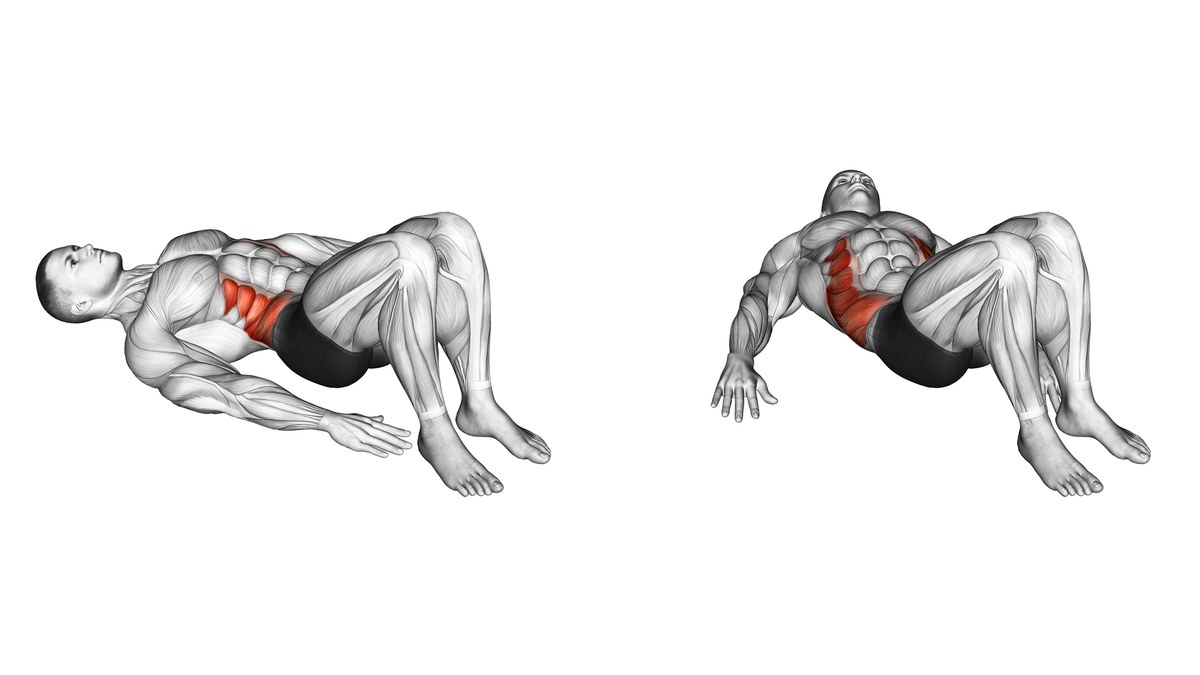
Heel touches are an abdominal exercise performed lying on your back with your knees bent and feet on the floor. You hold a small shoulder lift and reach one hand toward the heel on the same side, then alternate. The side-to-side movement involves the obliques and rectus abdominis.
How do you perform heel touches?
Set up
- Lie on your back with your knees bent and feet flat, roughly hip-width apart. Rest your arms beside your torso with your palms facing inward.
- Lift your head and shoulder blades a little, keeping your neck comfortable and your pelvis on the floor.
Execution
- Bend your upper body slightly to one side, sliding that hand toward the heel on the same side. Keep both feet planted.
- Return through the centre, then reach toward the other heel without dropping your shoulders or rolling your hips.
- Continue alternating at a controlled pace, then lower your head and shoulders to end the set.
Common mistakes
Reaching only by moving the arm
Let the small side bend move the hand toward the heel; do not turn it into an arm swing.
Placing the heels too far away
Bring the feet a little closer or reach toward the ankle without forcing a touch.
Where it fits in a session
Use it with other abdominal exercises, using either a repetition count or a timed set.
Count each side as a repetition or count a left-right pair; use the same convention each time. End the set when you need to swing or pull with your neck.
Muscles worked
Primary
Secondary
Schematic surface view. Some muscles are partly visible or not shown.
The obliques move the trunk from side to side while the rectus abdominis helps hold the shoulder lift.
Variations
- Short-reach heel touch — Reach partway toward the heel while keeping the same feet-down position.
Frequently asked questions
Are heel touches the same as dead-bug heel taps?
No. Here the feet stay planted and the hands reach toward the heels. In a heel-tap dead bug, the knees start above the hips and a heel lowers toward the floor.
Do I have to touch my heel?
No. A controlled reach toward the heel is enough. Adjust foot placement rather than straining your neck or rocking your hips to make contact.
Should my shoulders stay off the floor?
Keep a small shoulder lift while alternating sides. Rest your head and shoulders between sets, or end the set sooner if that position becomes uncomfortable.
Sources
- J. Gordon Betts and colleagues, OpenStax. Anatomy and Physiology 2e, section 11.4: Axial muscles of the abdominal wall and thorax. 2022. https://openstax.org/books/anatomy-and-physiology-2e/pages/11-4-axial-muscles-of-the-abdominal-wall-and-thorax