
Hip airplane
Also called hip aeroplane.
What is a hip airplane?
A hip airplane is a bodyweight drill in which you balance on one leg, hinge forward and turn your pelvis inward and outward around the supporting hip. You stay hinged during the turns instead of standing up between them. Start with a hand on a fixed support so you can concentrate on the hip movement.
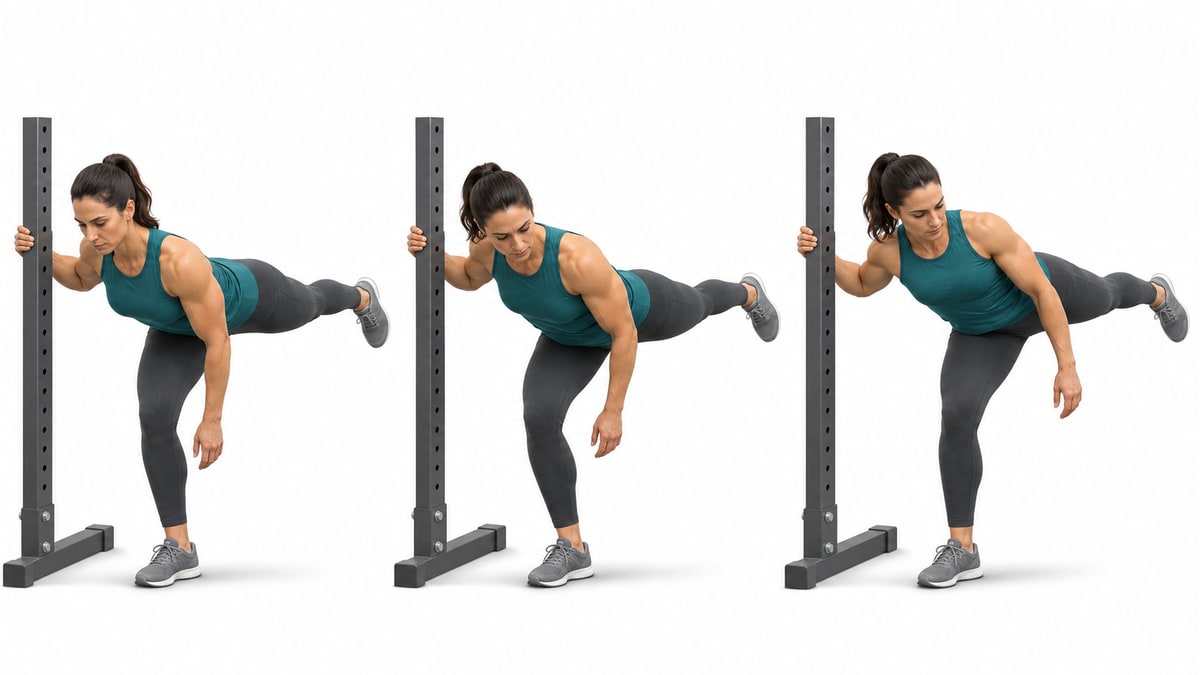
How do you perform a hip airplane?
Set up
- Stand within reach of a fixed rack and take a light handhold. Shift your weight onto one foot, keeping that knee slightly bent and the other foot off the floor.
- Brace your torso and push the standing hip back as the free leg reaches behind you. Start with both hip bones facing the floor, at a forward lean you can hold steadily.
Execution
- Keep the standing foot flat and the knee pointing along the toes. Turn your chest and pelvis together toward the standing leg, letting the free-side hip roll down a little.
- Reverse the turn to open your chest and pelvis away from the standing leg, lifting the free-side hip toward the ceiling. Stop before your foot pivots or the standing knee twists.
- Turn back until both hip bones face the floor. Repeat the inward and outward turns while staying hinged, keeping the free leg in line with your torso rather than kicking it sideways.
- Finish with the hips facing the floor, then return upright and place the free foot down. Reset your balance before changing legs.
Common mistakes
Twisting only the shoulders
Let the pelvis turn with the chest around the standing hip. A large shoulder turn over an unmoving pelvis misses the movement you are practising.
Swinging the free leg to make a bigger turn
Keep the free thigh aligned with the torso and make the turn smaller. Use the rack to regain control instead of throwing the leg out to the side.
Turning the standing foot or knee with the pelvis
Reduce the rotation until you can keep the foot planted and the knee steady. Do not force a larger turn by swivelling on the supporting leg.
Where it fits in a session
Practise before lower-body lifting, or in a session set aside for hip control.
Begin with a few slow turns on each leg and stop when you can no longer keep the supporting foot and knee steady. Keep the hand support and forward lean consistent when comparing sessions; add range before trying to do the drill without support.
Muscles worked
Primary
Secondary
Schematic surface view. Some muscles are partly visible or not shown.
The standing-side glutes help control the pelvis over the supporting leg. This is a hip-control drill, with the free leg following the pelvis rather than swinging on its own.
Variations
- Unsupported hip airplane — Uses the same hinged turns without a handhold. Keep the support available and release it only while you can control the movement.
- Single-leg RDLRepeats the hip hinge and return to standing while keeping the pelvis square, rather than turning it while hinged.
Frequently asked questions
What muscles does the hip airplane work?
The gluteus medius helps support the pelvis over the standing leg. The gluteus maximus also contributes to hip rotation and support. Keep the focus on controlling the turn rather than adding weight.
Is a hip airplane the same as a single-leg RDL?
They share a one-leg hinge position. A single-leg RDL lowers and raises the torso with the pelvis kept square. A hip airplane holds the forward lean while the pelvis turns inward and outward around the standing hip.
Can I hold on to something?
Yes. A light handhold on a fixed rack is the starting version taught here. Use enough support to keep your foot and knee steady. Release the handhold only when you can make the same controlled turns without it.
How far should I rotate?
Use a comfortable range that lets the supporting foot stay flat and the knee keep its direction. You do not need to stack your hips or bring your chest parallel to the floor. Shorten the turn if you feel a pinch; stop if it hurts.
How do I count repetitions?
Count an inward turn followed by an outward turn as one repetition, returning to the hips-square position before the next. Use the same convention on each side and each session. Stand up to reset whenever you lose control of the position.
Sources
- Shah A, Bordoni B. Anatomy, Bony Pelvis and Lower Limb, Gluteus Medius Muscle. StatPearls. 2023. https://www.ncbi.nlm.nih.gov/books/NBK557509/
- Elzanie A, Borger J. Anatomy, Bony Pelvis and Lower Limb, Gluteus Maximus Muscle. StatPearls. 2023. https://www.ncbi.nlm.nih.gov/books/NBK538193/