
Single-leg RDL
Also called single-leg Romanian deadlift, one-leg RDL, dumbbell single-leg deadlift.
What is a single-leg RDL?
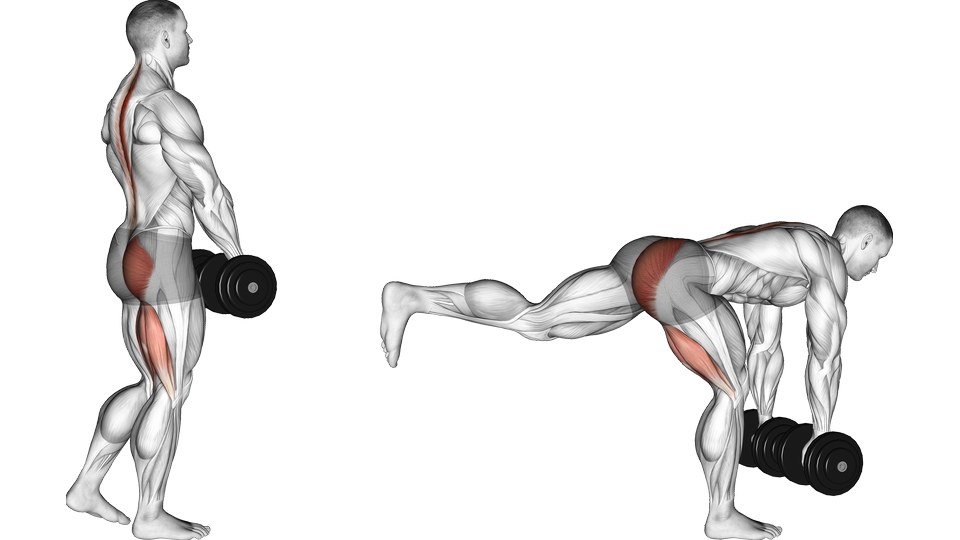
The single-leg RDL is a unilateral hip hinge. You balance on one softly bent leg, push that hip back while the free leg extends behind you, and return to standing. The standing leg's hamstrings and gluteus maximus do most of the work.
How do you perform a single-leg RDL?
Set up
- Stand tall with a dumbbell in each hand and your feet about hip-width apart.
- Shift your weight onto one foot, soften that knee and let the other foot hover just behind you.
- Brace your torso and square both hip bones toward the floor in front of you.
Execution
- Push the standing hip back as your torso tips forward and the free leg reaches behind you.
- Keep the dumbbells close to the standing leg and stop before the pelvis opens or the back rounds.
- Drive the standing hip forward to return upright, regain balance, and repeat before changing sides.
Common mistakes
Opening the free-side hip
Rotating the pelvis turns the hinge sideways and hides range that the standing hip cannot control.
Squatting on the standing leg
Increasing the knee bend moves the body down without creating the intended hip hinge.
Chasing dumbbell depth
The bottom is set by a square pelvis, a braced back and tension in the standing hamstrings, not by reaching the weights to the floor.
Where it fits in a session
As unilateral posterior-chain work after a main squat or hinge, or earlier with light load when balance practice is the priority.
Use the same support, footwear and loading arrangement when tracking progress. If balance ends the set before the standing hip is challenged, use a light fingertip support or a kickstand variation.
Muscles worked
Primary
Secondary
Schematic surface view. Some muscles are partly visible or not shown.
The standing leg's hamstrings and gluteus maximus extend the hip; the trunk and hip stabilizers keep the pelvis square while the forearms hold the dumbbells.
Variations
- Bodyweight single-leg RDL — Practises the hinge and balance without external load.
- Kickstand RDL — Keeps the rear toes on the floor for balance while the front leg carries most of the load.
- Contralateral single-leg RDL — Holds one weight in the hand opposite the standing leg.
- Ipsilateral single-leg RDL — Holds one weight on the same side as the standing leg.
Frequently asked questions
What muscles does the single-leg RDL work?
The standing leg's hamstrings and gluteus maximus extend the hip. The erector spinae and hip stabilizers hold the trunk and pelvis, while the forearms grip the dumbbells.
Should the standing knee be straight?
Keep it softly bent rather than locked. Set that small bend before the hinge and avoid turning the movement into a squat by adding more knee bend on the way down.
How low should the dumbbells go?
Only as low as you can keep the back braced and the pelvis square. Your hamstring length and balance set the bottom; the weights do not need to reach the floor.
Should I feel a single-leg RDL in my lower back?
The back muscles work to hold the trunk, but the movement should come from the standing hip. If the back rounds or becomes the limiting factor, reduce the load or range and rebuild the hinge.
What can I do if balance is the limiting factor?
Use a light fingertip on a rack or wall, practise the bodyweight version, or use a kickstand stance. Support is useful when it lets the standing hip, rather than wobbling, determine the set.