JM press
Also called JM bench press, barbell JM press, Blakley press.
What is a jM press?
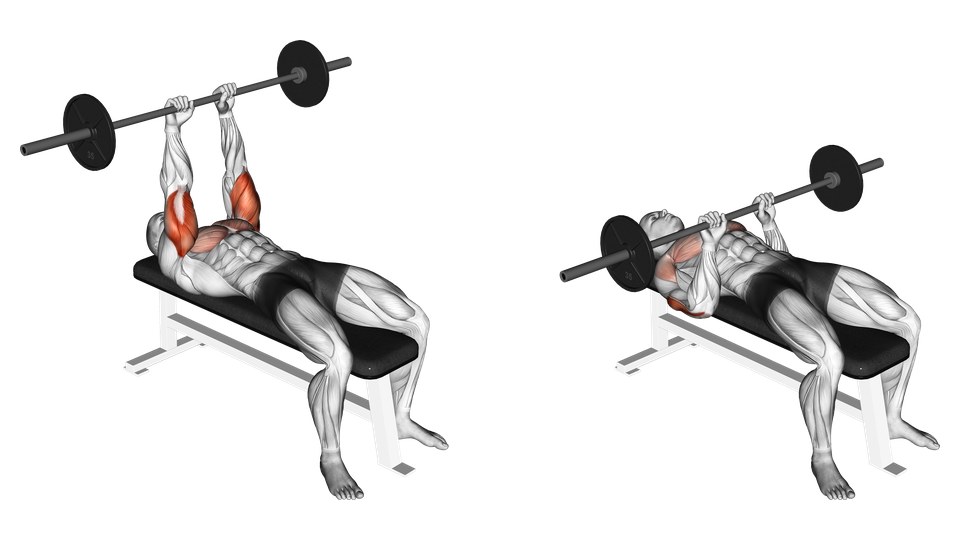
The JM press is a barbell triceps exercise that sits between a close-grip bench press and a lying triceps extension. From straight arms over the shoulders, you let the elbows bend and move slightly forward as the bar travels toward the upper chest, then extend the elbows to press it back.
How do you perform a jM press?
Set up
- Lie on a flat bench with your eyes under the bar, feet planted and shoulder blades set against the bench.
- Grip the bar around shoulder width, unrack it to straight arms and hold it over your upper chest or shoulders.
Execution
- Bend your elbows and let them travel slightly forward as the bar lowers toward the upper chest or base of the throat.
- Stop before the bar touches you or the shoulders roll forward; keep the wrists stacked over the forearms.
- Extend the elbows to return the bar to the start, then rerack securely after the final rep.
Common mistakes
Turning it into a close-grip bench press
Dropping the elbows toward the ribs and lowering to the lower chest makes shoulder pressing dominate. Let the elbows move forward and keep the bar higher.
Turning it into a skull crusher
Holding the upper arms completely fixed sends the bar toward the forehead and changes the exercise. The JM press allows the upper arms to move as the elbows bend.
Loading it like a competition bench press
The short, elbow-dominant path is less forgiving when control is lost. Begin light and add weight only while the bar stops consistently above the upper chest.
Where it fits in a session
Use it after your main bench press or as the first direct triceps movement when you want a press that can take more load than most extensions.
Treat it as a controlled assistance lift rather than a max-effort bench variation. A spotter or safeties are useful because the bottom position is close to the neck and upper chest.
Muscles worked
Primary
Secondary
Schematic surface view. Some muscles are partly visible or not shown.
The triceps extend the elbows. The chest and anterior deltoid assist as the upper arms move enough to guide the bar toward the upper chest.
Variations
- Close-grip bench pressLowers toward the chest with more shoulder movement and a more ordinary pressing path.

- Lying triceps extensionKeeps the upper arms more fixed and lowers the bar toward the forehead or behind the head.
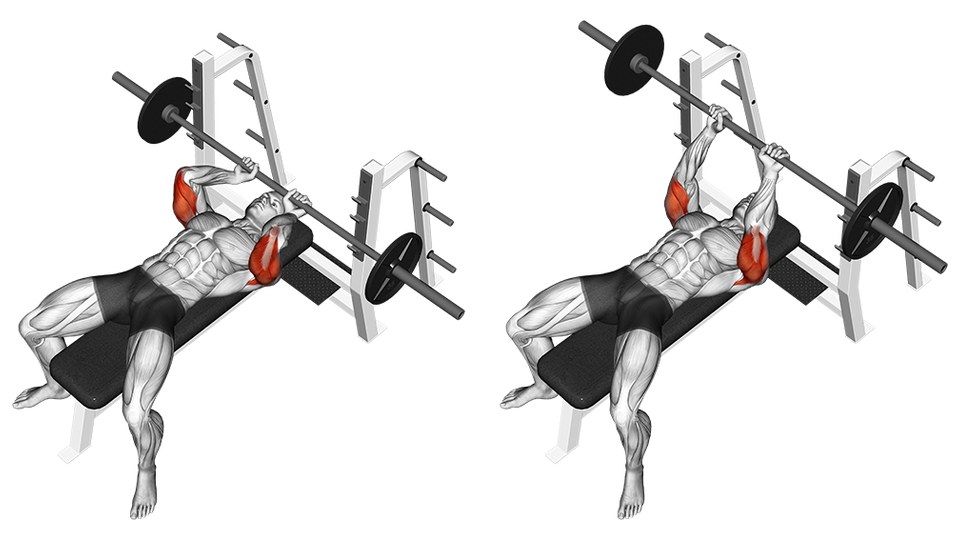
- Smith machine JM press — Uses fixed rails, so bench position determines the bar path.
Related tools
Frequently asked questions
What muscles does the JM press work?
It mainly trains the triceps. The pectoralis major and anterior deltoid assist as the upper arms move during the bar path.
Where should the bar go on a JM press?
Lower it toward the upper chest or base of the throat, stopping under control before contact. It should not travel to the lower chest like a bench press or toward the forehead like a skull crusher.
Is the JM press a bench press or a triceps extension?
It is a hybrid. The elbows bend like an extension while the upper arms move enough to guide the bar toward the upper chest.
Sources
- Tiwana MS, Sinkler MA, Bordoni B. Anatomy, Shoulder and Upper Limb, Triceps Muscle. StatPearls. https://www.ncbi.nlm.nih.gov/books/NBK536996/
- Solari F, Burns B. Anatomy, Thorax, Pectoralis Major. StatPearls. https://www.ncbi.nlm.nih.gov/books/NBK525991/
- Elzanie A, Varacallo MA. Anatomy, Shoulder and Upper Limb, Deltoid Muscle. StatPearls. https://www.ncbi.nlm.nih.gov/books/NBK537056/