
Kettlebell push press
Also called single-arm kettlebell push press, one-arm kettlebell push press.
What is a kettlebell push press?
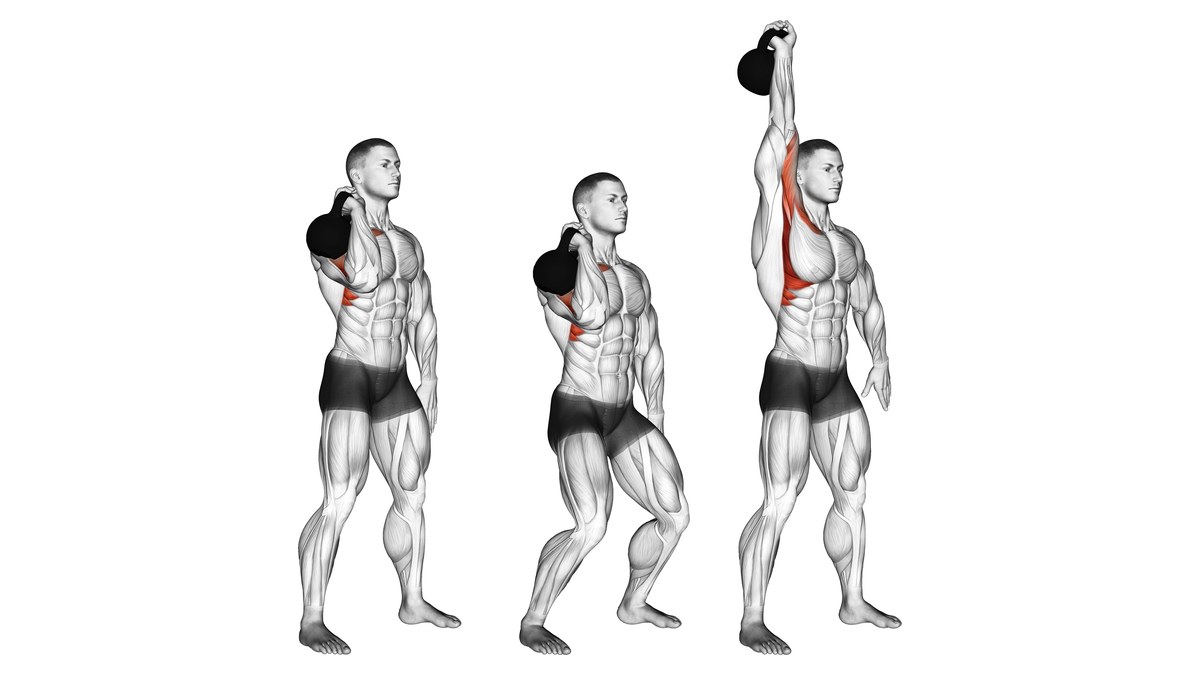
A kettlebell push press starts with the bell at your shoulder and uses a brief leg drive to help send it overhead. Working one arm at a time, dip, drive, then finish the press with straight legs, without dropping under the bell for a second catch.
How do you perform a kettlebell push press?
Set up
- Choose a light kettlebell and clear space overhead. Bend your hips and knees to lift it with both hands, stand up, and guide it into one hand at your shoulder. Set your feet about shoulder width apart.
- Rest the bell behind your forearm with the handle seated in your palm, your wrist nearly straight and your elbow close to your ribs. Brace your middle and let your other arm hang clear.
Execution
- Lower yourself a few inches by bending your knees and hips together. Keep your chest upright, your feet flat and the bell resting at your shoulder.
- Reverse direction promptly and drive upward through your legs, continuing the bell's rise with your arm. Finish tall with your hand above your shoulder, your elbow and legs straight, without dipping under the bell again.
- Bend your elbow to bring the bell back to your shoulder, softening your knees as it settles. Stand and reset before the next repetition.
- After your last repetition, return to the shoulder rack and support the bell with both hands. Lower it in front of you, bend your hips and knees to set it on the floor, then change sides.
Common mistakes
Starting the arm press before the legs drive
Keep your elbow bent through the dip, then let the upward leg drive start the bell moving. Use less weight while you learn to connect those actions.
Dropping beneath the bell to catch it overhead
A second knee bend changes the repetition into a jerk. Choose a load you can finish overhead after one dip and drive, with your legs straight.
Losing the upright position
If you fold forward in the dip or lean back to finish, shorten the dip and reduce the load. Settle in the rack before trying another repetition.
Where it fits in a session
Practise it while you can coordinate the dip, drive and overhead finish consistently.
Start with a bell you can lower comfortably as well as lift. Record each arm's repetitions and the weight of the single bell; stop the set if you need to catch it with bent knees.
Muscles worked
Primary
Secondary
Schematic surface view. Some muscles are partly visible or not shown.
The shoulders and triceps press the bell; the quadriceps and gluteus maximus contribute to the leg drive. These roles describe the movement, not measured activation percentages.
Variations
- Kettlebell overhead pressThe strict version raises the bell with still legs rather than starting it with a dip.
- Barbell push pressBoth hands share a barbell in front of the shoulders instead of holding one offset bell.
Frequently asked questions
What muscles does a kettlebell push press work?
The front and side deltoids move the upper arm, and the triceps straighten the elbow. Your quadriceps and gluteus maximus contribute as your knees and hips extend during the drive. The leg contribution is part of this exercise, unlike a strict press with still legs.
How is it different from a kettlebell jerk?
Both begin with a dip and leg drive. A jerk adds another knee bend to receive the bell overhead before standing up. Finish a push press with straight legs as your arm reaches overhead; bending the knees to soften the return to your shoulder is a separate action.
Do I clean the bell before every repetition?
No. Repetitions here begin and end at the shoulder rack. Position a light bell with both hands as described, or use a clean if you already know that skill. Cleaning from a backswing before every press makes it a clean-and-push-press combination.
Can I use two kettlebells?
Yes, a double-kettlebell push press uses a bell at each shoulder with the same dip-and-drive idea. The illustration shows one arm working on its own. Two bells require a separate rack and entry setup; keep their training records separate from one-arm sets.
How much should I bend my knees?
Use a shallow dip that lets you stay upright and change direction smoothly. You do not need to lower into a full squat. If the bell pulls you forward or you cannot control the return, use a lighter bell before adding more leg drive.
Sources
- University of Washington Department of Radiology. Muscle atlas: Deltoid. https://rad.uw.edu/muscle-atlas/deltoid
- OpenStax. Anatomy and Physiology 2e, section 11.5: Muscles of the pectoral girdle and upper limbs. https://openstax.org/books/anatomy-and-physiology-2e/pages/11-5-muscles-of-the-pectoral-girdle-and-upper-limbs
- OpenStax. Anatomy and Physiology 2e, section 11.6: Appendicular muscles of the pelvic girdle and lower limbs. https://openstax.org/books/anatomy-and-physiology-2e/pages/11-6-appendicular-muscles-of-the-pelvic-girdle-and-lower-limbs