Push press
Also called barbell push press.
What is a push press?
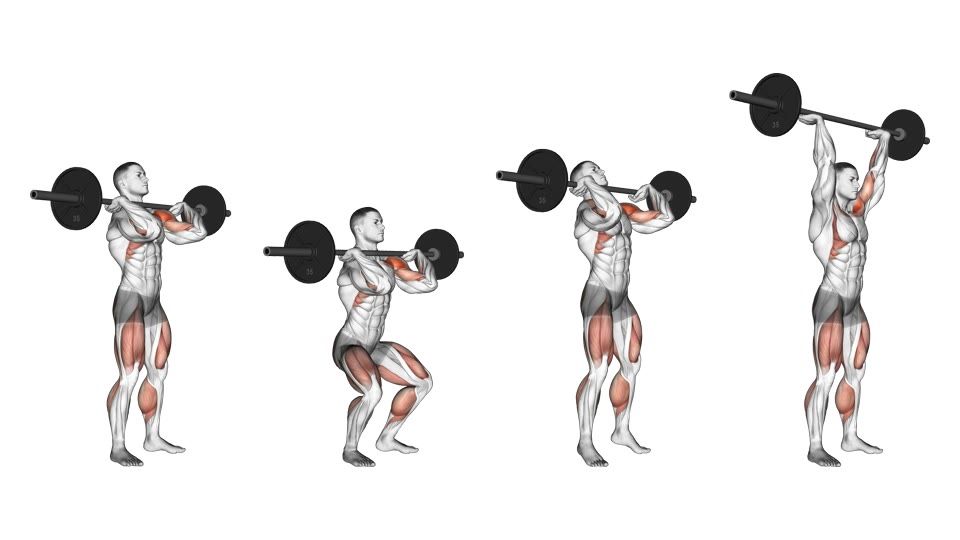
A push press is a standing barbell press started with a short dip and drive from the legs. You finish by straightening your arms overhead, keeping your legs straight as the bar reaches the top. It combines shoulder and triceps work with leg drive.
How do you perform a push press?
Set up
- Set the rack hooks just below shoulder height and clear space overhead. Grip the bar just outside your shoulders, with the elbows slightly in front of it.
- Unrack the bar onto the front of your shoulders and take short steps back. Stand with your feet around hip width and brace your torso.
Execution
- Bend the knees into a short dip while keeping the torso upright and your heels on the floor.
- Immediately drive through your feet to send the bar upward, continuing into the overhead press as your legs straighten. Move your face out of its path.
- Finish tall with the bar over your shoulders and feet, arms straight. Do not bend your knees again to get under the bar.
- Lower the bar under control to your shoulders, soften your knees as you receive it and reset. After the last repetition, return it securely to the hooks.
Common mistakes
Turning the dip into a forward bow
Keep your chest upright and shorten the dip if the bar moves toward your toes.
Pressing before the leg drive
Let the upward drive from your legs start the bar moving before finishing the press.
Catching the bar with a second knee bend
That changes the lift toward a jerk. Reduce the load until you can finish with straight legs.
Where it fits in a session
Practice it before tiring shoulder or leg accessories, while the dip and drive are well coordinated.
Use a light bar while learning the timing. Stop the set when the dip tips forward or you need a second knee bend to finish.
Muscles worked
Primary
Secondary
Schematic surface view. Some muscles are partly visible or not shown.
Variations
- Dumbbell push press — Uses the same dip and drive with a dumbbell in each hand.
- Push jerk — Adds a second knee bend to receive the weight overhead.
Frequently asked questions
How deep should the dip be?
Keep it short enough that you stay upright and can reverse direction smoothly. It is a brief knee bend, not a full squat.
Is a push press the same as an overhead press?
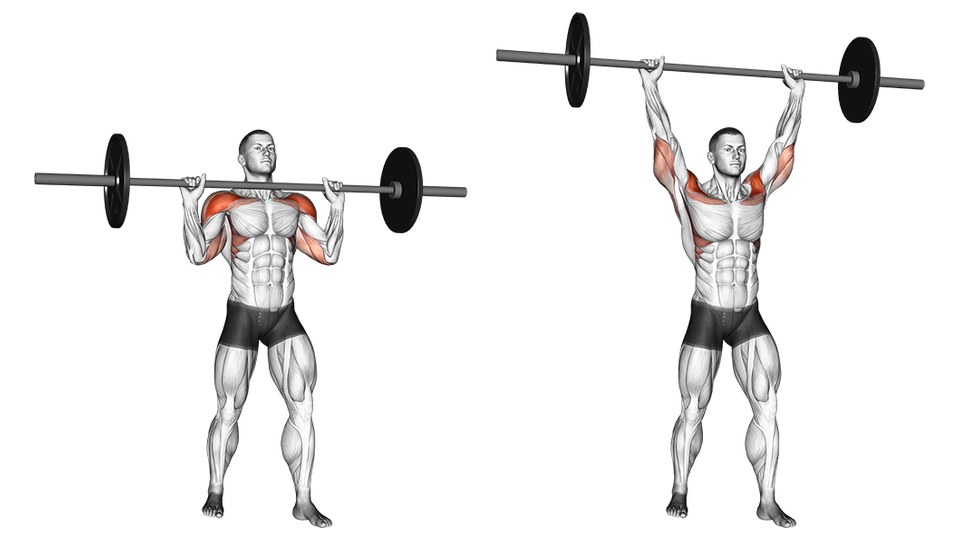
The push press uses a dip and drive to start the bar. A strict overhead press keeps the legs still. Track them separately so their loads are not mixed.
What is the difference between a push press and a jerk?
A jerk includes a second knee bend to receive the bar overhead. In a push press, you finish the overhead portion with straight legs.
Sources
- Bruno Bordoni; Matthew A. Varacallo. Anatomy, Bony Pelvis and Lower Limb: Thigh Quadriceps Muscle. 2023. https://www.ncbi.nlm.nih.gov/books/NBK513334/
- Adel Elzanie; Judith Borger. Anatomy, Bony Pelvis and Lower Limb, Gluteus Maximus Muscle. 2023. https://www.ncbi.nlm.nih.gov/books/NBK538193/