Kettlebell swings
Also called kettlebell swing, two-hand kettlebell swing, Russian kettlebell swing, KB swings.
What are kettlebell swings?
Kettlebell swings are a ballistic hip-hinge exercise in which a forceful hip extension sends the kettlebell forward while the arms guide it. The standard two-hand version mainly trains the glutes and hamstrings, with the trunk and grip supporting the movement.
How do you perform kettlebell swings?
Set up
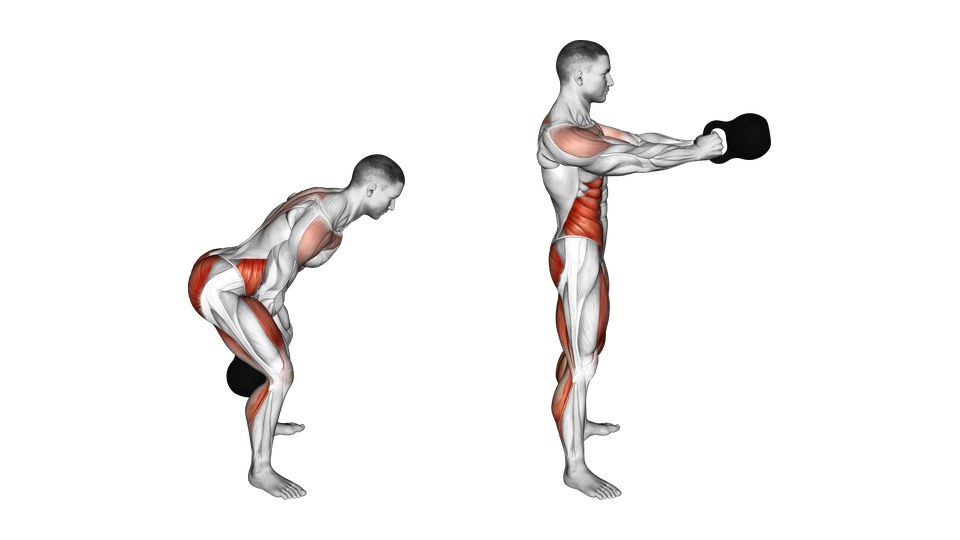
- Place the kettlebell a short step in front of you, stand with your feet just wider than hip width and hinge back to take the handle with both hands.
- Brace your trunk, keep your arms long and tilt the bell toward you so it is ready to move without rounding your back.
Execution
- Hike the kettlebell back high between your thighs as your hips move behind you.
- Drive your feet down and snap the hips forward to stand tall, letting that force float the bell to about chest height.
- Let the bell fall, keep it close as it passes between the thighs and hinge again to absorb it.
- After the final swing, guide the bell forward and park it on the floor instead of trying to stop it under your body.
Common mistakes
Squatting the swing
Dropping mostly through the knees removes the sharp hip hinge that drives the bell. Send the hips back while keeping only a modest knee bend.
Lifting with the shoulders
The bell should float from hip power rather than being raised by the arms. Keep the arms long and stop around chest height.
Leaning back at the top
The repetition finishes at a tall stacked position. Squeeze the glutes without pushing the ribs or hips past that line.
Where it fits in a session
Use it early when practicing power or in a conditioning block while the hinge remains crisp.
End the set when the bell no longer floats from a sharp hip drive or the back position begins to change.
Muscles worked
Primary
Secondary
Schematic surface view. Some muscles are partly visible or not shown.
The glutes and hamstrings drive the hip extension. The spinal erectors hold the trunk position and the forearm and finger flexors hold the kettlebell.
Variations
- One-arm kettlebell swing — Uses one hand and adds a rotational pull that the trunk has to resist.
- American kettlebell swing — Continues overhead instead of ending around chest height; it is not the version taught here.
- Double-kettlebell swing — Swings one kettlebell in each hand with a wider stance.
Frequently asked questions
What muscles do kettlebell swings work?
They mainly train the gluteus maximus and hamstrings. The spinal erectors stabilize the trunk and the forearm and finger flexors hold the bell.
How high should the kettlebell swing?
For the standard Russian swing taught here, let it float to about chest height. Do not pull it higher with the arms.
Is a kettlebell swing a squat?
No. The main movement is a hip hinge: the hips travel back with only a modest knee bend, then extend forcefully.
Should you use your arms?
Use them to hold and guide the kettlebell. The force that sends it forward should come mainly from the hips.
Sources
- Elzanie A, Borger J. Anatomy, Bony Pelvis and Lower Limb, Gluteus Maximus Muscle. StatPearls. https://www.ncbi.nlm.nih.gov/books/NBK538193/
- Hu Y, Raja A. Anatomy, Bony Pelvis and Lower Limb, Hamstring Muscle. StatPearls. https://www.ncbi.nlm.nih.gov/books/NBK546688/
- Henson B, Kadiyala B, Edens MA. Anatomy, Back, Muscles. StatPearls. https://www.ncbi.nlm.nih.gov/books/NBK537074/
- Mitchell B, Whited L. Anatomy, Shoulder and Upper Limb, Forearm Muscles. StatPearls. https://www.ncbi.nlm.nih.gov/books/NBK536975/