
Kettlebell thruster
Also called double kettlebell thruster, double KB thruster.
What is a kettlebell thruster?
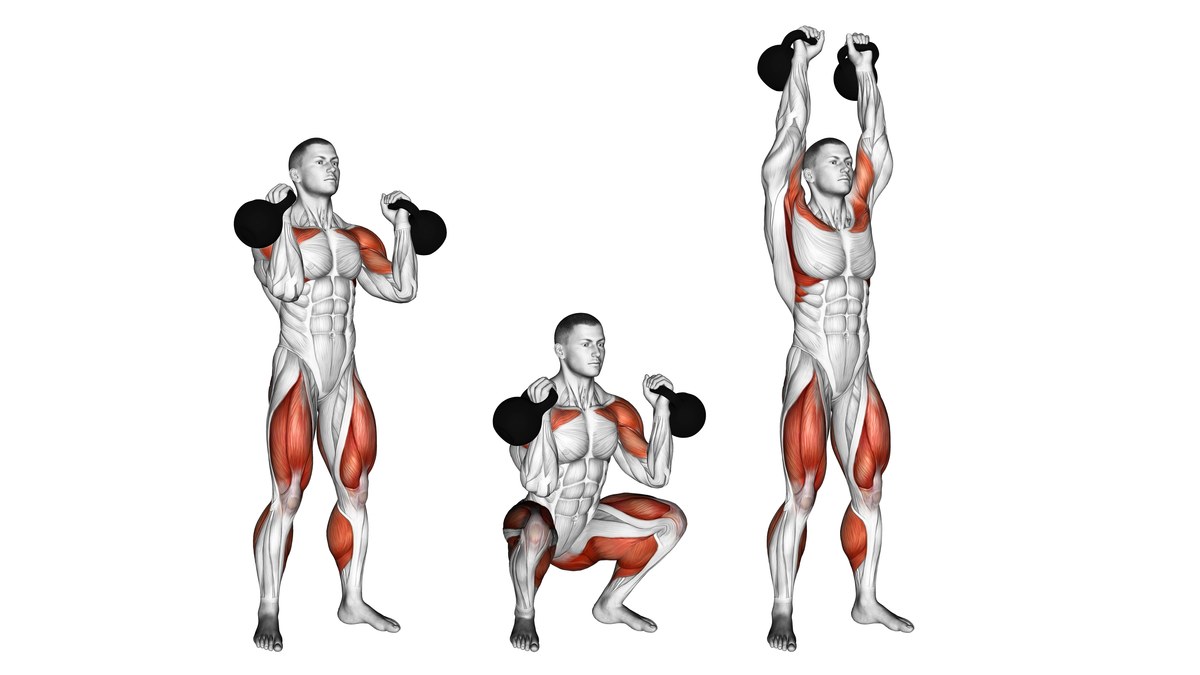
A kettlebell thruster combines a front squat with an overhead press, using the rise from the squat to help send the bells overhead. This guide uses two kettlebells, one racked at each shoulder. Lower them back to the rack between repetitions; the clean gets you into position at the start of the set.
How do you perform a kettlebell thruster?
Set up
- Choose two light, matching kettlebells and clear space above and around you. Place them a short reach in front of your feet. Stand wide enough for both bells to pass between your thighs, then bend at your hips and knees to grip the handles with a steady back.
- Brace and draw both bells back between your thighs, then stand briskly through your hips. Bend your elbows and guide your hands around the handles so the bells settle against your forearms beside your shoulders. Keep your fingers clear of the gap between the handles.
- Settle into your squat stance with toes slightly out. Support the bells close to your chest, handles across the bases of your palms, wrists straight and elbows pointing down and a little forward. Brace your midsection before descending.
Execution
- Bend your hips and knees into a full squat, keeping your heels down and knees following your toes. Keep the bells racked as you lower your hips to about knee height or below, within a depth you can control.
- Drive upward through your feet and carry that rise straight into pressing both bells. Finish tall with your elbows and knees straight, bells balanced above your shoulders, without dipping back under them.
- Bend your elbows to bring the bells back to the rack, softening your knees as they settle. Regain your support before beginning the next full squat; you do not need another clean between repetitions.
- After the last repetition, return to the rack. Let the bells roll off your forearms into a controlled backswing as you bend at your hips and knees, keeping hold of the handles. As they come forward, place both on the floor ahead of you. Release them once stable.
Common mistakes
Stopping at standing before starting the press
That separates the squat from the press. Use a lighter pair and practise carrying the upward movement into the arms, rather than starting a fresh lift from still shoulders.
Replacing the squat with a quick knee dip
A short dip and drive is a push press. Keep a recognisable full squat in each thruster, and reduce the load or end the set when you can no longer repeat that depth.
Bending the knees again to catch the bells overhead
That is a jerk-style catch. Finish the upward phase on straight legs. Softening your knees when the bells return to the rack is part of lowering, after the overhead finish.
Where it fits in a session
Practise the double clean and the squat-to-press transition before doing longer sets.
Choose bells you can control in the rack and overhead, including the return to the floor. Stop the set when the press stalls, the squat becomes a shallow dip, or you need to catch the bells on bent knees.
Muscles worked
Primary
Secondary
Schematic surface view. Some muscles are partly visible or not shown.
The quads and glutes extend your legs and hips as you rise; the front deltoids help lift your upper arms, and the triceps straighten your elbows during the press. These roles do not rank muscle activation.
Variations
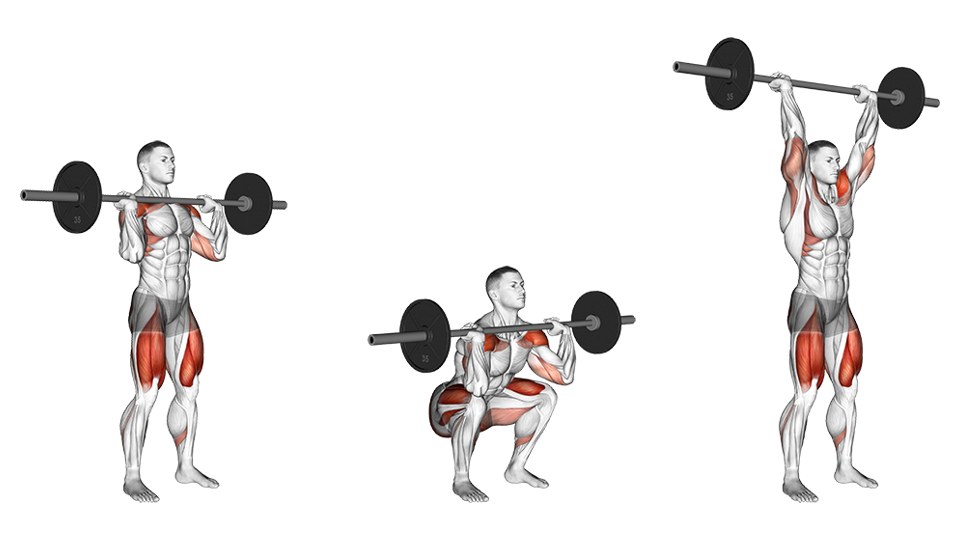
- Barbell thrusterJoins the squat and press with a single bar supported across the front of the shoulders.
Frequently asked questions
Do kettlebell thrusters use one bell or two?
Both versions are used. This guide teaches two bells, with one in each hand at the shoulders. A single-arm version racks one bell beside one shoulder. Holding one bell centrally with both hands is a different setup from either shoulder-racked version.
Is a kettlebell thruster the same as a push press?
A thruster starts with a full squat and flows into the press as you rise. A push press uses a short dip to start the overhead lift. Neither needs a second dip to catch the bells overhead; that catch belongs to a jerk.
Do I clean the kettlebells on every repetition?
Clean them once to establish the rack, then repeat the squat and press from there. Returning to a clean between every thruster adds another movement to the sequence.
What muscles does a kettlebell thruster work?
The squat uses the quadriceps and gluteus maximus, while the press involves the front deltoids and triceps. The leg drive helps the overhead phase, but you still finish by lifting your upper arms and straightening your elbows.
Sources
- J. Gordon Betts et al. Anatomy and Physiology 2e, section 11.6: Appendicular muscles of the pelvic girdle and lower limbs. OpenStax, 2022. https://openstax.org/books/anatomy-and-physiology-2e/pages/11-6-appendicular-muscles-of-the-pelvic-girdle-and-lower-limbs
- Mohammed A. Miniato, Prashanth Anand and Matthew A. Varacallo. Anatomy, Shoulder and Upper Limb, Shoulder. StatPearls, updated 2023. https://www.ncbi.nlm.nih.gov/sites/books/NBK536933/