
Kroc row
Also called Kroc rows.
What is a Kroc row?
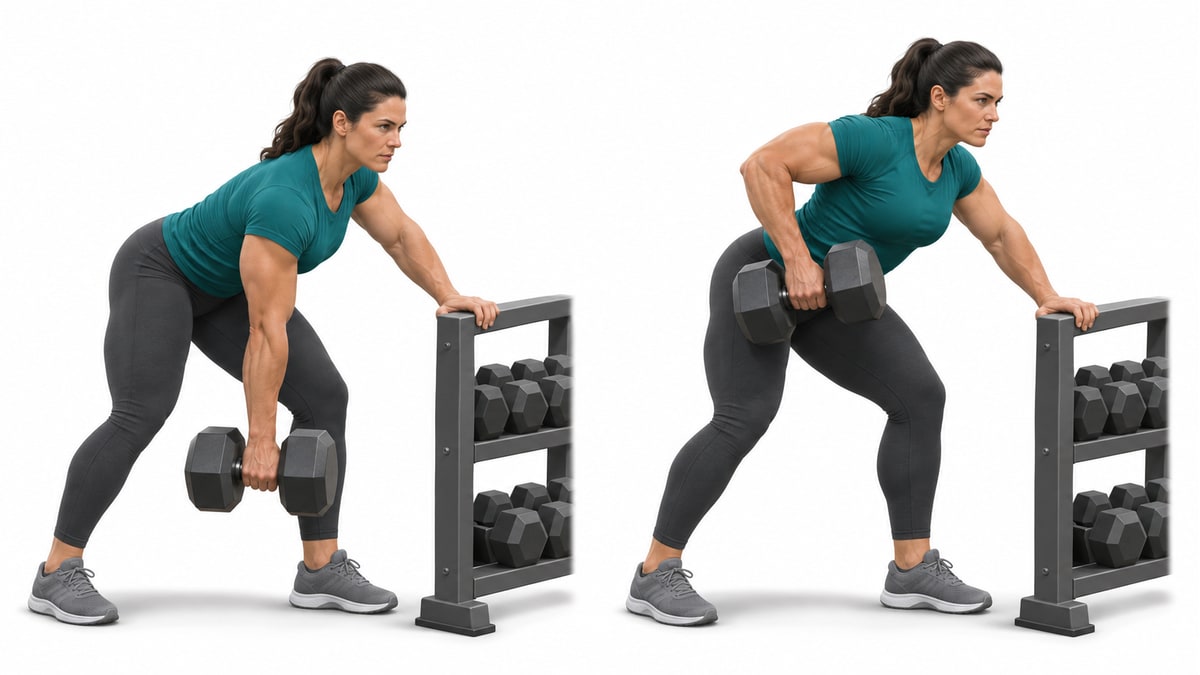
A Kroc row is a heavy one-arm dumbbell row performed for a long set of repetitions, with some deliberate body movement allowed. You brace the free hand, row the dumbbell toward your lower ribs and return to a long arm between reps. It differs from a strict dumbbell row, where the torso stays still. This guide uses a standing stance with both feet on the floor.
How do you perform a Kroc row?
Set up
- Place the dumbbell beside a sturdy fixed support. Brace your free hand on it and plant both feet in a staggered stance, leaving room for the dumbbell to pass your leg.
- Hinge at the hips with softly bent knees and your shoulders a little higher than your hips. Brace your midsection, grip the dumbbell with your palm facing in and lift it clear of the floor with your arm hanging long.
Execution
- Pull firmly, taking your elbow back and bringing the dumbbell beside your lower ribs. Allow a little torso movement with the pull, keeping your supporting hand and feet steady.
- Lower deliberately until your elbow is straight and your working shoulder reaches forward. Keep your lower back from rounding as the shoulder moves.
- Continue with the same reach and pulling path. End the set when you can no longer control the return, keep your grip secure or repeat the pull without a much bigger heave.
- Lower the dumbbell to the floor while keeping your free hand braced. Rest, then set up on the other side.
Common mistakes
Turning the pull into a full-body throw
A small, deliberate movement is part of this variation. A sudden leg drive or a large backward lurch that flings the dumbbell upward goes beyond it. Reduce the load when you cannot keep the arm rowing through the intended path.
Losing the bottom position as the set continues
If the elbow stays more bent on each return, the later reps cover less distance. Let the arm lengthen each time, or finish the set rather than counting progressively shorter pulls.
Dropping the dumbbell between pulls
Keep hold of the lowering phase. If the weight pulls you out of your stance or you cannot guide it back down, finish the set and choose a lighter dumbbell next time.
Where it fits in a session
Place the long working set after your main pulling work, with enough time to rest between arms.
Warm up with lighter rows before the heavy set. One long working set per arm, often aiming for 20 or more reps, is the characteristic Kroc format. Choose the load for a controlled long set rather than a few maximal pulls. Keep the setup, range and use of straps consistent when comparing sessions, and stop at your control limit even if you miss the planned reps.
Muscles worked
Primary
Secondary
Schematic surface view. Some muscles are partly visible or not shown.
The lats and rear deltoids move the upper arm back. The rhomboids and middle trapezius draw the shoulder blade toward the spine, while the elbow flexors bend the arm. These are anatomical roles, not a ranking of muscle activation.
Variations
- Strict one-arm dumbbell rowKeeps the torso still while the free hand and same-side knee rest on a bench.
- Bench-supported Kroc row — Uses the free hand and same-side knee on a bench instead of keeping both feet on the floor.
Frequently asked questions
What muscles do Kroc rows work?
The back and rear-shoulder muscles move the upper arm and shoulder blade, including the lats, rhomboids, middle trapezius and rear deltoids. The biceps, brachialis and brachioradialis help bend the elbow. This list does not establish that Kroc rows work any one of them more than another row.
How are Kroc rows different from regular dumbbell rows?
Kroc rows combine a heavy dumbbell, a long set and some deliberate torso movement. A strict one-arm row keeps the torso still. Keep the two variations separate when comparing loads and reps; adding more swing to a strict row changes the exercise you are measuring.
How much body movement is allowed?
Enough to accompany a strong row, while the supporting hand, stance and lowering remain controlled. Keep the movement small and repeatable. If you need to stand sharply upward, twist farther on every rep or throw the dumbbell toward your ribs, end the set or lower the load. There is no angle you need to force.
Do I need lifting straps?
No. Kroc rows can be done with or without them. If you choose straps, learn to secure and release them with a light dumbbell first, and keep track of which setup you used. Straps do not change the requirement to control the weight.
Should beginners start with Kroc rows?
Learn a strict one-arm dumbbell row first, including the braced position and controlled return. Then try the Kroc format with a manageable load. Heavy high-repetition work is not a reason to skip learning the basic pull or to continue after you lose control.
Sources
- University of Arkansas for Medical Sciences, Department of Neuroscience. Muscles of the Back Region. https://medicine.uams.edu/neuroscience/education/medical-school-courses/human-structure-module/anatomy-tables/muscle-tables/muscles-of-the-back-region/
- University of Arkansas for Medical Sciences, Department of Neuroscience. Muscles of the Upper Limb. https://medicine.uams.edu/neuroscience/education/medical-school-courses/human-structure-module/anatomy-tables/muscle-tables/muscles-of-the-upper-limb/
- Gordana Sendić, MD; reviewed by Dimitrios Mytilinaios, MD, PhD. Trapezius muscle. Kenhub. https://www.kenhub.com/en/library/anatomy/trapezius-muscle