Dumbbell row
Also called one-arm dumbbell row, single-arm dumbbell row, bent-over dumbbell row.
What is a dumbbell row?
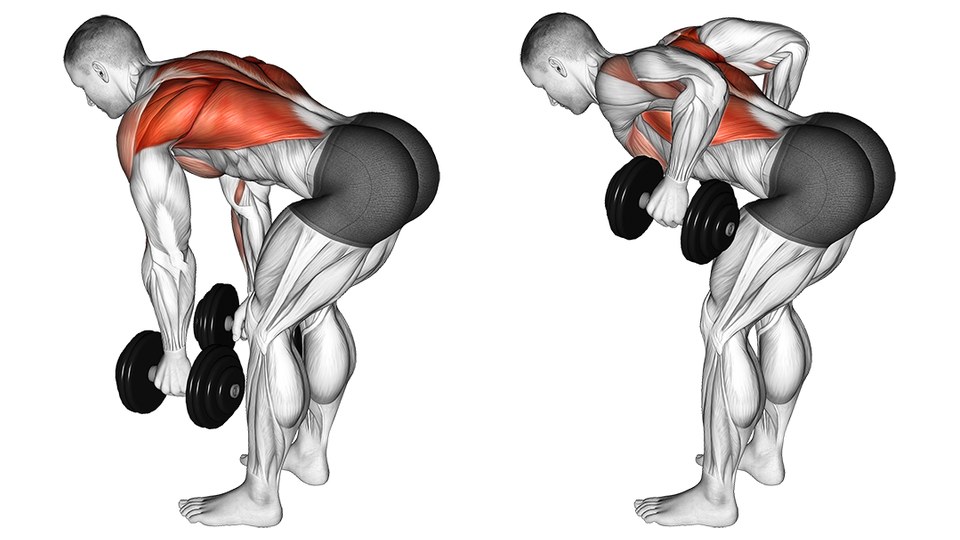
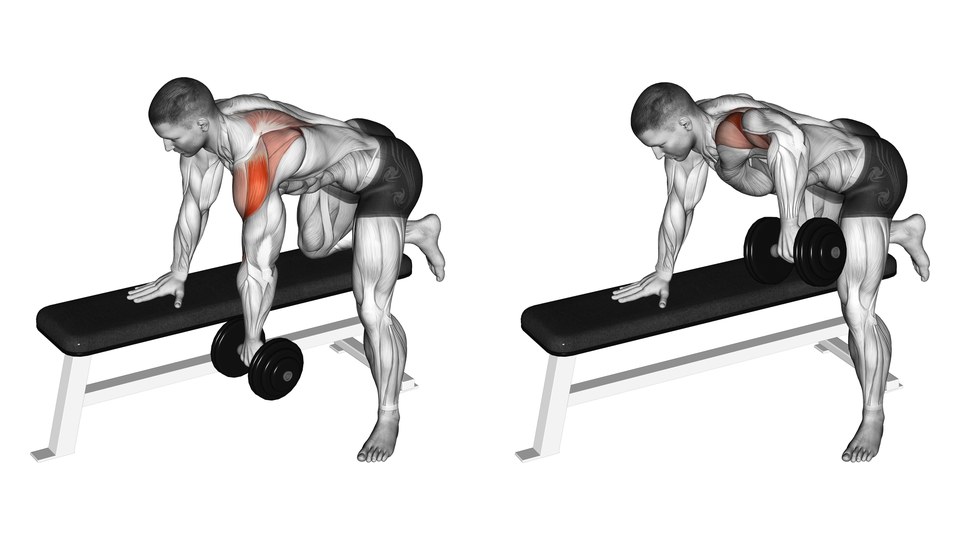
A dumbbell row is a bent-over horizontal pull. The torso is held roughly parallel to the floor, or not far above it, and the dumbbell travels from under the shoulder to the side of the ribcage. It works the muscles that extend and adduct the upper arm, the latissimus dorsi and teres major, with the posterior deltoid extending it too. The rhomboids and the middle trapezius draw the shoulder blade back toward the spine, while the lower trapezius pulls it down. The elbow flexors bend the arm on the way up. There is more than one way to hold the position: one arm at a time with the free hand and knee on a bench, both arms at once from a hip hinge, or chest down on an incline bench. Those are preferences rather than a right answer, so nothing on this page treats one of them as the version to copy.
How do you perform a dumbbell row?
Set up
- Place one hand and the same-side knee on a flat bench, then plant your other foot slightly behind you.
- Brace your core, keep your shoulders and hips square, and let the dumbbell hang below your free shoulder with your palm facing in.
Execution
- Let your working shoulder blade reach forward, then draw it back to start the pull.
- Drive your elbow back close to your body without twisting your torso.
- Stop when your upper arm is roughly in line with your torso and the dumbbell is beside your lower ribs.
- Lower under control until your arm is straight and your shoulder blade reaches forward again.
Common mistakes
Turning the torso open as the dumbbell comes up
Rotating toward the working side lifts the dumbbell without the upper arm travelling any further, so the weight goes up and the range at the shoulder does not. It is the single most effective way to make a row look heavier than it was, and on a one-arm row it is almost invisible from the inside because the movement feels like effort either way.
Cutting the bottom of the rep off
The bottom is where the latissimus dorsi and teres major are longest and where the shoulder blade actually moves. Stopping short keeps the dumbbell travelling and quietly removes the part of the range that nothing else in a session covers, which is most of the reason to do the movement at all.
Shrugging the dumbbell up
Bringing the shoulder toward the ear is scapular elevation, which is the upper trapezius. Drawing the two shoulder blades together is the middle fibres. Shrugging swaps one for the other, so a rep that feels bigger has moved the work to a part of the trapezius the row was not asking for.
Sagging into the supporting arm on the bench
Letting the braced shoulder collapse tilts the whole trunk, so the working side is being rowed at a different angle than it was on the first rep and than the other arm will be. On a movement whose point is that each side is loaded on its own, that removes the comparison.
Choosing the weight before the position
Once a hip or a shoulder has to twist to complete a rep, the extra load is being moved by rotation rather than by the back. The number in the log goes up while what the muscles did stays where it was, and on a unilateral exercise that hides a genuine side-to-side difference instead of exposing it.
Where it fits in a session
Early in a pulling session, or straight after a vertical pull such as a pulldown or a pull-up, while you can still hold the bent-over position.
A loadable compound done one side at a time, which is the whole argument for it: the stronger side cannot quietly carry the weaker one. Set the reps by the weaker arm and let the stronger one match, rather than the other way round. Three or four working sets a side is a normal dose. With the elbow close to the body it takes heavier loading than most dumbbell work, but only up to the weight the torso can hold still, and past that point the extra weight is being moved by rotation. The rear-delt row uses a wide elbow path; choose its load separately so that path stays controlled.
Muscles worked
Primary
Secondary
Schematic surface view. Some muscles are partly visible or not shown.
The two lists split by job, not by how much each muscle contributes. Everything in the first list produces one of the joint actions a row is made of: the latissimus dorsi and teres major extend and adduct the upper arm, and activate as a single unit; the posterior deltoid extends and externally rotates it; the rhomboids and the middle fibres of the trapezius draw the shoulder blade back toward the spine, and the lower fibres pull it down.
The second list includes the elbow flexors and trunk muscles. Biceps, brachialis and brachioradialis help bend the elbow; the neutral grip does not establish how much growth each receives. The spinal extensors help hold the trunk position.
What anatomy will not do is rank the first list against itself. Which of those muscles is best placed depends on where the elbow travels, and that is a question about how you row rather than about the muscles, so none of them is singled out here as the one the exercise is for.
What lifters actually do
About two in five regular RepCount users have ever logged a dumbbell row, which makes it a minority movement even among people who train often, and it shows up in roughly one workout in twenty-eight. The company it keeps is pulling work: a third of the workouts containing a dumbbell row also contain a pulldown, just under a quarter contain a dumbbell curl, and a cable row, a hammer curl and a pull-up each turn up in about one in five. Those are seven-exercise sessions, so the typical dumbbell row is one item on a pull day rather than the movement the session is built around.
Most often trained alongside
Share of dumbbell row sessions that also include each exercise.
- Pulldowns34%
- Dumbbell bicep curl23.3%
- Cable row21%
- Hammer curl20.9%
- Pull up20.8%
Figures come from workouts tracked in RepCount.
Scientific studies on dumbbell rows
A direct training experiment compared dumbbell rows with curls. It measured the elbow flexors, so its findings answer an arm-training question rather than ranking exercises for back growth.
Rows can contribute to elbow-flexor growth, but the underhand-row trial favored curls for that outcome. Strength gains also depended on the exercise practiced. The study does not establish the same growth difference for a neutral-grip row.
Can rows replace curls for arm growth?
In ten untrained men, one arm trained dumbbell rows and the other trained dumbbell curls for eight weeks. Both arms gained elbow-flexor thickness, with greater growth on the curl side.
The row used an underhand grip and support for the free hand. Our instructions use a neutral grip, so the result is not an exact test of this version. The ultrasound measure also combined the elbow flexors; it did not isolate biceps growth from brachialis growth.
Rows involve the arms, but this study gives no basis for treating row and curl sets as interchangeable for arm growth.
Sources
Does getting stronger at rows carry over to curls?
Both arms were tested on both exercises. The row-trained arm improved more on the row test, while the curl-trained arm improved more on the curl test. Each test measured the heaviest load completed for ten repetitions.
Track strength in the exercise you want to improve. The finding does not mean there was no transfer, and it does not compare dumbbell rows with barbell or cable rows.
Sources
Variations
- Single-arm dumbbell row — Hand and knee on a bench, which takes the cost of holding the hinge out of the movement.
- Bent-over two-dumbbell row — Both arms at once from a hip hinge. Quicker, and the hips and spinal extensors hold the position for the whole set.
- Chest-supported dumbbell rowFace down on an incline bench, so the bench holds the torso and there is nothing to swing the weight with.
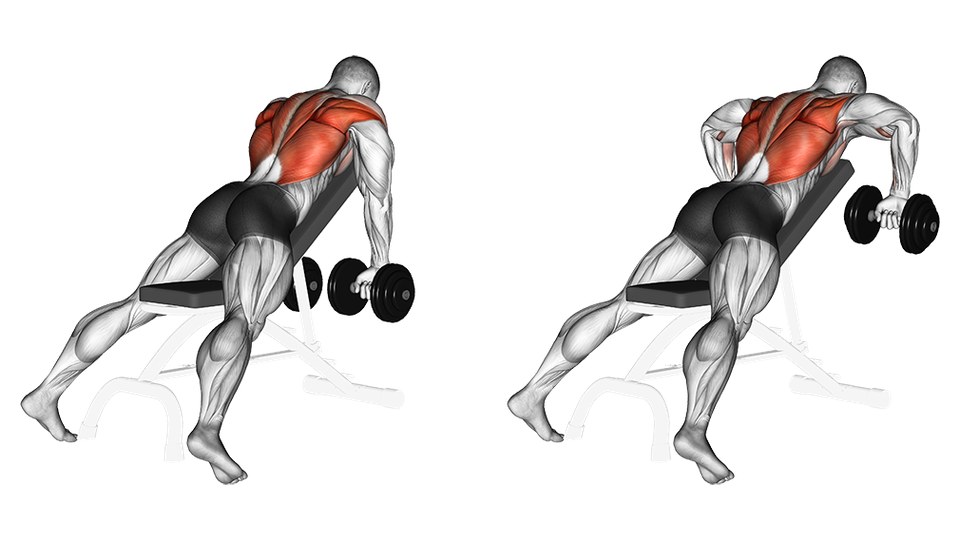
- Seal row — Face down on a raised flat bench with the arms hanging straight down. Removes the hinge entirely.
- Renegade rowRowed from a push-up position, alternating arms. Resisting the rotation is most of the work.
- Kroc row — A heavy, high-rep single-arm row using straps and deliberate body English, run as one long set.
Articles
Related tools
Frequently asked questions
What muscles does a dumbbell row work?
The pull at the shoulder comes from the latissimus dorsi and teres major, which extend and adduct the upper arm and which activate as a single unit, with the posterior deltoid extending it as well. The shoulder blade is drawn back toward the spine by the rhomboids and the middle fibres of the trapezius; the lower fibres pull it down. The elbow flexors bend the arm on the way up, and the spinal extensors hold the torso in place without moving it. Rowing one arm at a time adds a demand the two-arm version does not have, since the load hangs on one side and the trunk has to resist being turned by it.
Should I row one arm at a time or both at once?
Either. Nothing settles it, so it is a preference rather than a technique point. One arm at a time lets you brace the free hand and knee on a bench, which supports the torso at both ends and loads each side on its own. Both at once is quicker and asks the hips and spinal extensors to hold the hinge throughout. Lying chest down on an incline bench removes that demand almost entirely. Any one description or illustration can only show one of the three, and whichever one it shows is not the recommended version.
Should the elbow stay tucked in or flare out?
Keep the elbow near the ribs for the dumbbell row covered on this page. Taking the elbow out to the side is the rear delt row, which has its own guide and places more work on the posterior deltoid and scapular retractors. Its upper-arm path stops around a right angle to the torso. Choose the movement before the set and select a load that preserves its own path without twisting or shrugging.
Do dumbbell rows work the biceps?
Yes, the biceps participates in elbow flexion alongside the brachialis and brachioradialis. A neutral grip does not make it inactive. The growth study reviewed here measured combined elbow-flexor thickness during underhand rows and found a larger increase with curls. It did not determine each muscle’s growth from a neutral-grip row, so do not count a row as a guaranteed replacement for a curl.
Is a dumbbell row better than a barbell row?
They are not the same job. Rowing one arm at a time means the stronger side cannot carry the weaker one, and bracing a hand and knee on a bench asks far less of the spinal extensors than holding a bent-over position unaided does. A barbell row loads both sides together, which allows more total weight and asks more of the position. Neither replaces the other.
What is a chest-supported dumbbell row?
The same pull performed lying face down on an incline bench, so the bench holds the torso rather than the hips and spinal extensors. That is why people use it: there is nothing left to swing the weight up with. The trade is that the chest against the pad limits how far the shoulder blade can travel forward at the bottom of the rep. It is a variation of the same movement, not a different exercise.
How heavy should my dumbbell row be?
We do not publish a number for this one, and the reason is our own data rather than a judgment about anyone else's: bodyweight is recorded on only a small share of the workouts we hold, so a weight-for-bodyweight table built from them would rest on a thin slice. The usable test is positional rather than numerical: whether you can finish the reps with the hips and shoulders square to the floor and the arm straightening at the bottom, and whether the weight that lets you do that has moved over the past few months. That test is for the close-elbow row; with the elbow out to the side, expect the weight to be much lower. On a one-arm row it is also worth matching the two sides, since the reason to load one arm at a time is that a difference between them becomes visible.
Are dumbbell rows worth doing?
About two in five regular RepCount users have logged one, so it is common without being universal, and it appears in roughly one workout in twenty-eight. The sessions it turns up in are pulling sessions: a third of them also contain a pulldown, just under a quarter a dumbbell curl, and about one in five a cable row, a hammer curl or a pull-up. That is the profile of a useful addition to a pull day rather than a movement a whole session is built around.
Sources
- Anatomy, Back, Latissimus Dorsi. StatPearls. https://www.ncbi.nlm.nih.gov/books/NBK448120/
- Syros A, Rizzo MG. Anatomy, Shoulder and Upper Limb, Teres Major Muscle. StatPearls. https://www.ncbi.nlm.nih.gov/books/NBK580487/
- Anatomy, Back, Rhomboid Muscles. StatPearls. https://www.ncbi.nlm.nih.gov/books/NBK534856/
- Anatomy, Back, Trapezius. StatPearls. https://www.ncbi.nlm.nih.gov/books/NBK518994/
- Anatomy, Shoulder and Upper Limb, Shoulder Muscles. StatPearls. https://www.ncbi.nlm.nih.gov/books/NBK534836/
- Anatomy, Shoulder and Upper Limb, Deltoid Muscle. StatPearls. https://www.ncbi.nlm.nih.gov/books/NBK537056/
- Anatomy, Back, Muscles. StatPearls. https://www.ncbi.nlm.nih.gov/books/NBK537074/
- Anatomy, Shoulder and Upper Limb, Biceps Muscle. StatPearls. https://www.ncbi.nlm.nih.gov/books/NBK519538/
- Plantz MA, Bordoni B. Anatomy, Shoulder and Upper Limb, Brachialis Muscle. StatPearls. https://www.ncbi.nlm.nih.gov/books/NBK551630/
- Anatomy, Shoulder and Upper Limb, Forearm Brachioradialis Muscle. StatPearls. https://www.ncbi.nlm.nih.gov/books/NBK526110/
- Mannarino P, Matta T, Lima J, Simão R, Freitas de Salles B. Single-Joint Exercise Results in Higher Hypertrophy of Elbow Flexors Than Multijoint Exercise. 2021. https://pubmed.ncbi.nlm.nih.gov/31268995/