Lateral step-up
Also called side step-up, sideways step-up.
What is a lateral step-up?
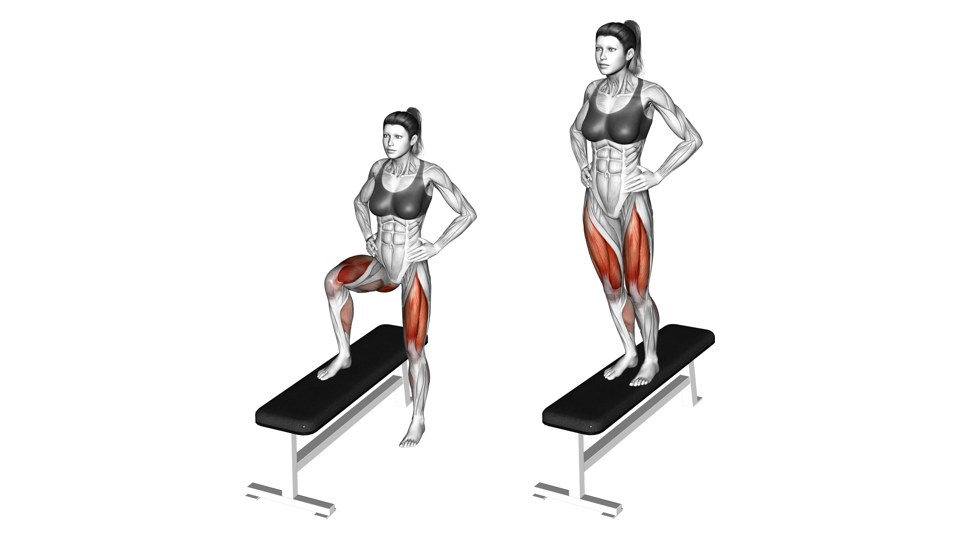
A lateral step-up starts beside a platform and steps onto it sideways with the nearer leg. The quadriceps and gluteus maximus straighten that knee and hip to lift you onto the platform. This guide shows the bodyweight version.
How do you perform a lateral step-up?
Set up
- Choose a stable step or platform that supports your whole foot. Start with a height you can step onto without jumping or tipping your hips.
- Stand beside it and place the nearer foot fully on top, with your knee pointing in the same direction as your toes. Keep the other foot on the floor.
Execution
- Press through the foot on the platform to raise your body, straightening the working hip and knee. Bring the other foot onto the platform beside it.
- Bend the working leg to lower the trailing foot back to the floor on the same side under control. Leave the working foot on top for the next repetition.
- Complete the planned repetitions, then move to the other side of the platform and repeat with the other leg.
Common mistakes
Pushing hard off the floor foot
Use a lower platform if you need a jump or a strong kick from the trailing leg to reach the top.
Placing only the toes on the platform
Move closer and support the whole foot before starting the lift.
Dropping back to the floor
Keep the descent slow enough to place the trailing foot down rather than falling onto it.
Where it fits in a session
Use it as single-leg work in your lower-body session.
Record the platform height and repetitions per leg. Keep the height consistent before comparing repetitions or adding load.
Muscles worked
Primary
Secondary
- None listed in this guide
Schematic surface view. Some muscles are partly visible or not shown.
The quadriceps straighten the working knee and the gluteus maximus extends the hip.
Variations
- Forward step-upApproaches the platform from the front; the linked guide illustrates a dumbbell version.
Frequently asked questions
How is this different from a regular step-up?
The approach changes: for a lateral step-up you stand beside the platform and lift onto it sideways. A forward step-up starts in front of the platform.
How high should the step be?
Choose a height you can reach with your whole foot supported and lift from without jumping, tipping your hips or pushing hard from the floor leg. Start lower if the movement is difficult to control.
Should both feet come onto the platform?
The version shown brings the trailing foot beside the working foot at the top. You can instead leave that foot hovering, but keep the lift and return controlled and record the variation consistently.
Can I hold dumbbells?
Yes, once you can control the bodyweight version. Keep the weights at your sides and use the same sideways approach. Log the loaded version separately if you want to compare it consistently.
Sources
- Elzanie A, Borger J. Anatomy, Bony Pelvis and Lower Limb, Gluteus Maximus Muscle. StatPearls. https://www.ncbi.nlm.nih.gov/sites/books/NBK538193/
- Bordoni B, Varacallo MA. Anatomy, Bony Pelvis and Lower Limb: Thigh Quadriceps Muscle. StatPearls. https://www.ncbi.nlm.nih.gov/sites/books/NBK513334/