
Low-to-high cable fly
Also called low-to-high cable crossover, standing low cable fly.
What is a low-to-high cable fly?
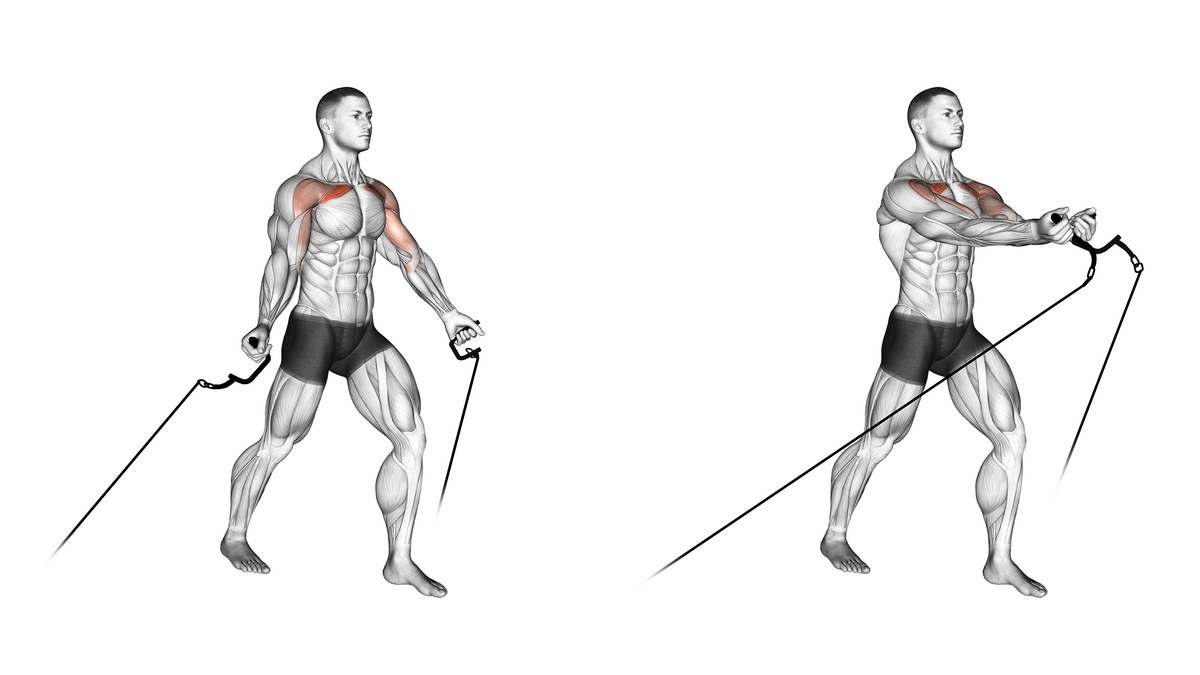
A low-to-high cable fly is a standing chest exercise using two low pulleys. You sweep the handles from beside your hips up and together in front of your chest, keeping a small bend in your elbows. It trains the pectoralis major, with the front deltoids assisting.
How do you perform a low-to-high cable fly?
Set up
- Fit a single handle to each pulley, set both pulleys near the floor and choose a light load on each stack.
- Take one handle at a time, keep it close to your body and move to the centre facing away from the machine.
- Step forward into a stable split stance with soft knees, hands beside your hips, palms forward and elbows slightly bent.
Execution
- Sweep your arms forward, upward and inward without changing the bend in your elbows or leaning back.
- Bring the handles close together in front of your chest, stopping at a height you can reach comfortably.
- Reverse the arc slowly until your hands are beside your hips again.
- After the final rep, step back toward the pulleys, let the stacks settle gently and return one handle at a time.
Common mistakes
Pressing the handles
If your elbows fold and then straighten, shorten the arc and reduce the load so you can keep the fly shape.
Lifting with a backward lean
Choose a lighter load if you need to arch your back to finish.
Chasing a high finish
End the arc before your shoulders shrug or the movement becomes uncomfortable.
Where it fits in a session
Use it after your main pressing work or where your session calls for a chest fly.
Start with a load you can bring through the whole arc without rocking or changing your elbow bend.
Muscles worked
Primary
Secondary
Schematic surface view. Some muscles are partly visible or not shown.
The pectoralis major brings the arms inward, and its upper fibres also help lift them forward. The front deltoids assist as the arms rise.
Frequently asked questions
What muscles does the low-to-high cable fly work?
It trains the pectoralis major, the large chest muscle, with the front deltoids assisting the rising arm movement.
Where should my hands finish?
Bring them close together in front of your chest. The exact height is a coaching choice; keep it comfortable and repeatable rather than forcing your hands toward your face.
Is this the same as an incline cable fly?
This version is performed standing between two low pulleys. An incline cable fly supports your torso on an inclined bench, so it has a different setup.
Sources
- Complete Anatomy. Pectoralis major muscle. Elsevier. https://www.elsevier.com/resources/anatomy/muscular-system/muscles-of-upper-limb/pectoralis-major-muscle/18194
- Complete Anatomy. Clavicular part of deltoid muscle. Elsevier. https://www.elsevier.com/resources/anatomy/muscular-system/muscles-of-upper-limb/clavicular-part-of-deltoid-muscle/22661