Machine dip
Also called seated dip, seated dip machine, tricep press, triceps dip machine.
What is a machine dip?
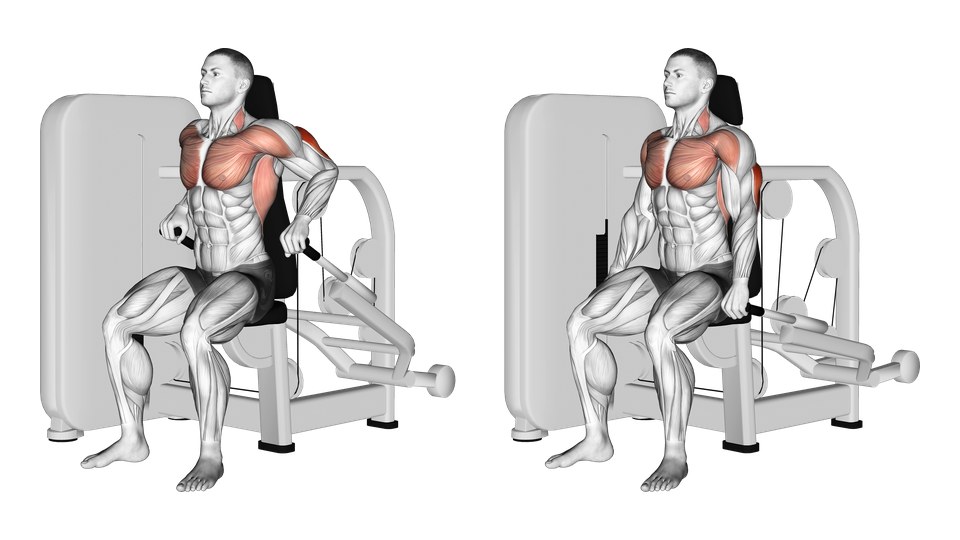
The machine dip is a seated compound press in which you push guided handles down beside your body. It mainly trains the triceps, with the chest and front deltoids assisting.
How do you perform a machine dip?
Set up
- Adjust the seat so you can take the handles with your elbows bent and pointing behind you, without your shoulders being forced upward.
- Sit against the back pad, plant your feet and hold the handles with your wrists straight.
Execution
- Press the handles down by straightening your elbows while keeping your torso against the pad.
- Finish with controlled straight arms, without lifting your shoulders or driving your hips off the seat.
- Let the handles rise slowly until you reach a comfortable shoulder stretch, then press again from the same seated position.
Common mistakes
Setting the seat too low
Starting with the shoulders crowded toward the ears makes the position harder to control. Raise the seat until the handles and elbows feel natural.
Rocking away from the back pad
Torso movement turns the first part of the press into momentum. Keep contact with the pad and reduce the load if needed.
Letting the handles rebound
A fast return gives up control near the deepest shoulder position. Guide the levers back to a range you can repeat comfortably.
Where it fits in a session
Use it as a supported pressing exercise or as direct triceps work after other chest and shoulder presses.
Record the seat and handle settings so the range stays comparable between sessions.
Muscles worked
Primary
Secondary
Schematic surface view. Some muscles are partly visible or not shown.
The triceps straighten the elbows. The chest and front deltoids assist as the upper arms move down and forward against the levers.
Variations
- Assisted dipsKeeps the body moving between bars while a machine or band offsets part of your bodyweight.

- Plate-loaded machine dip — Uses weight plates and independent or linked levers instead of a selectorized stack.
Frequently asked questions
What muscles does the machine dip work?
It mainly trains the triceps. The pectoralis major and anterior deltoid assist during the downward press.
Is a machine dip the same as a bodyweight dip?
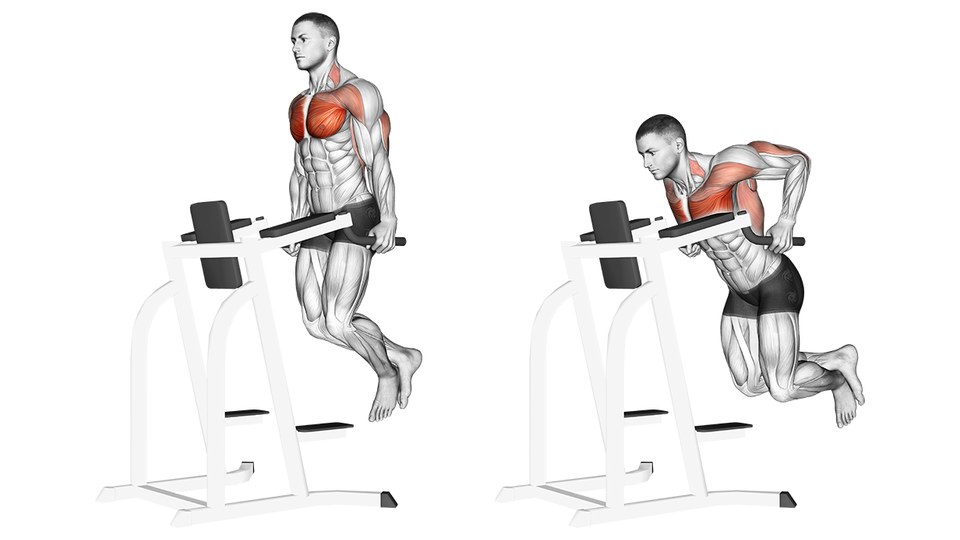
No. The machine supports the torso and guides the handles, while a bodyweight dip moves your whole body between fixed bars.
How far should the handles rise between reps?
Use a depth that gives a comfortable stretch while your shoulders stay down and your back remains on the pad. Machine geometry differs, so there is no universal handle height.
Should you lean forward on a machine dip?
Follow the machine's back pad and keep that torso position steady. Different machines recline by different amounts.
Sources
- Tiwana MS, Sinkler MA, Bordoni B. Anatomy, Shoulder and Upper Limb, Triceps Muscle. StatPearls. https://www.ncbi.nlm.nih.gov/books/NBK536996/
- Solari F, Burns B. Anatomy, Thorax, Pectoralis Major. StatPearls. https://www.ncbi.nlm.nih.gov/books/NBK525991/
- Elzanie A, Varacallo MA. Anatomy, Shoulder and Upper Limb, Deltoid Muscle. StatPearls. https://www.ncbi.nlm.nih.gov/books/NBK537056/