
Dips
Also called parallel bar dip, bar dip.
What are dips?
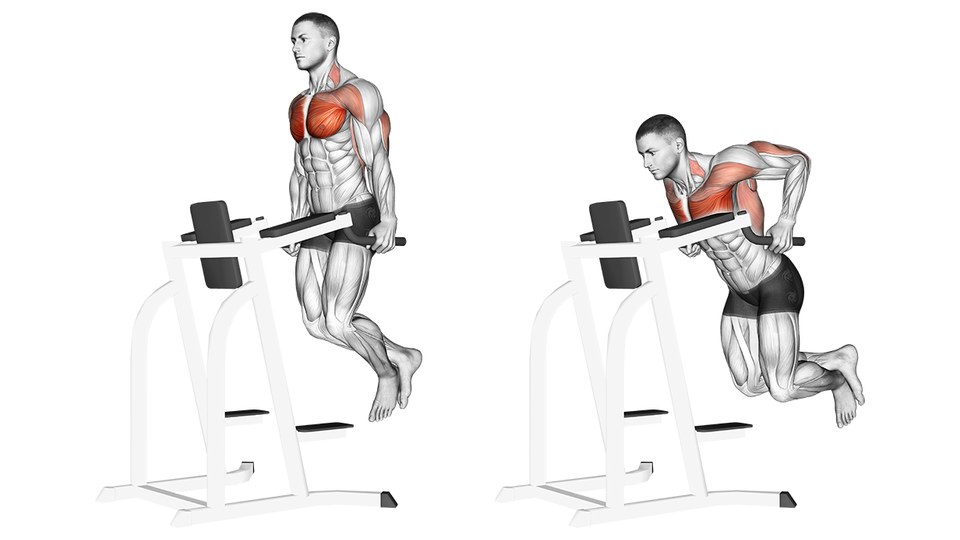
A dip is a bodyweight press. You hold yourself at arm's length on a pair of parallel bars, lower until your upper arms are roughly parallel with the floor, and press back up to a straight arm. It trains the chest, the triceps and the front of the shoulder together, while the muscles around the shoulder blade hold you up between the bars. Chest and triceps are both prime movers on every rep — leaning the torso forward asks more of the chest, staying upright with the elbows close asks more of the triceps.
How do you perform dips?
Set up
- Grip parallel bars about shoulder-width apart and support yourself with straight arms.
- Pull your shoulders down away from your ears, brace your torso and wait until your body stops swinging.
- Bend your knees, keep your feet together behind you and lean slightly forward.
Execution
- Bend your elbows and lower under control, keeping them pointed mostly behind you and your shoulders down.
- Stop when your upper arms are about parallel with the floor, or sooner if the range hurts or your shoulders start to rise.
- Press the bars away until your arms are straight, without shrugging or swinging.
Common mistakes
Sinking into the bottom and letting the shoulders shrug up
When you stop holding the shoulder blades down, your bodyweight stops being carried by muscle and starts being carried by the joint. It also wrecks the rep you are about to do — you now have to start the press from a collapsed position, which is why that first inch turns into a jerk.
Chasing depth for its own sake
Aim for about upper arms parallel with the floor, and stop sooner if the movement hurts or becomes uncontrolled. Lowering farther just to make the rep look deeper is not a reason to exceed the range you can manage.
Flaring the elbows on an upright dip
Elbow path follows torso angle. Leaning forward, the elbows sit a little wider and the chest takes more of the press. Upright, they track back close to your ribs. Flare them while you stay upright and the shoulder is pushed out to the side under your full bodyweight, with your hands fixed on the bars so there is no grip change to relieve it. Pick the lean and the elbow path together, and hold both for the whole set.
Kipping the legs to get out of the bottom
Swinging the legs makes the hardest part of the rep disappear, which is the part you are there for. On a dip it does something worse than on other movements: the swing changes your torso angle mid-rep, so you are not even doing the same exercise twice in a set.
Adding weight while the last reps are already collapsing
Dips already load your whole bodyweight, so a belt is a big jump, not a small one. If your last two reps are half-depth with the shoulders creeping up, adding weight buys you a worse version of a set you were already failing.
Treating a bench dip as the same exercise
Hands behind you on a bench puts the shoulder into far more extension and hands part of the load to your legs. It is a related movement, not the same one: log it separately and do not count bench-dip reps as progress toward a bar dip. Assisted dips and slow lowering from the top get you to a first bar dip more directly.
Where it fits in a session
On a pressing day, early enough in it that you can still load the movement properly. A dip carries your whole bodyweight from the first rep, which makes it a main press rather than an accessory.
Dips scale better by adding weight than by adding reps. Once a set of ten is comfortable, a dip belt is a better answer than sets of twenty-five — long sets turn a loadable press into conditioning. Coming the other way, if you cannot yet do a controlled rep, work from an assisted machine, a band, or slow lowering from the top, rather than dropping into the bottom and hoping to find the way out.
Muscles worked
Primary
Secondary
Schematic surface view. Some muscles are partly visible or not shown.
Chest and triceps are listed together rather than ranked, because the anatomy ranks neither. Two things have to happen at once for a dip to happen at all: the elbow straightens, which is the triceps, and the upper arm travels from behind the torso back to your side, which is the pectoralis major and the front of the deltoid. Skip either and there is no rep. Which one does more of the work depends on how upright you hold your torso, and that is a choice you make on the day rather than a property of the exercise.
The anterior deltoid is in the primary list for the same reason as the chest. Coming out of the bottom, the upper arm moves forward from an extended position to hanging at your side, and the front fibres of the deltoid flex the arm alongside the pectoralis major.
The secondary list is not a second tier of movers. It is the two muscles that hold the shoulder blade down while your whole bodyweight hangs off the shoulder: the pectoralis minor, which pulls the blade down and forward against the ribcage, and the lower fibres of the trapezius, which depress it. They hold a position rather than produce the movement.
The latissimus dorsi is not listed, although most dip pages list it. The anatomy reference we would have cited for it gives the muscle adduction, medial rotation and extension of the upper arm, and no action on the shoulder blade at all — and extension is the opposite of what the arm does coming out of a dip. It is left off rather than listed on a job nothing we read gives it.
What lifters actually do
Dips read as push-day work in the logs, and unusually cleanly: all five of the exercises they most often appear beside are chest, shoulder or triceps work. A bench press is in about a third of the workouts that contain a dip, an incline dumbbell press and lateral raises in about a quarter each, a triceps pushdown in more than a fifth, a dumbbell shoulder press in about a sixth. No back or leg movement makes the list at all.
A chest exercise and a triceps exercise both sit near the top of that list, which is about right for a movement that is genuinely both.
About two in five regular RepCount users have logged a dip at some point, but dips appear in only about one workout in twenty: widely tried, kept as occasional work rather than a staple. When they do appear it is about three sets, in a session of around seven exercises.
Most often trained alongside
Share of dips sessions that also include each exercise.
- Bench press32.3%
- Pushdowns21.8%
Figures come from workouts tracked in RepCount.
Scientific studies on dips
Small laboratory studies have compared dip variations and examined what changes as a set becomes tiring. They help describe the movement, but do not establish an ideal depth or which version builds the most muscle.
Bench, bar and ring dips are different loading situations. During a tiring bar-dip set, slower repetitions and changes at the top can appear even when peak joint angles stay similar. These findings do not establish injury rates or a universally safe range.
Are bench, bar and ring dips interchangeable?
A comparison in 13 experienced men found more shoulder extension in bench dips than bar dips: the upper arm travelled farther behind the torso. Bar dips produced higher peak electrical activity in the measured chest, front-shoulder and triceps muscles than bench dips.
Eleven participants also completed ring dips. Rings increased activity in the measured chest region compared with bars, but triceps activity did not clearly differ. Participants chose their own technique, and the fixed bars were V-shaped. These were brief bodyweight sets, so the findings do not establish a growth ranking, a progression program or the results of adding weight.
What changes as a dip set gets tiring?
Fifteen men who regularly performed dips completed a set to exhaustion. Compared with early repetitions, their last three completed reps took longer and covered less vertical distance. Peak chest and triceps activity increased. Maximum joint angles did not clearly change, but shoulder position at the top did.
The failed repetitions were excluded from that main comparison. In two of the four failed attempts, shoulder extension exceeded the participant’s earlier range test. This is a useful limit on the headline result: similar peak angles in completed reps do not mean technique stays unchanged through failure. The study did not measure injuries.
Variations
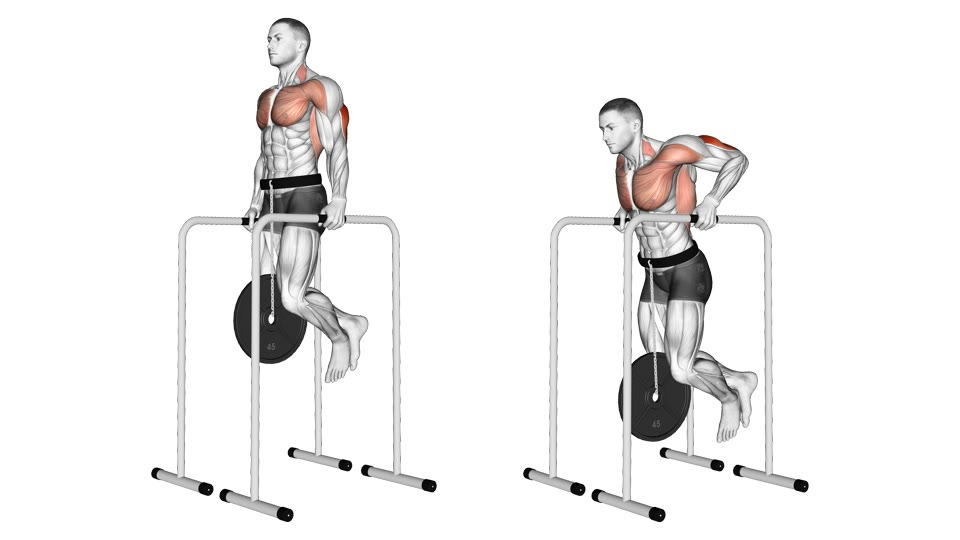
- Weighted dipLoad hung from a dip belt or held between the feet, once bodyweight sets stop being hard.
- Assisted dipA machine or a band carries part of your bodyweight, which is how most people get to a first unassisted rep.

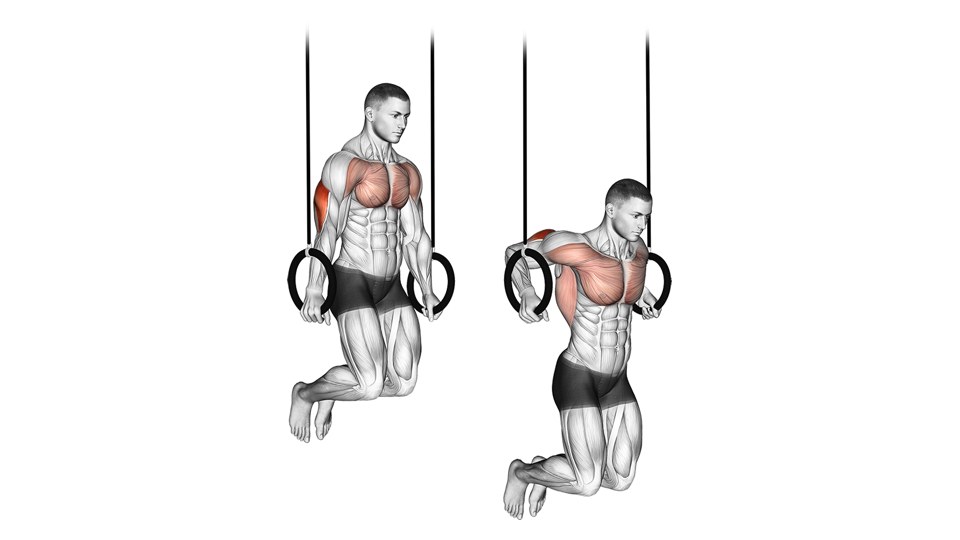
- Ring dipThe hands are free to rotate and drift, so holding the bottom still is most of the exercise.
- Straight bar dip — Both hands on a single bar in front of you, which fixes the hand spacing and makes the torso work around the bar.
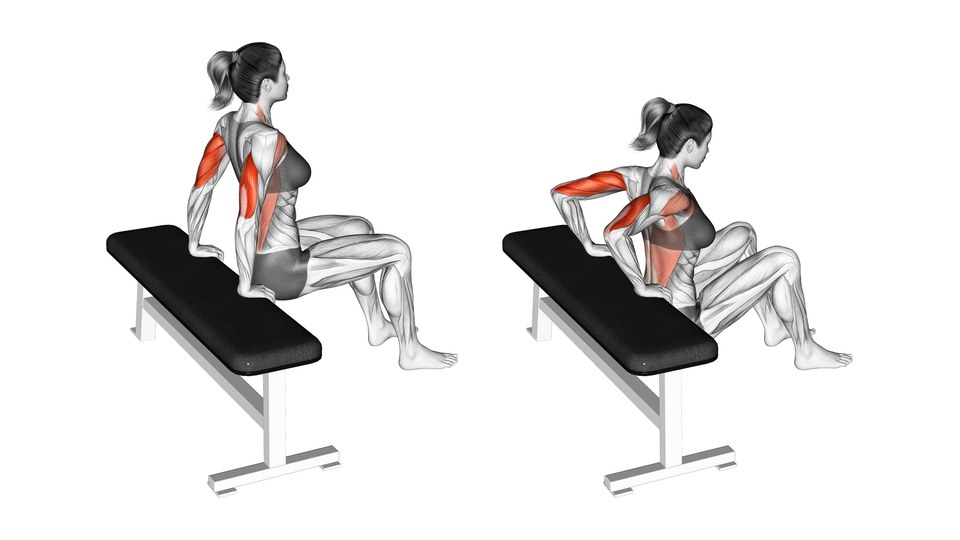
- Bench dipHands behind you on a bench, feet out in front. Grouped with dips by name, but the shoulder sits in much more extension and the legs carry part of the load.
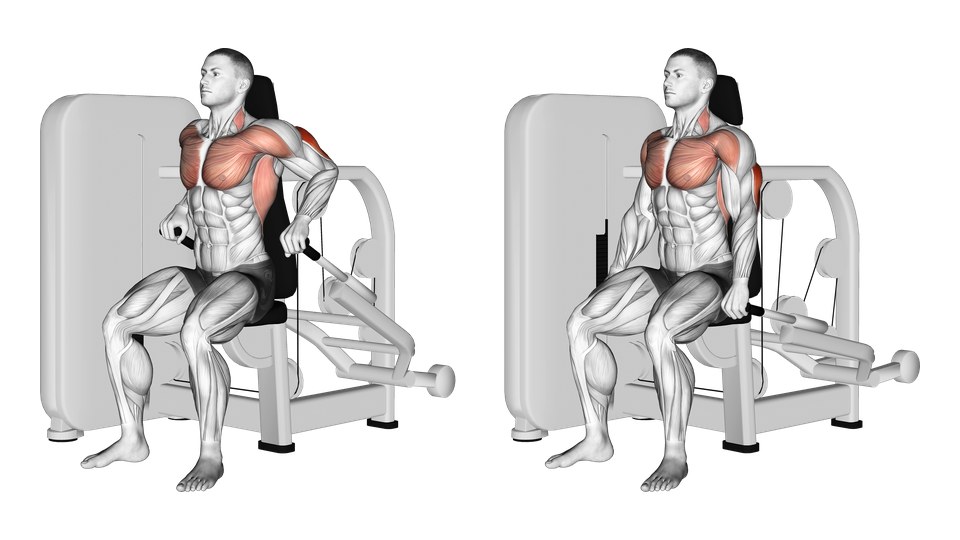
- Machine dipSeated, with the torso supported and the load taken off a stack instead of set by your bodyweight.
Related tools
Frequently asked questions
What muscles do dips work?
The chest, the triceps and the front of the shoulder, all at once. Two joints move on every rep: the elbow straightens, which is the triceps brachii, and the upper arm swings forward from behind your torso back to your side, which is the pectoralis major and the anterior fibres of the deltoid. Behind those, two muscles pull the shoulder blade down and hold it there while you hang between the bars: the pectoralis minor and the lower fibres of the trapezius.
Are dips a chest exercise or a triceps exercise?
Both, in every version. What changes the balance is your torso. Leaning forward, with the elbows sitting a little wider, puts more of the job on the chest; staying upright with the elbows close to your ribs puts more of it on the triceps. Neither is the correct way to dip, and any single picture of a dip is showing you one choice rather than the instruction. Pick the one that matches what you want out of the movement, and hold the same lean and the same elbow path for the whole set.
How deep should you go on a dip?
Aim for about upper arms parallel with the floor, as the technique cue used in this guide. Stop sooner if the range hurts or you cannot keep the movement controlled. The studies reviewed here do not establish a universal angle beyond which the shoulder becomes unsafe.
Are dips bad for your shoulders?
The studies reviewed here do not establish injury rates or a universally safe depth. The bottom position places the upper arm behind the torso under load, which makes control and a comfortable range relevant. If a range hurts, stop short of it rather than pushing through. A persistent shoulder problem is worth an assessment by a clinician.
How do I do my first dip?
Take weight off rather than shortening the movement. An assisted dip machine or a band under the knees lets you do full reps with less than your bodyweight and take the assistance down over weeks. Slow lowering from the top position works too, since you can control more weight coming down than you can press up. Bench dips are a related movement rather than the same one: the shoulder position is different enough that bench reps do not count as progress toward a bar dip, so log them separately.
Dips or bench press?
In practice a lot of people who dip do both. A bench press is in about a third of the RepCount workouts that contain a dip, so for that third the dip is a second press on a pressing day rather than a substitute for the first. The dip carries your bodyweight from the start, so it is already loaded in a way a beginner's bench press is not, and it needs a station rather than a rack and a spotter.
How many sets of dips should I do?
Lifters logging dips in RepCount do about three sets of them, in a workout of around seven exercises. The more useful question is what the set looks like: dips are worth loading once bodyweight reps get easy, and long sets of an easy bodyweight dip stop being press training.
Are dips worth doing?
About two in five regular RepCount users have logged one at some point, but dips show up in only about one workout in twenty — widely tried, kept as occasional work. The logs are unusually consistent about where they belong: the five movements dips most often appear beside are a bench press, an incline dumbbell press, lateral raises, a triceps pushdown and a dumbbell shoulder press. All five are chest, shoulder or triceps work, and nothing from a back or leg day is on the list. Lifters use them as push-day work, and they are one of the few pressing movements that needs no bench and no bar.
Sources
- Baig MA, Bordoni B. Anatomy, Shoulder and Upper Limb, Pectoral Muscles. StatPearls. https://www.ncbi.nlm.nih.gov/books/NBK545241/
- Tiwana MS, Sinkler MA, Bordoni B. Anatomy, Shoulder and Upper Limb, Triceps Muscle. StatPearls. https://www.ncbi.nlm.nih.gov/books/NBK536996/
- Elzanie A, Varacallo MA. Anatomy, Shoulder and Upper Limb, Deltoid Muscle. StatPearls. https://www.ncbi.nlm.nih.gov/books/NBK537056/
- Ourieff J, Scheckel B, Agarwal A. Anatomy, Back, Trapezius. StatPearls. https://www.ncbi.nlm.nih.gov/books/NBK518994/
- McKenzie A, Crowley-McHattan Z, Meir R, Whitting J, Volschenk W. Bench, Bar, and Ring Dips: Do Kinematics and Muscle Activity Differ?. 2022. https://pmc.ncbi.nlm.nih.gov/articles/PMC9603242/
- McKenzie A, Crowley-McHattan Z, Meir R, Whitting J, Volschenk W. Fatigue Increases Muscle Activations but Does Not Change Maximal Joint Angles during the Bar Dip. 2022. https://pmc.ncbi.nlm.nih.gov/articles/PMC9659300/