Mountain climbers
Also called mountain climber, slow mountain climbers.
What are mountain climbers?
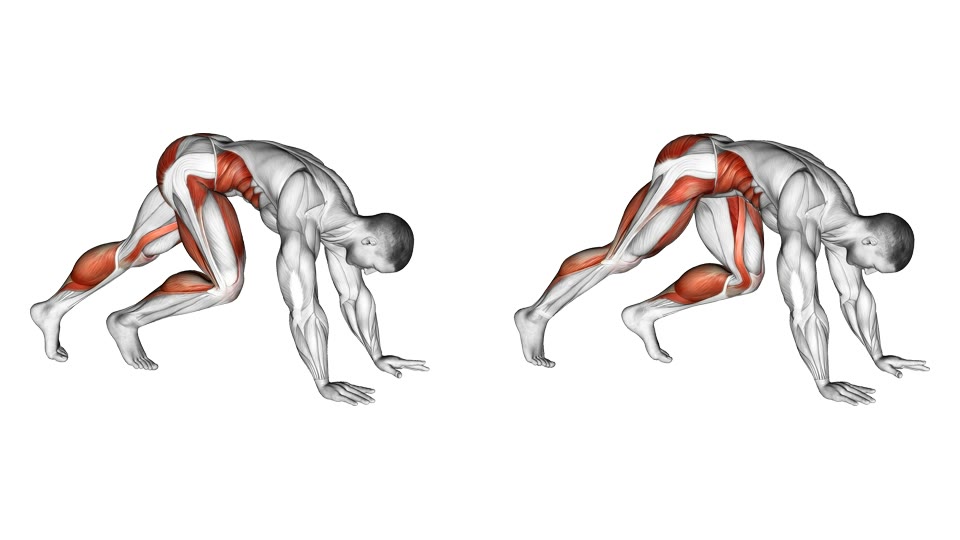
Mountain climbers alternate knee drives toward the chest from a high plank. Your hands stay on the floor while the legs change places. The abdominal muscles hold the torso steady and the hip flexors bring each knee forward.
How do you perform mountain climbers?
Set up
- Place your palms beneath your shoulders on a firm, non-slip surface. Step both feet back into a high plank.
- Brace your abdomen and spread your fingers for a steady base. Leave enough space for your knees to move beneath you.
Execution
- Bring one knee forward under your torso without shifting your shoulders far behind your hands.
- Return that foot and bring the other knee forward, keeping your hips at a similar height.
- Continue alternating at a pace that lets you control each change. To finish, bring your knees down under control.
Common mistakes
Hiking the hips higher with each switch
Slow down and reset the plank when your body position changes.
Letting the lower back sag
Shorten the set or elevate your hands if you cannot hold your torso steady.
Chasing speed before controlling the feet
Return to slow knee drives until the hands stay planted and the feet land predictably.
Where it fits in a session
Use the version and pace that fit your planned trunk work or conditioning session.
Keep the movement controlled at your chosen pace. End the set or use an elevated hand position when you can no longer hold the same torso position.
Muscles worked
Primary
Secondary
Schematic surface view. Some muscles are partly visible or not shown.
Variations
- Elevated mountain climbers — Places the hands on a stable bench instead of the floor.
- Cross-body mountain climbers — Directs each knee toward the opposite side of the torso.

Frequently asked questions
Do mountain climbers have to be fast?
No. Slow, separate knee drives are a useful way to learn the movement. Increase the switching speed only while you can hold the plank position.
Should the forward foot touch the floor?
It can touch lightly during a slow stepping version. Keep the same approach throughout the set rather than reaching farther just to put the foot down.
What if the floor version is too difficult?
Place your hands on a stable bench and use slow knee drives. Choose a support that will not slide or tip.
Sources
- William Flynn; Paula Vickerton. Anatomy, Abdomen and Pelvis: Abdominal Wall. 2023. https://www.ncbi.nlm.nih.gov/books/NBK551649/
- Bruno Bordoni; Matthew A. Varacallo. Anatomy, Bony Pelvis and Lower Limb: Iliopsoas Muscle. 2026. https://www.ncbi.nlm.nih.gov/books/NBK531508/