Pistol squat
Also called single-leg squat, one-leg squat, bodyweight pistol squat.
What is a pistol squat?
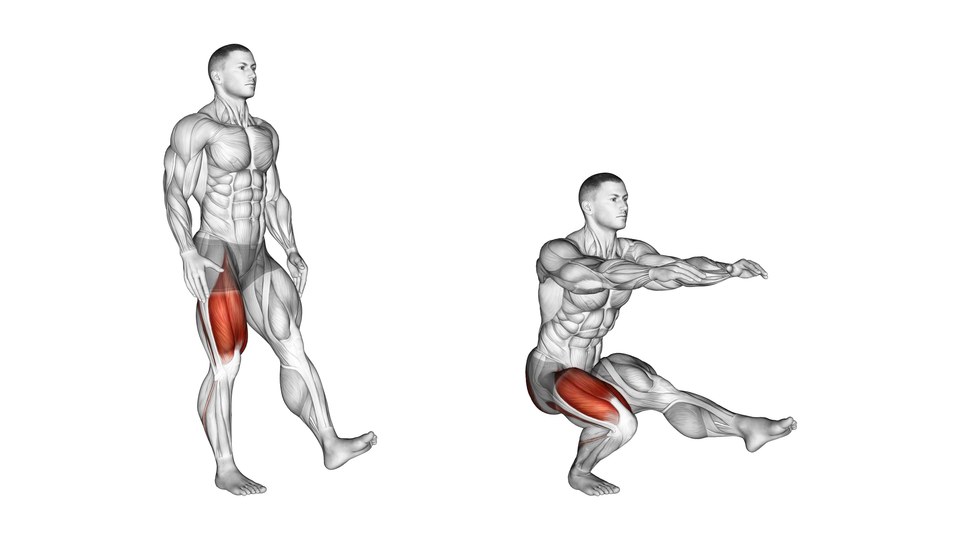
A pistol squat is a bodyweight squat performed on one leg while the other leg stays off the floor in front. The standing knee and hip bend together as you sit down, then the same leg drives you back to standing.
How do you perform a pistol squat?
Set up
- Stand on one foot with the whole foot planted. Reach the other leg and both arms forward for balance.
- Brace your midsection and fix your eyes on one point ahead. Use a stable support if you cannot balance through the range yet.
Execution
- Bend the standing knee and hip together, letting the knee track in the same direction as the toes while the free leg stays clear of the floor.
- Sit as low as you can keep the heel down, the foot stable and the movement controlled.
- Push through the whole foot to stand, finishing tall before the next repetition.
Common mistakes
Forcing depth after the heel lifts
Once the heel loses the floor, balance and ankle position change. Use a support, counterweight or shallower range instead of chasing the bottom.
Letting the knee collapse inward
The foot and knee should keep pointing in roughly the same direction as you lower and stand.
Dropping into the bottom
A fast drop can hide the range you actually control and makes the change of direction harder to organise on one leg.
Where it fits in a session
As a single-leg strength or skill exercise while you are fresh enough to balance and control the lowering phase.
Choose assistance and depth that make every repetition repeatable. Reduce support or lower the box before adding external load.
Muscles worked
Primary
Secondary
Schematic surface view. Some muscles are partly visible or not shown.
The quadriceps and gluteus maximus of the standing leg produce the squat, with the hamstrings assisting. Balance and mobility often limit the movement before the target muscles do.
Variations
- Assisted pistol squat — Hold a rack, rail or suspension strap so balance does not decide the repetition.
- Box pistol squat — Sit to a box or bench that fixes the depth, then stand on the same leg.
- Counterweight pistol squat — Hold a light plate in front to make balancing over the standing foot easier.
Frequently asked questions
What muscles do pistol squats work?
They mainly train the quadriceps and gluteus maximus of the standing leg. Other hip and lower-leg muscles help keep the pelvis, knee and foot controlled.
Do I need to squat all the way down?
No. Use the deepest range you can control with the heel down and the knee tracking with the toes. A box gives you a repeatable stopping point.
Why does my heel lift in a pistol squat?
The movement asks for substantial ankle bend as the knee travels forward. Limited ankle range, balance or your proportions can all make the heel rise; a support or small counterweight can help you practise without forcing depth.
Is holding onto something cheating?
No. Assistance lets you train the single-leg squat pattern without balance ending the set. Use only as much help as you need and reduce it gradually.
Is a pistol squat the same as a regular squat?
It uses the same broad knee-and-hip bending pattern, but one leg carries the load while the other stays forward. That changes the balance, mobility and strength demands enough to track it separately.