Renegade row
Also called dumbbell renegade row.
What is a renegade row?
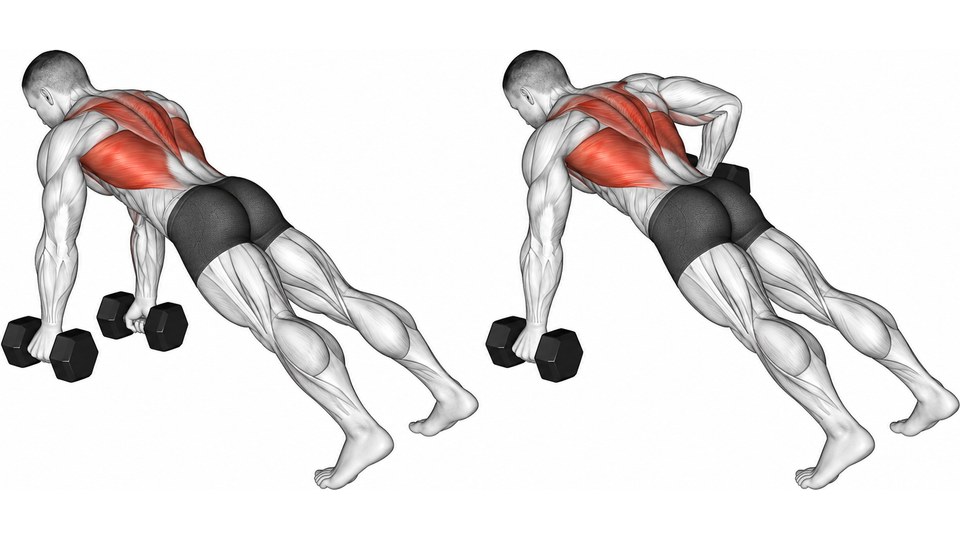
A renegade row is an alternating dumbbell row performed from a high plank. You support yourself on one dumbbell while lifting the other beside your ribs, then swap sides. This guide covers the row without an added push-up.
How do you perform a renegade row?
Set up
- Place two flat-sided dumbbells on a firm, non-slip floor, about shoulder-width apart. Check that neither can roll or tip under your hands.
- Grip the handles with palms facing inward, then step your feet back into a plank and spread them wider than your hips. Keep your shoulders above your hands and your body long from head to heels.
Execution
- Brace your middle and press into one handle as you prepare to lift the other dumbbell.
- Draw the free elbow back beside your ribs, stopping before you need to twist your chest or hips to lift farther.
- Set the dumbbell down gently and settle both hands before rowing with the other arm.
- Continue alternating sides. End the set if you can no longer hold the plank or keep the supporting dumbbell steady.
Common mistakes
Opening the hips toward the rowing arm
Use a lighter weight or a wider foot stance if you have to turn your body to finish the pull.
Letting the waist sag between rows
Reset your plank before the next pull, or finish the set when you cannot maintain it.
Rushing the hand-to-hand change
Put each dumbbell fully down before transferring your support to it.
Where it fits in a session
Place it where you can give the plank and each individual pull your full attention.
Choose a weight that lets you alternate without twisting or rushing. Record the weight of one dumbbell. When logging reps, use a consistent convention: for example, 6 per side means 12 pulls in total.
Muscles worked
Primary
Secondary
Schematic surface view. Some muscles are partly visible or not shown.
Back muscles, biceps and abdominals are involved. The red illustration shading marks the back only; it is not a complete muscle map.
Variations
- One-arm dumbbell rowUses a supported bent-over setup rather than a plank. Keep a separate training history for this movement.
Frequently asked questions
Does a renegade row include a push-up?
The standard version described here alternates rows only. A row-and-push-up combination adds another movement and should be logged separately.
Can I use round dumbbells?
Use flat-sided dumbbells that stay firmly in place under your hands. Do not attempt this setup on weights that roll, slide or tip.
How wide should my feet be?
Start wider than your hips and adjust until you can row without turning your pelvis. Foot spacing is a setup choice rather than a target to make narrower each workout.
How should I count renegade-row reps?
Count the pulls on each side consistently. If you write 8 per side, complete 8 left-arm pulls and 8 right-arm pulls; if you log total pulls, that same set is 16.