Reverse-grip bench press
Also called underhand bench press, supinated bench press, reverse grip barbell bench press.
What is a reverse-grip bench press?
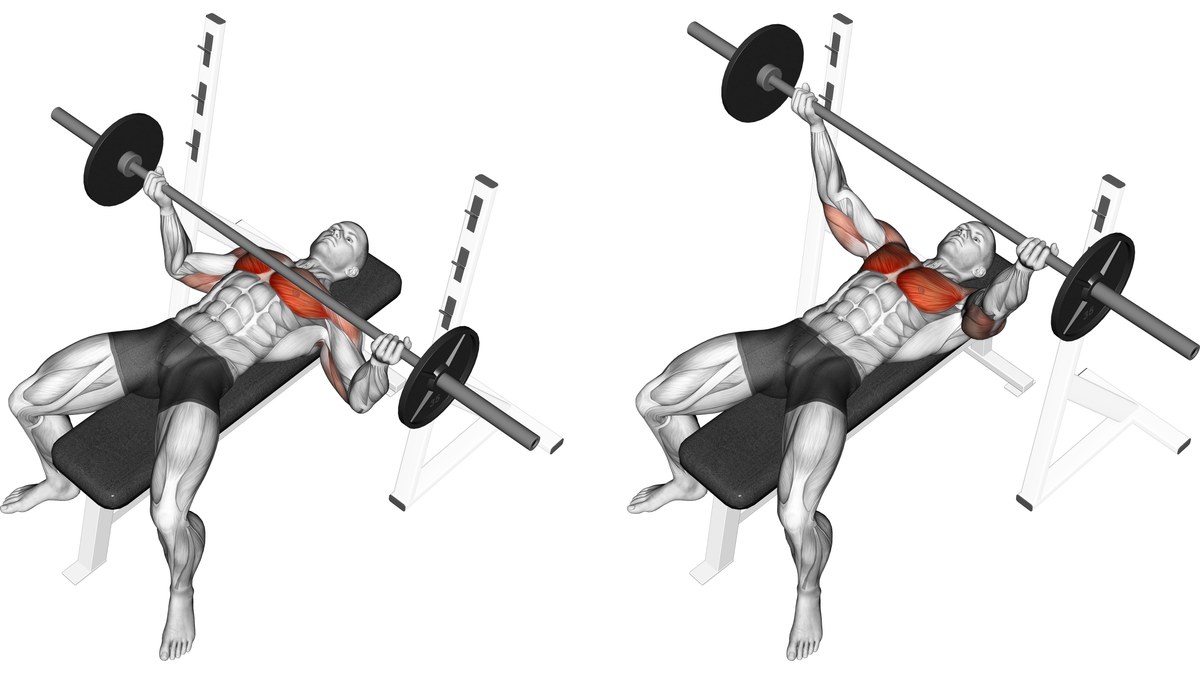
A reverse-grip bench press is a barbell press on a flat bench with both palms facing toward your face. You lower the bar to the lower chest and press it back up while keeping that underhand grip. The hand orientation distinguishes it from the usual overhand bench press.
How do you perform a reverse-grip bench press?
Set up
- Set the hooks so the bar clears with nearly straight arms, and arrange a spotter to help with the lift-off and return.
- Lie with your eyes under the bar, feet flat and glutes on the bench. Take an underhand grip wider than shoulder width, closing your fingers and thumbs around the bar with it supported in your palms.
- Pull your shoulder blades together and brace. With your spotter, lift the bar clear of the hooks and settle it above your shoulders before starting.
Execution
- Lower the bar slowly toward your lower chest, letting the elbows track beside your torso and keeping your forearms under the bar.
- Touch down gently, then press upward and slightly back to straight arms above your shoulders. Keep your feet, glutes and upper back in place; repeat with the same path.
- Finish with the bar steady at straight arms. Have your spotter help guide it back into both hooks, and check that it is supported before releasing your hands.
Common mistakes
Using a loose or thumbless grip
Close both hands fully before lifting off. End the set and reset if the bar starts to roll toward your fingers.
Trying your usual bench-press weight immediately
Learn the new grip with a light bar. Add load only when you can control the repetition and the return to the rack.
Bouncing off the chest
Reverse direction smoothly instead of using your chest to rebound the bar.
Where it fits in a session
Practise it early in an upper-body session, while you can give the grip and rack transfer your attention.
Keep its weights and repetitions separate from your overhand bench press. Begin with a light bar and build up only while every rep and rack transfer stays controlled.
Muscles worked
Primary
Secondary
- None listed in this guide
Schematic surface view. Some muscles are partly visible or not shown.
These muscles act together: the chest and front deltoid move the upper arms, while the triceps straighten the elbows.
Variations
- Bench pressKeeps the flat bench and barbell, with an overhand grip.
Frequently asked questions
What muscles does the reverse-grip bench press work?
The pectoralis major and anterior deltoid move the upper arms, and the triceps brachii straighten the elbows. They work together during the press.
Is reverse grip the same as close grip?
No. Reverse grip describes both palms facing toward your face. Close grip describes the distance between your hands. A close-grip bench press usually keeps the palms facing away from you.
How wide should your hands be?
Start a little wider than shoulder width and adjust until the grip feels secure and your forearms sit under the bar near the bottom. The illustration shows one wider option; you do not need to copy that exact spacing.
Where should the bar touch?
Aim for the lower chest with your forearms beneath the bar. Adjust the hand spacing and touch point together until you can repeat the path comfortably.
Can you use a thumbless grip?
Use a closed grip with your thumbs wrapped around the bar. Rehearse the lift-off and rerack with a light bar and a spotter before adding weight.
Sources
- Solari F, Burns B. Anatomy, Thorax, Pectoralis Major Major. StatPearls, updated July 24, 2023. https://www.ncbi.nlm.nih.gov/sites/books/NBK525991/
- Elzanie A, Varacallo MA. Anatomy, Shoulder and Upper Limb, Deltoid Muscle. StatPearls, updated January 30, 2024. https://www.ncbi.nlm.nih.gov/sites/books/NBK537056/
- Tiwana MS, Sinkler MA, Bordoni B. Anatomy, Shoulder and Upper Limb, Triceps Muscle. StatPearls, updated August 28, 2023. https://www.ncbi.nlm.nih.gov/sites/books/NBK536996/