
Barbell bench press
Also called bench press, flat bench press, flat barbell bench press.
What is a barbell bench press?
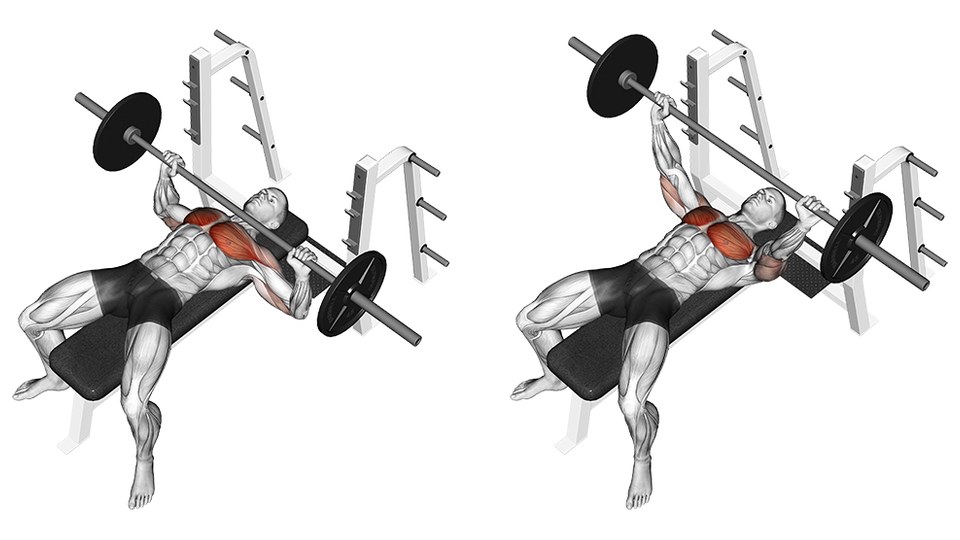
The barbell bench press is a horizontal press: lying on a flat bench, you lower a barbell to the chest and press it back to straight arms. It trains the pectoralis major, the anterior deltoid and the triceps brachii together, and on a flat bench the chest regions and the front delt work at close to the same level. Within the usual range, grip width and elbow angle are preferences: pick positions you can press comfortably, and progress the load.
How do you perform a barbell bench press?
Set up
- Set the rack hooks so you can lift the bar out with nearly straight arms. Use safety arms or a spotter for hard sets.
- Lie with your eyes under the bar, feet flat and glutes on the bench. Grip the bar with your thumbs wrapped around it and your forearms near vertical when the bar reaches your chest.
- Pull your shoulder blades back and down, press your feet into the floor and unrack the bar over your shoulders.
Execution
- Lower the bar under control to your chest, keeping your forearms near vertical. Touch without bouncing.
- Press the bar back over your shoulders to straight arms while your feet, glutes and shoulder blades stay planted.
- Repeat with the same touch point and bar path each rep.
- After the last rep, hold the bar at straight arms, guide it back to the uprights and lower it securely into both hooks before letting go.
Common mistakes
Letting the shoulder blades unstick at the top of the press
Retraction is what lowers posterior shear at the shoulder and the rotator cuff work needed to keep the joint together. Losing it at lockout gives that back on the rep where the load is still on the bar.
Bouncing the bar off the chest
It moves the weight without asking your chest and triceps to produce the force at the hardest part of the range, which is the part that decides what the set was worth.
Choosing a grip width to target a particular muscle
Grip width changes what you can lift far more than it changes which part of the chest does the work, and what it does change points the opposite way to the advice. Pick the width you can press well. See the scientific studies ↓
Cutting the range short and pressing from a few inches off the chest
Touching the chest on every rep is what keeps sets comparable, and the short version builds less strength than the full one. Press from the chest. See the scientific studies ↓
Where it fits in a session
First or second in an upper-body session, while you are fresh.
A heavy compound, and people give it the set count to match: 4.49 per session on average in RepCount's data, against about 3.2 for the machine and isolation exercises. It suits being loaded and progressed rather than taken to failure, and the full range is worth protecting as the load climbs — that is the part the training evidence actually supports.
Muscles worked
Primary
Secondary
Schematic surface view. Some muscles are partly visible or not shown.
Listed as co-actors rather than ranked. Three studies that report figures for both the chest and the front delt on a flat bench put them at close to the same level — about 27% against 26% of a maximal contraction in Rodríguez-Ridao, and within a few points of each other in Saeterbakken and in Mausehund — so the anterior deltoid is a co-actor here rather than a minor helper. The triceps is not ranked because the studies do not agree where it sits: Rodríguez-Ridao put one triceps head at about 15% while the pectoralis regions sat at 27%, and Mausehund put the lateral head of the triceps above every pectoralis portion it measured. The secondary pair are there for reasons the popular lists miss: the rotator cuff works throughout to keep the humeral head seated, and biceps brachii activity climbs steeply as the grip widens — though it climbs from a low base, and the study that measured it most carefully concluded the bench press does not stimulate the biceps at all. Pectoralis major has two heads, clavicular and sternocostal — there is no "inner" or "outer" chest to aim at.
What lifters actually do
The bench press turns up in about one workout in eight tracked in RepCount, and 69.3% of regular users have logged it at some point. It also gets the set count of a main lift rather than an accessory — 4.49 per session on average, against about 3.2 for the machine and isolation exercises — which is the signature of a movement lifters treat as the point of the session. It sits in workouts of about seven exercises, and what surrounds it is a push day: incline dumbbell press, lateral raises, pushdowns, shoulder presses and triceps extensions. Notably, the incline pressing beside it is usually the dumbbell version rather than the barbell one, and dips show up far less often than the incline dumbbell press.
Most often trained alongside
Share of barbell bench press sessions that also include each exercise.
- Pushdowns20.2%
- Incline bench press14.5%
- Dips12.4%
Figures come from workouts tracked in RepCount.
Scientific studies on the bench press
Bench press research explores how grip width, bench angle and range of motion affect the lift. These are useful questions when deciding how to train, but studies measure different things: muscle activity during a set, forces at the shoulder or strength gained over weeks of training.
Below, we look at what those findings mean for your bench press, starting with a distinction that matters throughout: muscle activity is not the same as muscle growth.
A wider grip can help you lift more weight, but the studies here do not establish that it builds more chest muscle. Flat pressing involves the upper chest too, and the shoulder research does not identify one elbow angle that prevents injuries. Full-range training has produced better strength gains than partial reps in a training study.
What can these studies tell us?
Several comparisons below use EMG, which records electrical activity in a muscle during an exercise. It helps researchers compare how muscles behave during a lift. A higher reading alone does not tell us that a variation will build more muscle over months of training.
It also matters how a result is described. Finding no clear difference between two techniques leaves uncertainty; it does not prove they are identical.
Study details: what was measured
For example, Saeterbakken compared grip widths in 28 men, measuring muscle activity and six-rep maximum loads. Larsen studied 14 trained men, measuring muscle activity, forces and movement during one-rep maximum lifts. Neither experiment tracked changes in muscle size.
These are examples from the studies discussed here, rather than a description of all bench press research. The later sections explain the different outcomes measured by the shoulder model and the ten-week range-of-motion study.
Which part of the chest are we talking about?
The pectoralis major has two main heads. The clavicular head starts at the collarbone and forms the upper chest. The larger sternocostal head starts along the breastbone and ribs below it. Some studies measure its lowest region separately and call it the abdominal portion.
These names describe regions of the same muscle. There are no separate anatomical heads called the inner chest and outer chest.
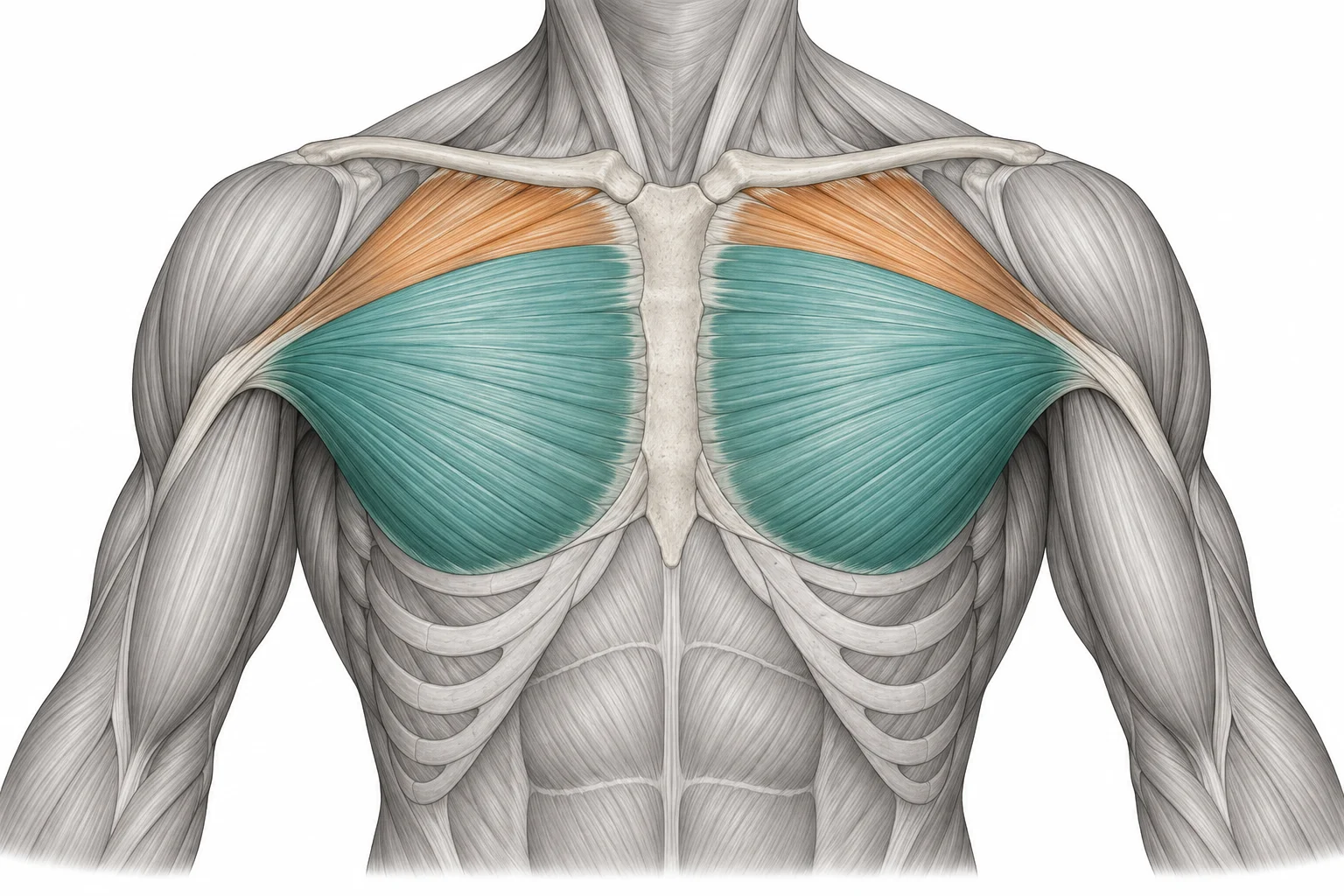
- Clavicular head
- Upper chest, shown in amber beneath the collarbone.
- Sternocostal head
- Larger region below it, shown in teal across the middle and lower chest.
Simplified anatomy of the pectoralis major. The colors identify regions, not how much a grip activates them.
Does a wider grip work your chest more?
The familiar advice is wide grip for chest, narrow grip for triceps. The chest findings are less tidy. Four studies found no clear change in sternocostal activity across grip widths. Two found more upper-chest activity with a narrow grip; the other two found no clear difference.
The lowest chest region gives a mixed result: one study favored wider grips, another found no clear difference. Triceps activity often fell with a wide grip, but the result varied by study and which triceps head was measured.
The more consistent finding is about load. In three studies, lifters could bench more with medium or wide grips than with narrow grips. That helps explain why changing your grip changes your numbers. It does not establish which grip builds more chest muscle.
Study details: grip width
The four chest studies were Mausehund (35 trained adults), Saeterbakken (28 men with mixed experience), Larsen (14 trained men) and Arseneault (13 trained men). They tested different loads, from a one-rep maximum to a twelve-rep maximum.
In Mausehund, upper-chest activity was 59.6% of a maximal contraction with a narrow grip and tucked elbows, 56.0% with a medium grip and 52.4% with a wide grip. A second narrow condition, with elbows farther out, measured 56.3%. Both narrow conditions exceeded the wide one.
Saeterbakken found that narrowing the grip reduced six-rep maximum loads by about 7% compared with medium or wide grips. Larsen and Mausehund also found lower loads with narrow grips. The grip widths were defined differently across studies, so these are comparisons within each experiment, not universal hand positions.
Do your elbows have to stay at 45 degrees?
Research has not established 45 degrees as the safest elbow angle for everyone. One shoulder model compared 45, 70 and 90 degrees and found trade-offs: a position could reduce one force while increasing another.
It used movement data from ten experienced lifters pressing a 16 kg bar. The researchers estimated joint loads; they did not track injuries. The findings cannot tell us that a particular angle prevents injury, or that every angle is equally safe.
Study details: shoulder loads
Noteboom and colleagues found more upward shear at the main shoulder joint with 45 degrees than with 70 degrees. Larger angles increased some compressive forces instead. Elbow angle affected the results less than grip width and shoulder-blade position.
Pulling the shoulder blades together reduced compression and backward shear at the main shoulder joint, but increased upward shear at the beginning and end of the rep. Narrower grips reduced compression at the joint between the collarbone and shoulder blade. These are model results under a light load, not measured changes in injury rates.
Do you need an incline for your upper chest?
Flat pressing involves the upper chest too. In the studies discussed here, an incline did not consistently produce more upper-chest activity than a flat bench. That challenges the idea that flat pressing leaves this region out. It does not settle which angle produces more growth.
Bench angle can still change the exercise. Rodríguez-Ridao found that steeper inclines shifted activity toward the front deltoid, the front of the shoulder. Choosing an incline is reasonable; treating it as essential based on these EMG results goes beyond what they measured.
Study details: bench angle
Rodríguez-Ridao tested five angles in 30 trained adults. Although the paper recommends 30 degrees for upper-chest activation, its direct comparison with flat pressing was not statistically significant (p = 0.688). A higher average alone does not establish an advantage.
Arseneault also found no upper-chest advantage for a 30-degree incline over flat pressing with the same wide, palms-forward grip. That study found no clear advantage for a decline over flat pressing in the lowest chest region either. Neither study measured muscle growth.
What about dumbbells and shorter reps?
A small study of 12 trained men found similar chest and front-shoulder activity with barbells, dumbbells and a Smith machine during maximum lifts. Dumbbell loads were lower. We could read only the abstract, and this was not a comparison of muscle growth.
Range of motion has training evidence behind it. In a ten-week study of 50 men, full-range bench training produced better strength and bar-speed results than training with the upper two-thirds or upper third of the movement. We read the abstract only. It supports full range for those outcomes; it did not measure muscle size.
Variations
- Close-grip bench pressGrip inside shoulder width. Costs you about 7% of your load compared with a medium or wide grip, and raises activity slightly in the lateral and medial heads of the triceps but not in the long head.

- Wide-grip bench press — Lets you lift the same as a medium grip rather than more. Grips beyond about 1.5 biacromial widths raise compression at the acromioclavicular joint, and the upper chest measures lower with a wide grip, not higher.
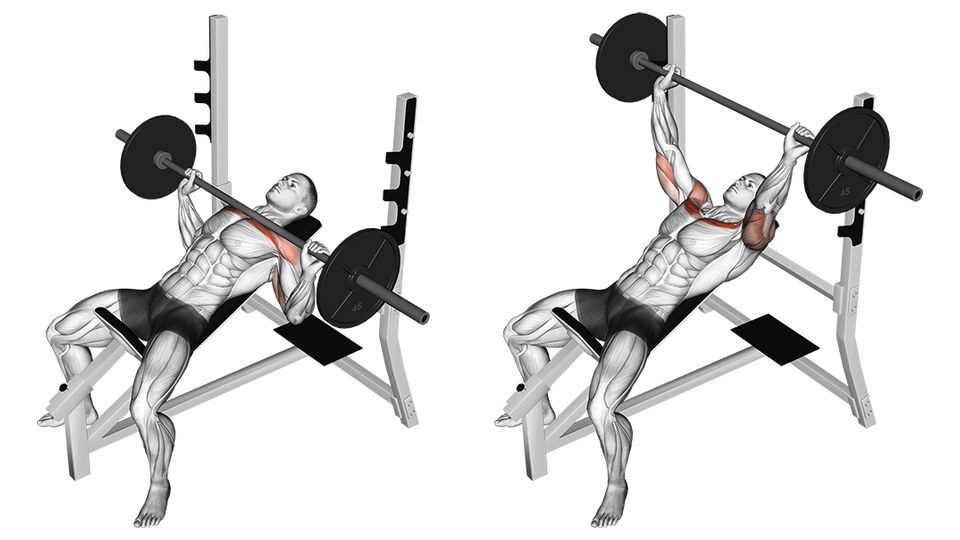
- Incline barbell bench pressBench raised, usually 30 to 45 degrees. Worth doing if you like it, but the flat version already trains the upper chest evenly and the pooled evidence does not put incline ahead of it for either part of the chest.
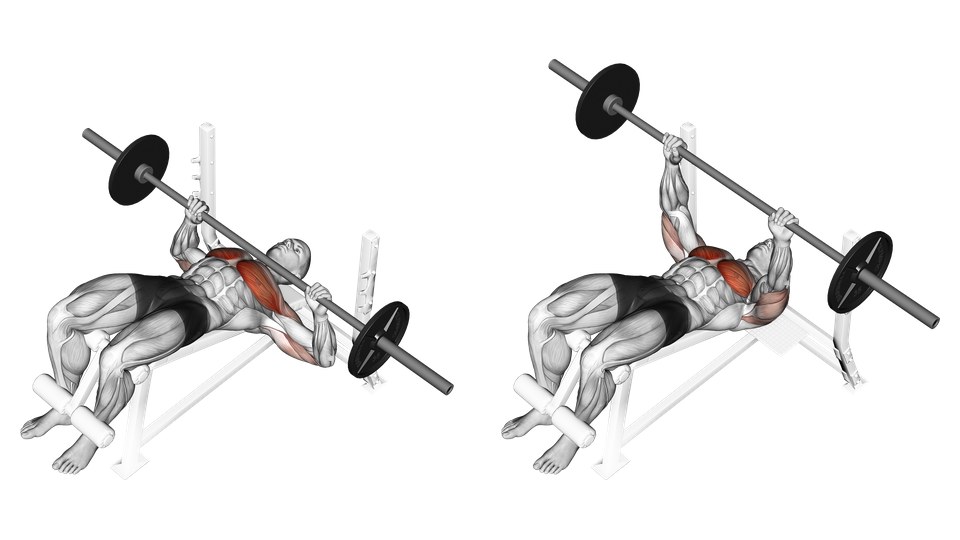
- Decline barbell bench pressBench angled down. The pooled EMG does not separate it from a flat bench for either pectoralis portion, and the one study to measure the bottom of the chest across bench angles found no advantage either.
- Paused bench pressBar held still on the chest, removing any stretch rebound. The competition standard in powerlifting.
- Reverse-grip bench press — Hands supinated. The pooled evidence for it rests on one study, and the one other paper to test supinated grips found their upper-chest advantage only on an incline, not on a flat bench. Treat claims about it as thin.
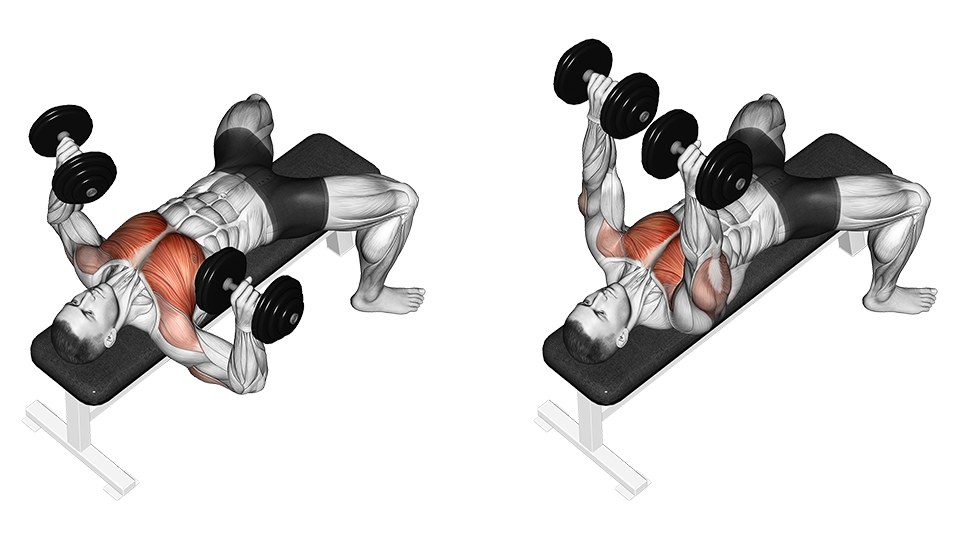
- Dumbbell bench pressChest and front-delt activity matched the barbell in the one study that compared them; the load is lower and the biceps work harder.
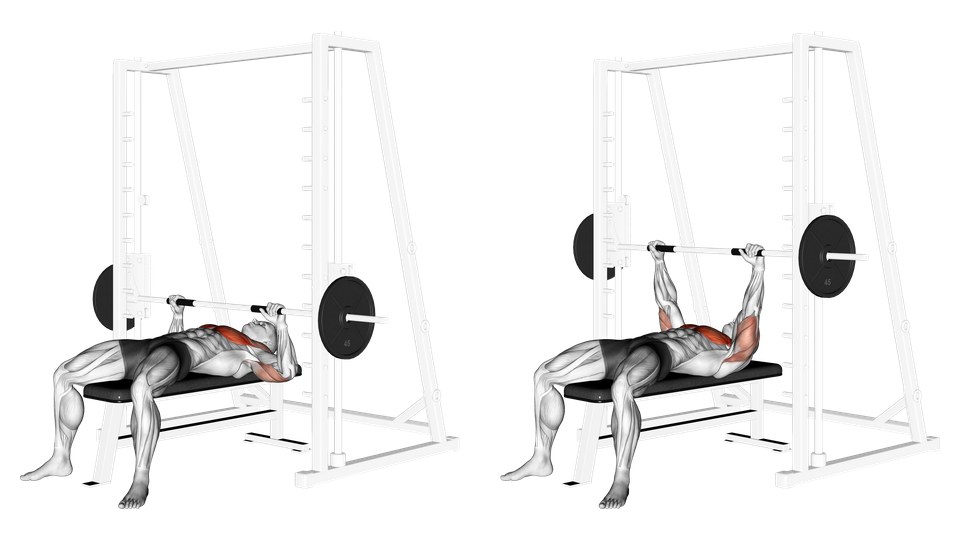
- Smith machine bench pressFixed bar path. Load sits near the barbell's, and chest activity did not differ.
Articles
Related tools
Frequently asked questions
What muscles does the bench press work?
Pectoralis major, anterior deltoid and triceps brachii, working together. Pectoralis major has two heads — clavicular and sternocostal — and flexes, adducts and internally rotates the arm at the shoulder. The anterior deltoid works with it to flex the arm, and on a flat bench it is active at roughly the same level, so it is a co-actor rather than a minor helper. The triceps extends the elbow, and its long head crosses the shoulder as well, so it is loaded through the press rather than only at lockout. Biceps brachii and the rotator cuff work too: the biceps more as the grip widens, the cuff throughout to keep the shoulder seated. The biceps effect is a large change on a small number, though: it never gets far off idle, and the study that measured it most closely concluded a bench press does not stimulate the biceps at all. There is no "inner" or "outer" chest — the anatomy references describe no such division.
Does a wide grip work the chest more?
No, and the measurements lean the other way. Four studies have looked at the sternocostal portion — the bulk of the chest — across grip widths on a flat bench, and none found a difference; the only meta-analysis to pool the question did not reach significance either. All four also measured the upper chest: two found it higher with a narrow grip, two found no difference, and none found it higher with a wide one. The single point for the wide grip is the very bottom of the chest, measured in one study and not confirmed in the other that looked. What is settled is that a wide grip lets you lift the same as a medium grip rather than more, and that grips much beyond one and a half times the bony width across your shoulders — measured point to point, not around the outside of the muscle — raise load on the joint at the end of the collarbone.
Does a close grip work the triceps more?
Slightly, and not everywhere in the muscle. It is the one part of the popular split that survives: a wide grip produced lower triceps activity than medium and narrow grips, with effect sizes of 0.27 and 0.32 — real but minor. Two studies each found it in a single head — the lateral head in one, the medial head in the other — and the one that measured the long head alone found no grip-width effect at all. A narrow grip also costs you about 7% of what you can lift. That trade is why a close-grip press is a triceps exercise in its own right rather than a way of tweaking a normal bench.
What grip width should I use?
Within the usual range this is a preference, and the evidence does not pick for you. A grip that puts your forearms roughly vertical at the bottom is a reasonable default because it is comfortable and repeatable, not because a study endorses it. Two things are worth knowing at the edges: a grip inside shoulder width will cost you around 7% of your load, and a grip much wider than one and a half times the bony width across your shoulders raises compression at the joint at the end of the collarbone. Between those, pick what you press well. The illustration here shows one grip because a drawing can only show one.
Should I tuck my elbows to 45 degrees?
The reason usually given for that number is not evidence-based, and the only paper to model it says so in its own introduction before finding that 45 degrees increased shear at the shoulder joint compared with 70 degrees. But that is a simulation of ten lifters using a 16 kg barbell, it found trade-offs in both directions rather than one safe angle, and its recommendation was aimed at lifters who already have pain above the shoulder. So this is not an argument for flaring your elbows. It is an argument that the cue is a preference stated as a mechanism. There is no weight in it either: the one study to press the same grip with the elbows in and with the elbows away from the body got the same 6RM both ways, and the elbows-out version put more load through the elbow and the shoulder for it. Let your forearms stay near vertical and the angle will follow from your build.
Do I need incline bench press to build the upper chest?
The evidence does not show that. A study of 30 trained lifters across five bench angles concluded that a flat bench produces even activity across all three pectoralis regions, and found no significant difference in the upper portion between flat and 30 or 45 degrees. A second study, of 13 trained men, found a 30-degree incline did not recruit the upper chest more than a flat or declined bench at the same grip. At the pooled level, flat beat incline for the lower chest and showed no significant difference for the upper. Incline pressing is worth doing if you like it, but the flat bench is not skipping your upper chest.
Is dumbbell bench press better than barbell for the chest?
Not for muscle activity. In the one study that compared barbell, dumbbell and Smith machine pressing directly, chest and front-delt activity did not differ between them. What changed was everything else: the dumbbell load was 17% lower, biceps activity was higher and triceps activity lower. That study was read as its published abstract only. Use dumbbells because you prefer them or because you are training one side at a time, not because they work the chest harder.
Should the bar touch my chest?
Yes, under control rather than bounced. The only multi-week training study to compare ranges split 50 trained men four ways — ten weeks of full, two-thirds or one-third range bench pressing, or no training at all — and full range produced the best strength results, with the gains shrinking as the range did. Roughly a dozen men per group, read as the published abstract only, and it measured strength rather than muscle size.
Should I squeeze my shoulder blades together?
Yes, and this is one of the few technique points with biomechanics behind it rather than tradition. In a musculoskeletal model of ten strength athletes, retracted scapulae lowered posterior shear at the shoulder, lowered compression in the joint and reduced the rotator cuff activity needed to keep the humeral head centred. The same model found retraction raised shear the other way at the very start and end of the rep, so it is a trade rather than a free win — but the trade is a good one, and it holds for the whole set, lockout included.
Is a 100 kg bench press good?
There is no honest way to answer that with a number. Whether a load is good depends on your bodyweight, your training age, your build and your leverages, and any table claiming otherwise is averaging over all of them. The useful question is whether the weight has moved over the last few months and whether you can still touch your chest with your shoulder blades set. This page publishes what lifters do, not what they should lift.
How many sets of bench press should I do?
Lifters using RepCount average 4.49 sets of bench press in a session, more than they give machine and isolation work, which sits nearer 3.2. That is a description of what people do rather than a recommendation, but it matches how a heavy compound is usually programmed: a handful of working sets, placed early in the session, in a workout of about seven exercises.
Sources
- López-Vivancos A, González-Gálvez N, Orquín-Castrillón FJ, Vale RGS, Marcos-Pardo PJ. Electromyographic Activity of the Pectoralis Major Muscle during Traditional Bench Press and Other Variants of Pectoral Exercises: A Systematic Review and Meta-Analysis. Applied Sciences. 2023. https://repositorio.ucam.edu/bitstream/handle/10952/7565/2023_Electromyographic.pdf
- Saeterbakken AH, et al. The Effect of Grip Width on Muscle Strength and Electromyographic Activity in Bench Press among Novice- and Resistance-Trained Men. Int J Environ Res Public Health. 2021. https://pmc.ncbi.nlm.nih.gov/articles/PMC8296276/
- Larsen S, Gomo O, van den Tillaar R. A Biomechanical Analysis of Wide, Medium, and Narrow Grip Width Effects on Kinematics, Horizontal Kinetics, and Muscle Activity on the Sticking Region in Recreationally Trained Males During 1-RM Bench Pressing. Front Sports Act Living. 2021. https://www.frontiersin.org/journals/sports-and-active-living/articles/10.3389/fspor.2020.637066/full
- Mausehund L, Werkhausen A, Bartsch J, Krosshaug T. Understanding Bench Press Biomechanics — The Necessity of Measuring Lateral Barbell Forces. J Strength Cond Res. 2022. https://www.klokeavskade.no/globalassets/publications/mausehund_2022_understanding-bench-press.pdf
- Arseneault K, Roy X, Sercia P. The Effect of 12 Variations of the Bench Press Exercise on the EMG Activity of Three Heads of the Pectoralis Major. International Journal of Strength and Conditioning. 2021. https://journal.iusca.org/index.php/Journal/article/download/39/124/
- Tanimoto M, Arakawa H, Sato M, Nagano A. Lateral Force and EMG Activity in Wide- and Narrow-Grip Bench Press in Various Conditions. Sports (Basel). 2023. https://pmc.ncbi.nlm.nih.gov/articles/PMC10458411/
- Noteboom L, et al. Effects of bench press technique variations on musculoskeletal shoulder loads and potential injury risk. Front Physiol. 2024. https://pmc.ncbi.nlm.nih.gov/articles/PMC11224528/
- Rodríguez-Ridao D, Antequera-Vique JA, Martín-Fuentes I, Muyor JM. Effect of Five Bench Inclinations on the Electromyographic Activity of the Pectoralis Major, Anterior Deltoid, and Triceps Brachii during the Bench Press Exercise. Int J Environ Res Public Health. 2020. https://pmc.ncbi.nlm.nih.gov/articles/PMC7579505/
- Saeterbakken AH, van den Tillaar R, Fimland MS. A comparison of muscle activity and 1-RM strength of three chest-press exercises with different stability requirements. J Sports Sci. 2011. https://pubmed.ncbi.nlm.nih.gov/21225489/
- Martínez-Cava A, Hernández-Belmonte A, Courel-Ibáñez J, Morán-Navarro R, González-Badillo JJ, Pallarés JG. Bench Press at Full Range of Motion Produces Greater Neuromuscular Adaptations Than Partial Executions After Prolonged Resistance Training. J Strength Cond Res. 2022. https://pubmed.ncbi.nlm.nih.gov/31567719/
- Solari F, Burns B. Anatomy, Thorax, Pectoralis Major. StatPearls. https://www.ncbi.nlm.nih.gov/books/NBK525991/
- Tiwana MS, Sinkler MA, Bordoni B. Anatomy, Shoulder and Upper Limb, Triceps Muscle. StatPearls. https://www.ncbi.nlm.nih.gov/books/NBK536996/
- Elzanie A, Varacallo MA. Anatomy, Shoulder and Upper Limb, Deltoid Muscle. StatPearls. https://www.ncbi.nlm.nih.gov/books/NBK537056/