Reverse hyperextension
Also called reverse hyper, reverse hyperextension machine.
What is a reverse hyperextension?
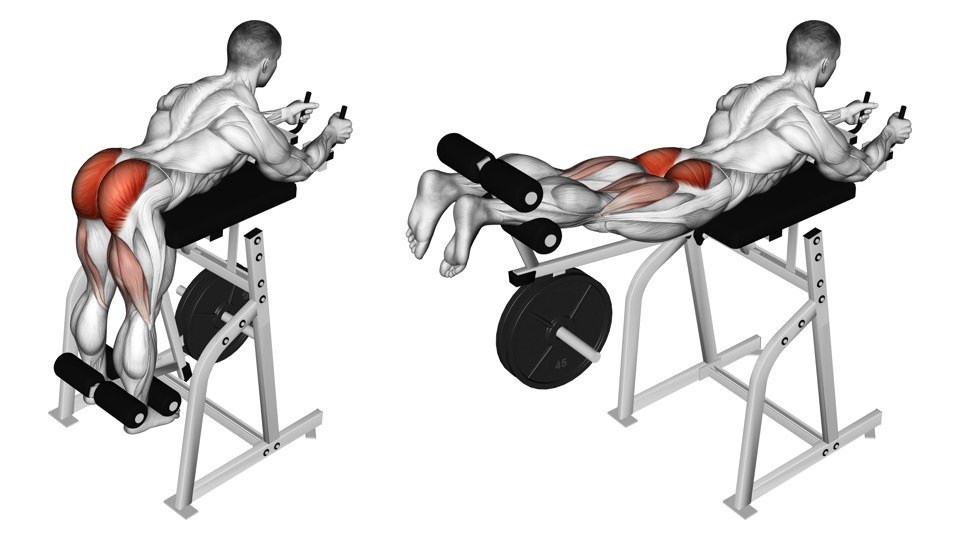
A reverse hyperextension raises the legs behind you while your torso rests on a padded support. This guide uses a dedicated plate-loaded machine with a lever connected to a lower-leg attachment. The glutes and hamstrings move the legs at the hips.
How do you perform a reverse hyperextension?
Set up
- Select a light starting load and set the machine according to its instructions. Secure the lower-leg attachment; the illustrated model uses rollers, while some machines use a strap.
- Lie face down with your hips near the pad edge and thighs free to move. Grip the handles and let the legs hang clear of the floor.
Execution
- Raise both legs behind you from the hips, keeping the torso settled on the pad and the knees almost straight.
- Stop around the point where your legs line up with your torso, without forcing a larger back arch.
- Lower the lever smoothly to the hanging position. Keep control through the change of direction instead of bouncing into the next lift.
Common mistakes
Throwing the lever into a large swing
Reduce the load or the range until you can control the return and start the next lift deliberately.
Chasing height by arching the back
Finish near torso height rather than using a larger back bend to send the feet higher.
Where it fits in a session
Include this exercise where it fits your planned lower-body session.
Record the machine settings and controlled range along with repetitions.
Muscles worked
Primary
Secondary
Schematic surface view. Some muscles are partly visible or not shown.
The gluteus maximus and hamstrings extend the hips while the torso is supported.
Variations
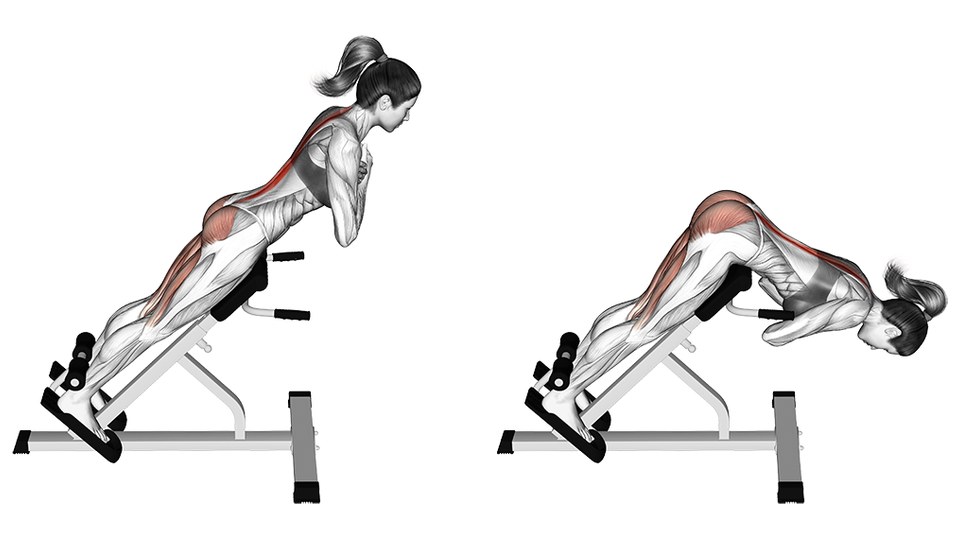
- Back extensionSupports the legs while the torso moves; the reverse hyper supports the torso while the legs move.
Frequently asked questions
Is a reverse hyperextension the same as a back extension?
No. A reverse hyperextension holds the torso on a pad and moves the legs. A back extension supports the lower body and moves the torso.
How high should I raise my legs?
For the version in this guide, finish near alignment with the torso. Use a lower endpoint if reaching that height makes you arch or lose contact with the pad.
Sources
- Anatomy, Bony Pelvis and Lower Limb, Gluteus Maximus Muscle. Adel Elzanie, Judith Borger. StatPearls. https://www.ncbi.nlm.nih.gov/sites/books/NBK538193/
- Anatomy, Bony Pelvis and Lower Limb, Hamstring Muscle. Young Hu, Avais Raja. StatPearls. https://www.ncbi.nlm.nih.gov/sites/books/NBK546688/