Back extension
Also called hyperextension, 45-degree back extension, Roman chair back extension.
What is a back extension?
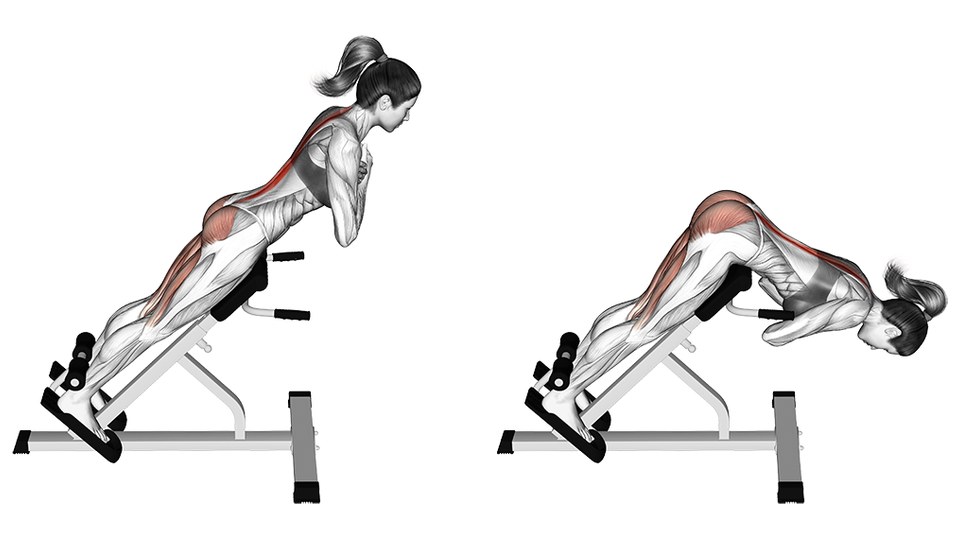
A back extension is done lying face down on an angled bench, ankles anchored and hips on the pad, lowering the torso toward the floor and raising it back to a straight line. It trains the erector spinae, the muscles running up either side of the spine, together with the gluteus maximus and the hip-crossing hamstrings, which extend the hips. Where the emphasis lands is a matter of how you do it. Bend at the waist as well as the hips on the way down and unroll back to straight, and the erectors do the lifting with the hips extending underneath them. Hold the back rigid and hinge only at the hips instead, and the work goes to the glutes and hamstrings. Despite the older name "hyperextension", both stop at a straight line rather than arching past it.
How do you perform a back extension?
Set up
- Set the pad just below your hip bones, then hook your ankles under the rollers.
- Cross your arms over your chest and set your body in a straight line.
Execution
- Lower your torso under control, bending at the hips and letting your back round as you go.
- Stop when your torso is roughly at a right angle to your legs, or sooner if a mild stretch through your hamstrings and lower back stops you.
- Come back up by unrolling your spine and extending your hips together, until your body is a straight line from head to heels.
- Stop at straight rather than arching past it, then lower into the next rep.
Common mistakes
Setting the pad too high
A pad pressing into your stomach restricts hip movement and shortens the range, shifting more of the movement to your spine.
Lifting past a straight line at the top
Straight is the finish. Going farther can turn the extra range into lumbar extension under load instead of useful hip extension.
Dropping into the bottom and bouncing out
Dropping makes the bottom harder to control and lets rebound start the next rep. Keep the descent smooth instead.
Pulling on your neck with your hands
Hands behind the head are a fair way to make the set harder — they move weight further from the hips — but once the reps get hard the hands can start pulling and strain the neck. If you put them there, let them rest. If you want the set harder still, cross your arms and hold a plate against your chest.
Where it fits in a session
Near the end of a back or leg session, after the compound lifts.
Start with bodyweight and move under control. Once those reps are comfortable, hold a plate against your chest rather than speeding up.
Muscles worked
- erector spinae
- gluteus maximus
- hamstrings
Listed together rather than ranked. The erector spinae extend the spine; the gluteus maximus and the hip-crossing hamstrings extend the hip; a back extension loads both joints at once. Which group does the dynamic work depends on which joint moves — letting the spine round and unroll hands the movement to the erectors with the hips extending underneath, and a rigid-back hinge works the erectors mostly as stabilisers while the hip extensors raise the torso.
What lifters actually do
About one in four regular RepCount users has logged back extensions, but they turn up in only about one workout in fifty — widely tried, a staple for few. When they do appear it is as accessory work: around three sets, inside a session of about eight exercises. The company they keep is split across the body. Pulldowns and cable rows are the most frequent companions, with leg extensions, leg curls and leg press not far behind, so the movement finishes back days and leg days rather than belonging to either.
Most often trained alongside
Share of back extension sessions that also include each exercise.
- Pulldowns30.5%
- Cable row22.1%
- Leg extensions16.4%
- Leg curls14.5%
- Leg press14%
Figures come from workouts tracked in RepCount.
Variations
- Weighted back extension — A plate held against the chest — the usual progression once bodyweight reps come easily.
- Horizontal back extension — On a flat bench or glute-ham developer. The torso finishes level with the floor, where gravity has the most leverage on it, so the top of the rep is harder than on the 45-degree bench.
- Stiff-spine back extension — Back held rigid and all the movement taken at the hips. The glutes and hamstrings raise the torso and the erectors only hold it still.
- Glute-focused back extension — Upper back held rounded and chin tucked throughout, so the hips do all the moving.
- Single-leg back extension — One leg anchored, which narrows the base and adds a balance demand.
- Machine back extension — Seated, extending the trunk against a pad. The machine fixes the hips, isolating spinal extension.
- Reverse hyperextension — Torso fixed and the legs swing instead — the same hip extension driven from the other end.
Frequently asked questions
What muscles do back extensions work?
Three groups across two joints. The erector spinae run up either side of the spine and are its primary extensor when both sides work together; they also control the torso's forward flexion, which is the work they do on the way down. The gluteus maximus extends the hip and engages when force is needed — straightening from a bent position is its textbook example. The hamstring group contributes to hip extension and knee flexion.
Are back extensions a back exercise or a glute exercise?
Either, depending on how you do them, which is why the same bench turns up on back days and leg days. Let the spine round on the way down and unroll it on the way up and the erectors do the moving, with the hips extending underneath them. Hold the back rigid and hinge only at the hips instead and the glutes and hamstrings raise your torso while the erectors hold the spine still. A third version keeps the upper back rounded and the chin tucked throughout and still hinges at the hip, which biases the glutes further. Pick the version that matches which muscles you came to train.
What is the difference between a back extension and a hyperextension?
They are the same exercise. The bench is often sold as a hyperextension bench, and plenty of gyms and training apps use the older name. Taken literally, "hyperextension" would mean arching past a straight line at the top, but the standard execution stops at straight. Going farther can turn the extra range into lumbar extension under load rather than useful hip extension.
Are back extensions worth doing?
They are a well-kept accessory rather than a staple. About one in four regular RepCount users has logged them, but they appear in only about one workout in fifty, typically for around three sets inside a session of about eight exercises. The sessions show where lifters file them: pulldowns and cable rows are the most frequent company, with leg extensions, leg curls and leg press not far behind, so they finish back days and leg days alike.
How do I make back extensions harder?
Hold a plate or a dumbbell against your chest — the load sits over the moving torso and leaves your neck alone. Slowing the lowering works too, because it keeps the descent controlled. Moving to a horizontal bench or a glute-ham developer also raises the difficulty, because the torso finishes level with the floor, which is where gravity has the most leverage on it.
How high should I come up on a back extension?
To a straight line from head to heels, and no further. The name "hyperextension" suggests arching past straight, but that range adds lumbar extension under load rather than useful hip extension. If you want more range, take it at the bottom — lower until your torso is at a right angle to your legs, or a mild stretch stops you — rather than at the top.
Sources
- Modes RJ, Lafci Fahrioglu S. Anatomy, Back. StatPearls. https://www.ncbi.nlm.nih.gov/books/NBK539746/
- Henson B, Kadiyala B, Edens MA. Anatomy, Back, Muscles. StatPearls. https://www.ncbi.nlm.nih.gov/books/NBK537074/
- Elzanie A, Borger J. Anatomy, Bony Pelvis and Lower Limb, Gluteus Maximus Muscle. StatPearls. https://www.ncbi.nlm.nih.gov/books/NBK538193/
- Hu Y, Raja A. Anatomy, Bony Pelvis and Lower Limb, Hamstring Muscle. StatPearls. https://www.ncbi.nlm.nih.gov/books/NBK546688/