
Reverse plank
Also called reverse plank hold.
What is a reverse plank?
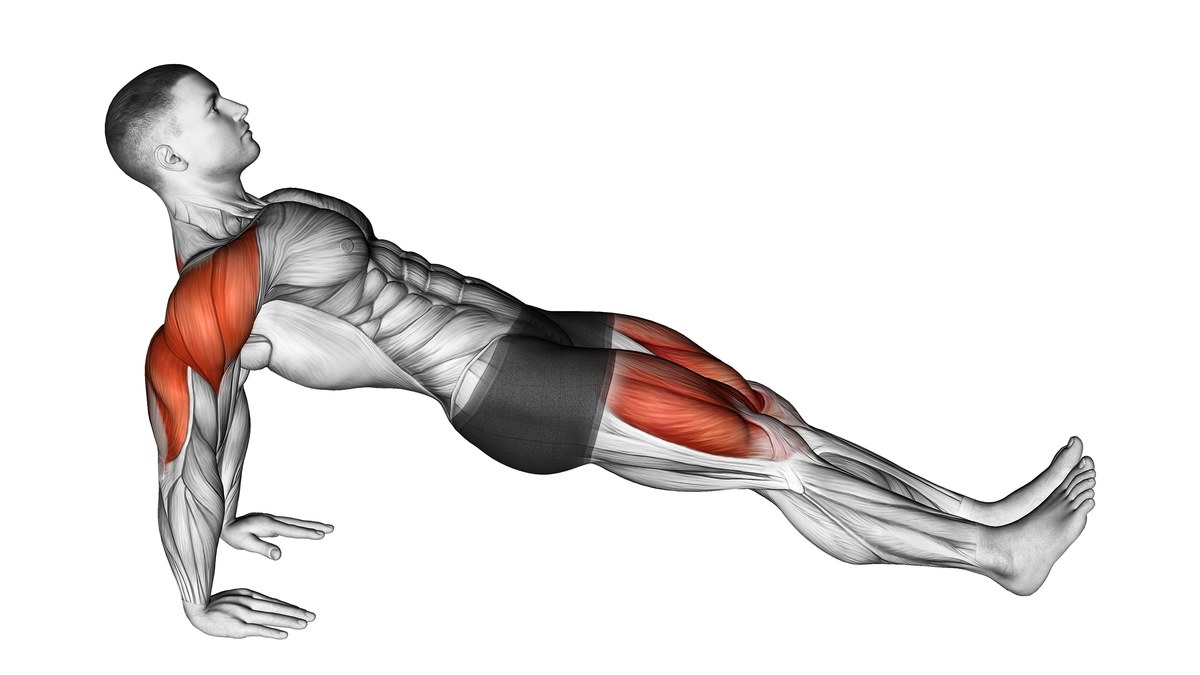
A reverse plank is a face-up hold supported on your palms and heels. You lift your hips until your torso and legs form a long line, with your hands behind you and your arms straight. Your glutes, hamstrings and back muscles help hold the position.
How do you perform a reverse plank?
Set up
- Sit with your legs extended and heels on the floor. Place your palms just behind your hips, about shoulder-width apart.
- Point your fingers toward your feet, spread them and press evenly through your palms. Keep a small bend available in the elbows rather than forcing them backward.
Execution
- Press through your hands and heels to lift your hips, bringing your torso and legs into a long line.
- Hold with your shoulders supported over your hands and your head in line with your torso. Keep breathing without dropping or thrusting your hips.
- Lower your hips to the floor under control to finish the hold.
Common mistakes
Hanging between the shoulders
Keep pressing through your palms instead of sinking into the support.
Lifting the ribs while the hips stay low
Raise the hips as part of the whole body line. Use a bent-knee version if the straight-leg hold is too difficult.
Where it fits in a session
Use it alongside other trunk or bodyweight exercises.
Start with brief holds and stop when the body line changes. If the hand position is uncomfortable, turn the fingers slightly outward or choose a different exercise.
Muscles worked
Primary
Secondary
Schematic surface view. Some muscles are partly visible or not shown.
The glutes and hamstrings help keep the hips extended while the back muscles help hold the torso in line.
Variations
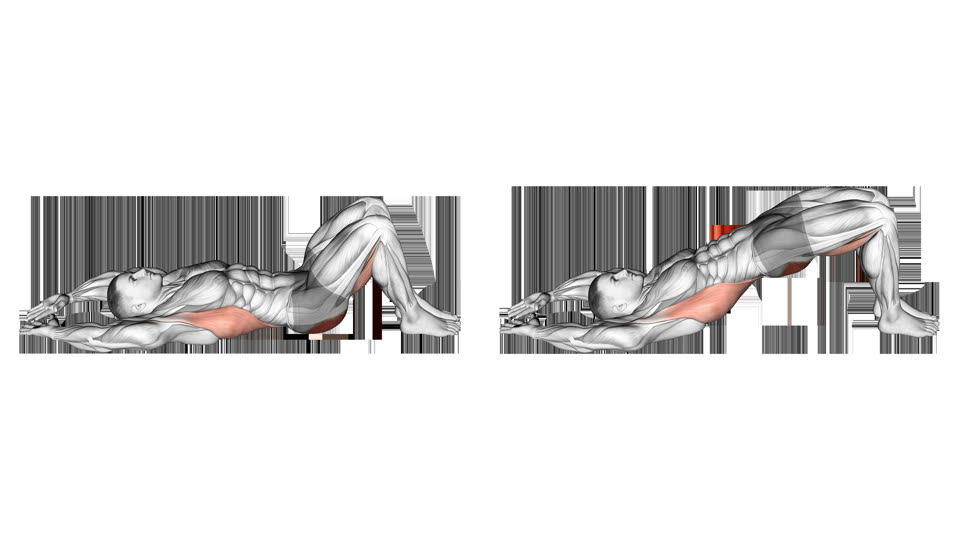
- Reverse tabletop hold — Bend the knees and place the feet flat while lifting the hips.
- Front plankFace the floor and support yourself on the forearms and toes instead of the palms and heels.

Frequently asked questions
Which way should my fingers point?
The illustration shows fingers pointing toward the feet, which is the starting option here. A slight outward turn is a coaching adjustment if it is more comfortable; do not force a painful wrist position.
Should I look behind me?
Keep your head following the line of your torso. You do not need to tip it backward to complete the hold.
How is it different from a front plank?
The reverse plank faces upward and uses straight-arm hand support with the heels on the floor. The front plank guide faces downward and uses the forearms and toes.
Sources
- J. Gordon Betts and colleagues, OpenStax. Anatomy and Physiology 2e, section 11.4: Axial muscles of the abdominal wall and thorax. 2022. https://openstax.org/books/anatomy-and-physiology-2e/pages/11-4-axial-muscles-of-the-abdominal-wall-and-thorax
- OpenStax. Anatomy and Physiology 2e, section 11.6: Appendicular muscles of the pelvic girdle and lower limbs. 2022. https://openstax.org/books/anatomy-and-physiology-2e/pages/11-6-appendicular-muscles-of-the-pelvic-girdle-and-lower-limbs
- Ali Zahiri; Shahab Alizadeh; Abdolhamid Daneshjoo; Nick Pike; Andreas Konrad; David G Behm. Core Muscle Activation With Foam Rolling and Static Planks. 2022. https://pmc.ncbi.nlm.nih.gov/articles/PMC8964357/
- J. Gordon Betts and colleagues, OpenStax. Anatomy and Physiology 2e, section 11.3: Axial muscles of the head, neck and back. 2022. https://openstax.org/books/anatomy-and-physiology-2e/pages/11-3-axial-muscles-of-the-head-neck-and-back