Glute bridge
Also called glute bridges, bodyweight glute bridge, hip bridge, butt bridge.
What is a glute bridge?
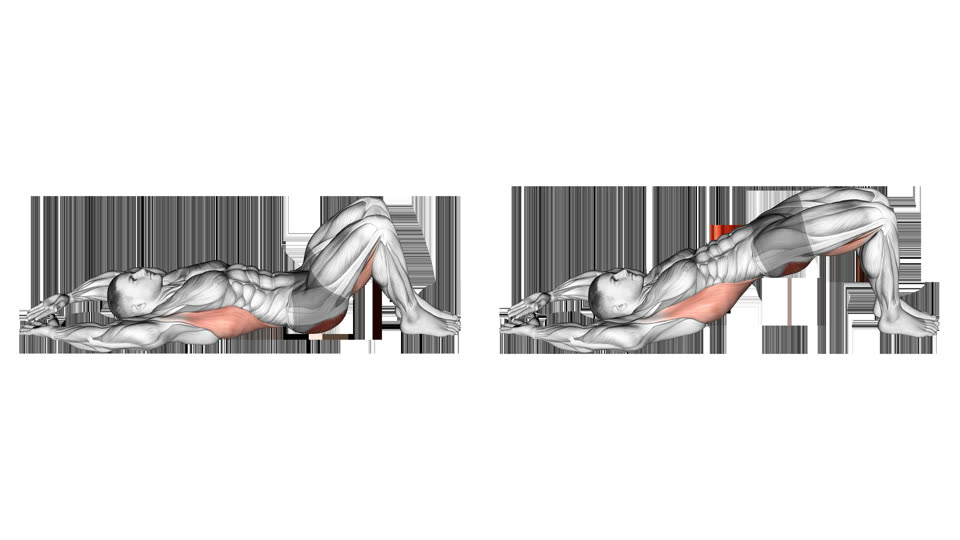
The glute bridge is a bodyweight hip-extension exercise performed on the floor. Lie with your knees bent and feet planted, then raise the hips until the trunk and thighs form a controlled line; the gluteus maximus is the main target.
How do you perform a glute bridge?
Set up
- Lie on your back, bend both knees and plant your feet around hip width, close enough that you can press through the whole foot.
- Rest your arms where they are comfortable, brace gently and begin with the pelvis and rib cage settled rather than the lower back arched.
Execution
- Press through both feet and squeeze the glutes to raise the hips from the floor.
- Stop when the trunk and thighs form a line without pushing the ribs upward or extending farther through the lower back.
- Lower the pelvis under control to the floor and reset the same foot pressure before repeating.
Common mistakes
Arching the lower back at the top
Extra spinal extension makes the hips look higher without adding useful hip extension. Stop when the trunk and thighs align.
Setting the feet too far away
A long distance can make the hamstrings dominate or cramp. Move the feet closer until the whole foot can press down comfortably.
Pushing mostly through the toes
Uneven foot pressure makes the position less stable and harder to repeat. Keep the heel and forefoot connected to the floor.
Where it fits in a session
Use it for bodyweight hip-extension practice, in a warm-up or as direct glute work when a bench or external load is not needed.
Progress first by making the top position and tempo repeatable, then use a unilateral or loaded variation when bodyweight becomes easy.
Muscles worked
Primary
Secondary
Schematic surface view. Some muscles are partly visible or not shown.
The gluteus maximus extends the hips. The hamstrings assist hip extension and the quadriceps help hold the knee angle while both feet press into the floor.
Variations
- Single-leg glute bridge — Raises one foot and makes each hip work separately.
- Barbell glute bridge — Keeps the shoulders on the floor and adds a bar across the hips.

Frequently asked questions
What muscles do glute bridges work?
The gluteus maximus is the main target. The hamstrings assist hip extension and the quadriceps help maintain the knee position.
How high should you lift your hips in a glute bridge?
Lift until the trunk and thighs form a controlled line. Stop before extra height comes from arching the lower back or flaring the ribs.
Where should your feet be in a glute bridge?
Place them around hip width and near enough that both heels and forefeet stay planted while the hips rise. Adjust for comfort rather than chasing one exact distance.
What is the difference between a glute bridge and a hip thrust?
A glute bridge keeps the shoulders on the floor. A hip thrust supports the upper back on a bench and is commonly performed with external load.
Sources
- Anatomy, Bony Pelvis and Lower Limb, Gluteus Maximus Muscle. StatPearls. https://www.ncbi.nlm.nih.gov/books/NBK538193/
- Anatomy, Bony Pelvis and Lower Limb: Posterior Thigh. StatPearls. https://www.ncbi.nlm.nih.gov/books/NBK546688/