
Reverse sled drag
Also called backward sled drag, backwards sled drag, backward sled pull, reverse sled pull.
What is a reverse sled drag?
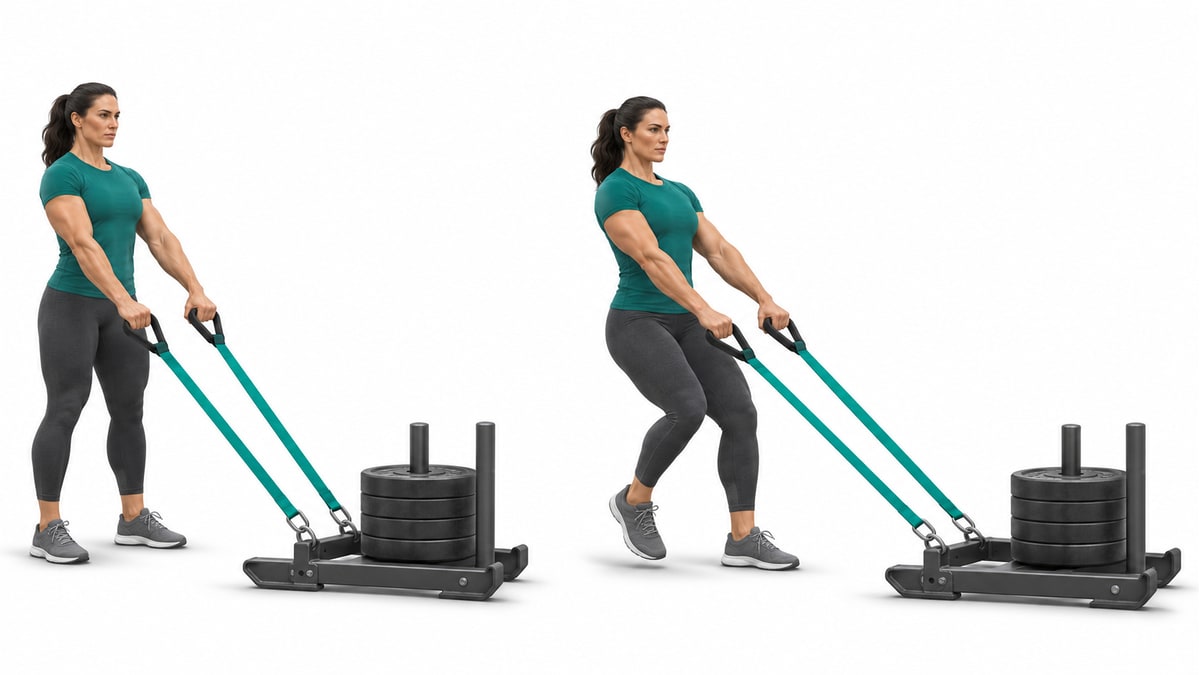
A reverse sled drag moves a loaded sled by walking backward while facing it and holding straps or handles. Your legs move you and the sled along the lane while your hands keep a steady hold. It is different from standing still and pulling a rope hand over hand, or pushing the sled forward.
How do you perform a reverse sled drag?
Set up
- Choose a sled and pulling attachment designed to work together. Check the connection and load the sled as its maker directs. Clear a straight lane, including the space behind you where you will walk.
- Face the sled and take a secure hold of both handles or strap ends. Stand far enough away to gently take up the slack, with your arms reaching toward the sled and your feet set apart for balance.
Execution
- Bend your knees a little, brace your trunk and lean back enough to put tension through the attachment. Begin with a short backward step rather than jerking the handles toward you.
- Keep taking small, alternating steps along the cleared lane. Hold your arms steady in front of you, keep your knees softly bent and let your legs move the sled instead of repeatedly rowing the handles.
- Slow your steps before the end of the lane and bring yourself and the sled to a stop while keeping your grip. Step toward the settled sled to release the tension, then lower the handles or straps.
- Reposition the equipment only once it has stopped. Check the attachment and clear the next lane before restarting; after the final length, leave the sled still and the straps out of the walking route.
Common mistakes
Pulling repeatedly with the arms
Bending and straightening the elbows turns the drag into a series of rows. Keep a comfortable, steady arm position while the backward steps move the load.
Taking steps too long to control
Reaching far behind you can disrupt your balance and interrupt the drag. Shorten the steps until you can place each foot securely and keep the sled moving without sudden tugs.
Dropping the handles while still moving
Stop before letting go. Keep your hold as the sled settles, then move toward it to slacken the attachment before putting it down.
Where it fits in a session
Use this setup when your planned session calls for backward sled dragging.
Choose a load that lets you start smoothly, keep your footing and stop under control throughout the available lane.
Muscles worked
Primary
Secondary
Schematic surface view. Some muscles are partly visible or not shown.
The quadriceps extend the knees as you move the sled with backward steps. The abdominal muscles help hold the trunk steady against the pull of the attachment. These are functional roles, not measured activation shares or a claim that the rest of the body is inactive.
Variations
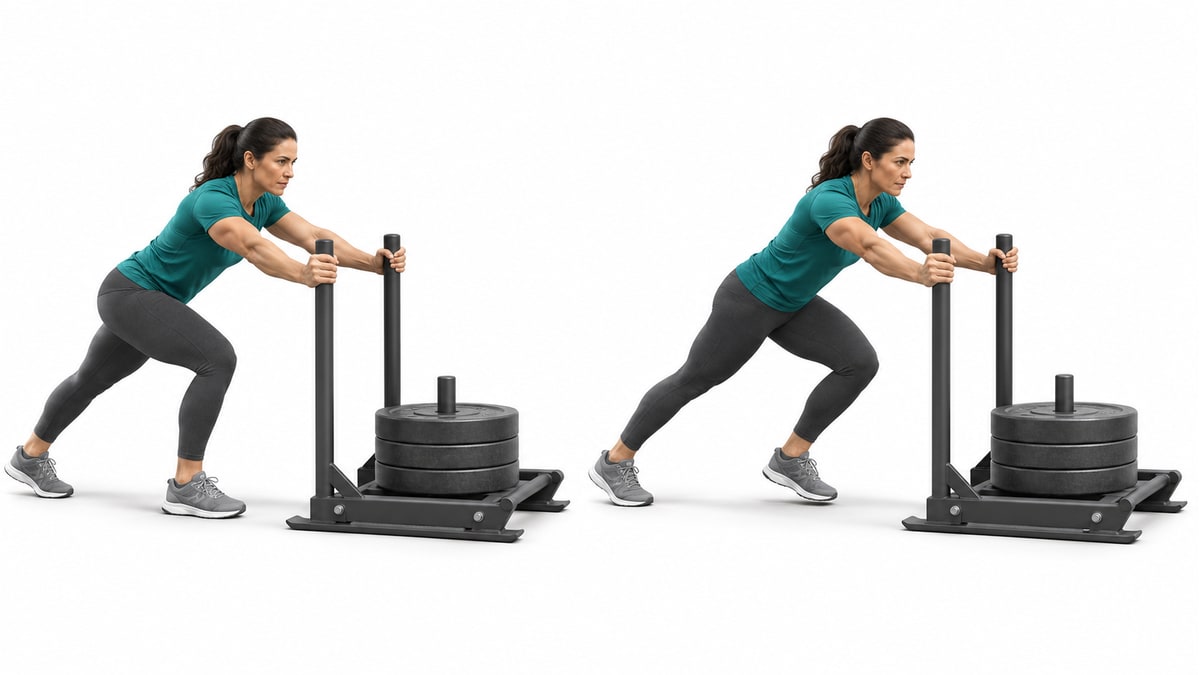
- Sled pushFace the direction of travel and drive through the sled handles; the shared implement does not make this the same movement as a backward drag.
Frequently asked questions
What muscles does a reverse sled drag work?
The quadriceps straighten the knees during the backward steps, while the abdominal muscles help steady the trunk as you hold the attachment. This guide emphasizes those roles without claiming to measure each muscle's share of the effort or isolate one part of the quadriceps.
Is a reverse sled drag the same as a sled rope pull?
The names are sometimes used loosely. Here, a reverse sled drag means walking backward while keeping hold of straps or handles. In a stationary hand-over-hand rope pull, your feet stay in place while you repeatedly change grips and pull the sled toward you.
How low should I sit during a backward drag?
Keep a modest knee bend that lets you take controlled steps and maintain your balance. You do not need to force a deep squat or one fixed body angle. If you have to hang far backward or lose your footing to move the sled, reduce the load and reset your position.
Should I pull with my arms?
Hold the attachment securely, but keep the arm position fairly steady while your legs move you backward. A slight elbow bend is fine. Repeated two-arm pulls or hand-over-hand rope exchanges are different sled exercises rather than extra steps in this version.
How heavy should the sled be?
Start with a load you can move without a sudden heave. You should be able to place each backward step securely and stop before the lane ends. If the sled keeps stalling or your grip and posture change immediately, take weight off rather than forcing the next length.
Sources
- Betts JG, et al. Anatomy and Physiology 2e, 11.6: Appendicular Muscles of the Pelvic Girdle and Lower Limbs. OpenStax. https://openstax.org/books/anatomy-and-physiology-2e/pages/11-6-appendicular-muscles-of-the-pelvic-girdle-and-lower-limbs
- Betts JG, et al. Anatomy and Physiology 2e, 11.4: Axial Muscles of the Abdominal Wall and Thorax. OpenStax. https://openstax.org/books/anatomy-and-physiology-2e/pages/11-4-axial-muscles-of-the-abdominal-wall-and-thorax