Sled push
Also called prowler push, power sled push, weighted sled push.
What is a sled push?
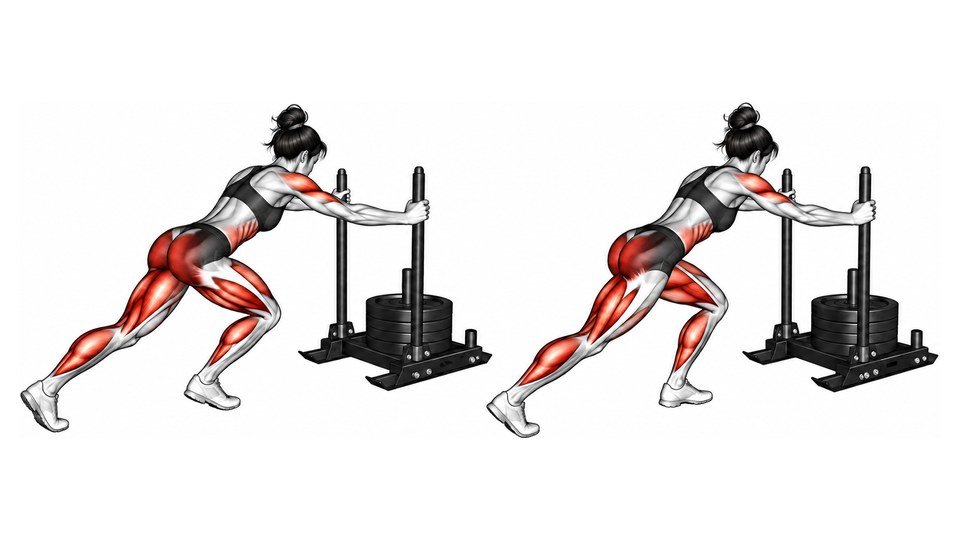
The sled push is a loaded movement in which you drive a weighted sled forward by walking or running while pushing through its handles. In the high-handle version shown here, you lean into active, mostly extended arms and alternate powerful steps while keeping the trunk braced.
How do you perform a sled push?
Set up
- Load the sled evenly on a clear, suitable surface and make sure the route ahead is free of people and obstacles.
- Grip both high handles with active, mostly extended arms, brace your midsection and take a staggered stance behind the sled.
Execution
- Lean forward as one controlled line and drive the sled away with the back leg.
- Alternate strong steps while keeping pressure through both handles and the neck in a neutral position.
- Continue for the planned distance, then slow the sled under control before releasing the handles.
Common mistakes
Loading the sled until every step stalls
A load that stops the intended rhythm changes the session. Reduce it until the chosen walking or running pattern stays repeatable.
Collapsing between the shoulders
Keep active pressure into both handles so the torso and arms transfer leg drive into the sled.
Looking straight up while leaning forward
Let the head follow the torso and look toward the route ahead without cranking the neck back.
Where it fits in a session
As lower-body strength, power or conditioning work, with the load and distance chosen for the session's goal.
A heavy walk and a light sprint are different efforts. Pick the intended pace first, then use a load that preserves it across the planned distance.
Muscles worked
Primary
Secondary
Schematic surface view. Some muscles are partly visible or not shown.
The quadriceps and gluteus maximus drive each step while the adductors, calves and abdominal muscles help transfer force into the sled. The exact emphasis changes with load, handle height and speed.
Variations
- Low-handle sled push — Uses the lower handles and usually creates a more horizontal body position.
- Heavy sled push — Uses a load that slows the steps for a short, force-focused effort.
- Sled sprint — Uses a lighter load and faster steps for a speed-focused effort.
- Backward sled drag — Faces the sled and steps backward while pulling it by straps or handles.
Frequently asked questions
What muscles does the sled push work?
It mainly trains the quadriceps and gluteus maximus. The adductors, calves and abdominal muscles assist as you alternate steps and transfer force through the handles.
Should my arms be straight during a sled push?
Keep the arms active and mostly extended in the high-handle version shown here. A small elbow bend is fine; avoid repeatedly pulling and pressing the handles with each step. Other handle setups can change the arm and torso position.
How far should I lean forward?
Lean enough to direct force into the sled while keeping the trunk controlled and the neck neutral. There is no single required angle because load, speed and handle height change the position.
Should I walk or run with the sled?
Match the pace to the goal and load. Heavy pushes usually use slower steps, while lighter pushes can use a faster stride; the chosen pace should remain repeatable for the distance.
How heavy should a sled push be?
Use a load that fits the intended pace and distance. If every step stalls or your position changes immediately, reduce the load rather than forcing the sled forward.