
Reverse wrist curl
Also called barbell wrist extension, palms-down wrist curl.
What is a reverse wrist curl?
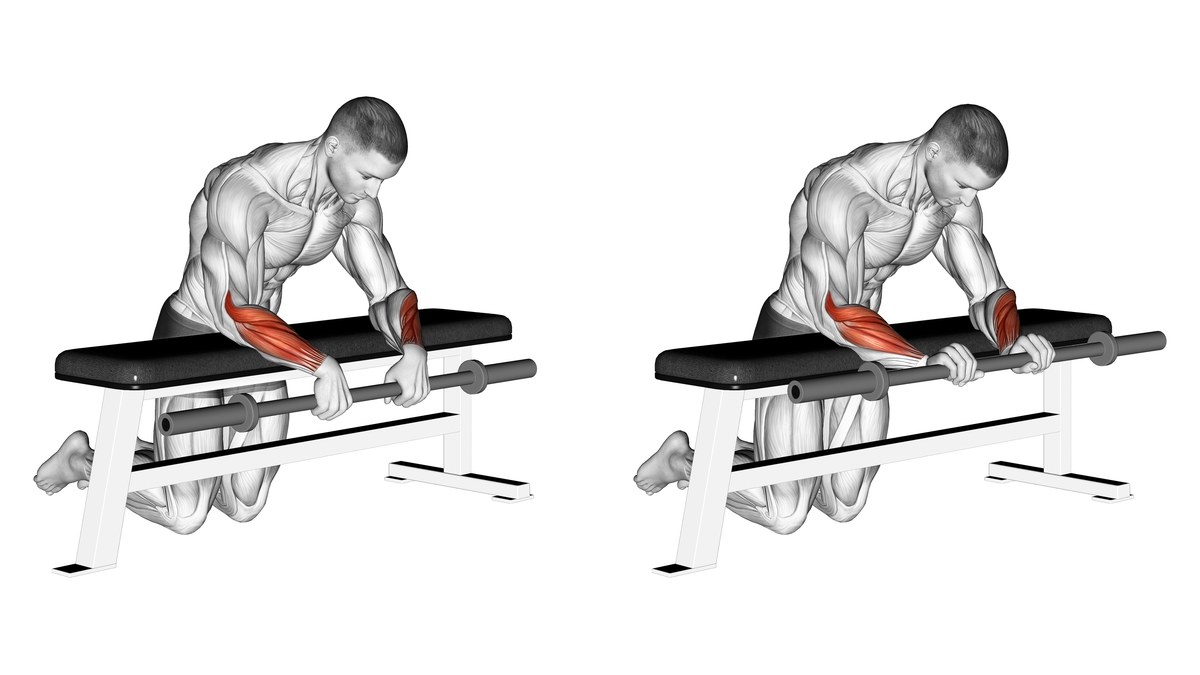
A reverse wrist curl raises a weight by extending the wrists while the palms face down. It trains the wrist extensors on the back of the forearms. In the barbell version shown here, both forearms rest on a bench and only the hands move through the repetition.
How do you perform a reverse wrist curl?
Set up
- Kneel at the long side of a stable flat bench and hold a light barbell with an overhand grip about shoulder-width apart.
- Lean forward and lay both forearms across the pad, palms down, with your wrists beyond the far edge and the bar clear of the frame. Keep your grip closed.
Execution
- Let your hands lower below the bench edge by bending at the wrists, keeping your elbows and forearms on the pad.
- Raise your knuckles toward the ceiling as far as you comfortably can without lifting your forearms or changing your grip.
- Lower the bar smoothly to the starting position and repeat without bouncing.
Common mistakes
Lifting the elbows to finish the rep
A rising elbow makes the movement harder to keep at the wrist. Reduce the load if you cannot keep the same forearm contact with the pad.
Bouncing out of the bottom
A rebound makes the change of direction harder to control. Let the hands settle into the turn instead of dropping and snapping the bar back up.
Letting the bar roll out toward the fingertips
Keep a closed grip for this version. You do not need a finger-opening phase to perform wrist extension, and a loose bar is harder to hold securely.
Where it fits in a session
After the exercises for which you need a fresh grip.
Start with a load you can move without lifting the forearms or bouncing. Add weight only when you can repeat the same wrist motion and keep a secure hold throughout the set.
Muscles worked
Primary
Secondary
- None listed in this guide
Schematic surface view. Some muscles are partly visible or not shown.
The wrist extensors run along the back of the forearm and raise the hand at the wrist. The elbows stay supported during this exercise.
Variations
- Thigh-supported reverse wrist curl — Sit and support the forearms on your thighs with the hands beyond the knees. This is an optional support choice; the demonstration uses a bench.
- Wrist curlThe related palms-up exercise raises the bar through wrist flexion.
Frequently asked questions
What muscles do reverse wrist curls work?
They train the wrist extensors on the back of the forearm, including extensor carpi radialis longus, extensor carpi radialis brevis and extensor carpi ulnaris. These muscles extend the wrist, raising the hand when the palm faces down.
How is a reverse wrist curl different from a wrist curl?
The reverse version uses a palms-down grip and lifts through wrist extension. A palms-up wrist curl lifts through wrist flexion. Both move at the wrist, with the forearms supported.
Is this the same as a reverse curl?
No. In a reverse curl, you bend the elbows to lift the bar toward your shoulders while keeping the wrists steady. A reverse wrist curl keeps the elbows in place and moves the hands at the wrists.
Do I need to kneel at a bench?
No. You can also sit with your forearms resting on your thighs and your hands beyond your knees. Choose a support that lets your wrists move freely and keeps the bar clear. The kneeling bench setup is the version illustrated here.
Can I use dumbbells instead?
Yes. A dumbbell lets you perform the palms-down wrist action with one hand at a time. Support the working forearm and leave the wrist beyond the edge. The instructions and media on this page use a barbell.
How much weight should I use?
Choose a light load that lets you lift and lower the hands with a secure grip while the forearms stay supported. If even an empty bar makes you shorten or jerk the movement, use a lighter fixed bar or a light dumbbell instead.
Sources
- Betts JG, et al. Anatomy and Physiology 2e, section 11.5: Muscles of the pectoral girdle and upper limbs. OpenStax. 2022. https://openstax.org/books/anatomy-and-physiology-2e/pages/11-5-muscles-of-the-pectoral-girdle-and-upper-limbs
- Eschweiler J, et al. Anatomy, Biomechanics, and Loads of the Wrist Joint. Life (Basel). 2022;12(2):188. https://pmc.ncbi.nlm.nih.gov/articles/PMC8880601/