
Wrist curl
Also called barbell wrist curl, palms-up wrist curl, seated wrist curl.
What is a wrist curl?
A wrist curl is a forearm isolation exercise performed with the palms up. With your forearms supported and wrists free to move, you lower the bar through wrist extension and curl it back by flexing the wrists.
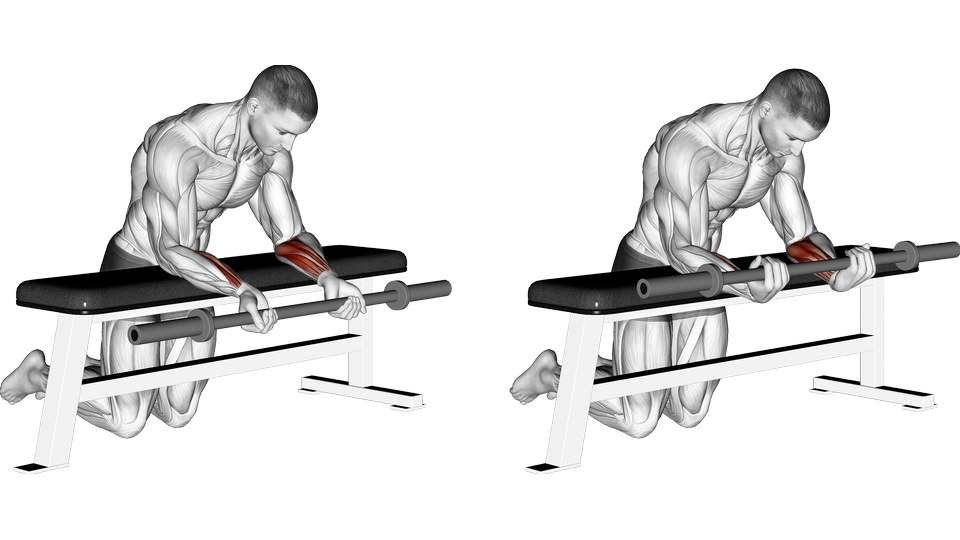
How do you perform a wrist curl?
Set up
- Sit at a bench and hold a light barbell with an underhand grip about shoulder-width apart.
- Rest your forearms on the bench with your palms up and your wrists just beyond the edge.
Execution
- Open your fingers slightly and let the bar roll toward them as your wrists lower.
- Close your grip, then curl the bar upward by flexing your wrists without lifting your forearms.
- Pause briefly at the top and lower under control into the next repetition.
Common mistakes
Using too much weight
A heavy bar encourages short, bouncing reps and makes it harder to keep the forearms supported.
Lifting the forearms from the bench
Once the elbows and forearms move, the exercise is no longer isolating wrist flexion.
Dropping the bar into the fingers
The finger-opening option should stay slow enough that you can close the hand securely before curling.
Where it fits in a session
Near the end of an upper-body or pulling session, after exercises where grip matters.
Use a light load and a controlled range. If grip or wrist position is needed for later compound work, save direct wrist curls until that work is finished.
Muscles worked
Primary
Secondary
- None listed in this guide
Schematic surface view. Some muscles are partly visible or not shown.
The palms-up curl trains the muscles that flex the wrist; the forearms stay supported so the movement comes from the wrists.
Variations
- Dumbbell wrist curl — Lets each wrist move independently with a dumbbell.
- Cable wrist curl — Uses a low cable for a different resistance profile.
- Reverse wrist curl — Uses a palms-down grip to train wrist extension instead of flexion.
- Behind-the-back wrist curl — Holds the bar behind the hips with the arms hanging rather than supported on a bench.
Frequently asked questions
What muscles do wrist curls work?
Palms-up wrist curls mainly work the forearm muscles that flex the wrist. Some also help close the fingers around the bar.
Should my forearms rest on my thighs or a bench?
Either can support the forearms. The version shown here uses a bench because its edge gives the wrists room to move while the elbows stay still.
Should the bar roll into my fingers?
It can, if you keep control and close your grip before flexing the wrists. You can also keep a closed grip throughout if the rolling portion feels insecure.
How heavy should wrist curls be?
Light enough to use the full controlled wrist motion without bouncing, shortening the range or lifting the forearms. Progress from that repeatable technique rather than from a universal weight target.
Are wrist curls the same as reverse wrist curls?
No. A palms-up wrist curl trains wrist flexion. A reverse wrist curl uses a palms-down grip and trains wrist extension.