
Safety bar squat

What is a safety bar squat?

A safety bar squat is a squat with a padded safety squat bar across the shoulders and upper back. Hold its forward handles as you descend and stand. This guide uses a free-standing squat, without pulling on the rack.
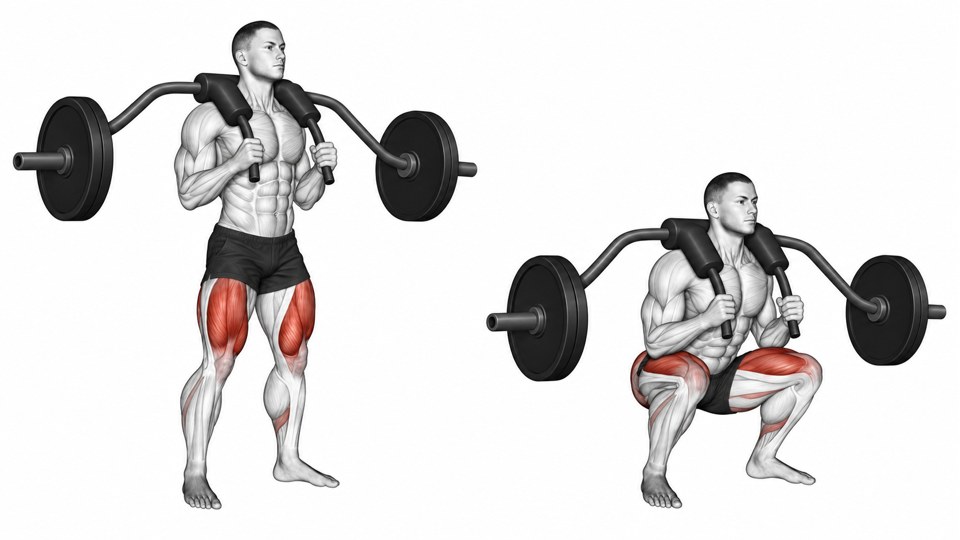
Exercise illustration: Standing and deep squat with a padded cambered safety bar and two forward handles.

How do you perform a safety bar squat?

Set up

  1. Set the rack hooks and safeties for your squat depth. Secure the plates and check the manufacturer’s intended orientation of the bar.
  2. Place the pads across your shoulders and upper back, hold both handles and unrack. Step back into a balanced stance.

Execution

  1. Brace and lower by bending your hips and knees, keeping the bar seated securely on your shoulders.
  2. Reach a depth you can control with your feet planted and your torso supported.
  3. Push through your feet to stand while keeping both hands on the handles.
  4. Reset before repeating; after the last rep, walk the bar into both uprights and lower it onto the hooks.

Common mistakes

  • Using the bar backward

    Check the maker’s instructions; safety bar designs and handle angles differ.

  • Changing the exercise by pulling on the rack

    This guide uses the bar’s handles. Rack-assisted squats are a separate setup.

Where it fits in a session

Use it in the squat portion of the session before tiring leg assistance work.

Record the bar used: safety bars differ in shape and unloaded weight. Keep the same bar and depth when comparing sessions.

Muscles worked

Front
Front — Schematic surface view. Some muscles are partly visible or not shown.
Back
Back — Schematic surface view. Some muscles are partly visible or not shown.

Primary

Secondary

  • None listed in this guide

Schematic surface view. Some muscles are partly visible or not shown.

Variations
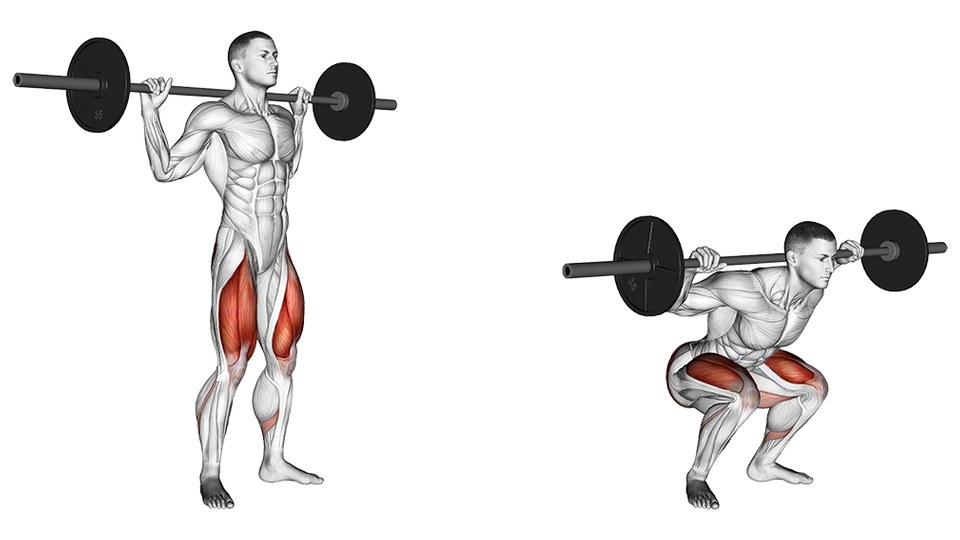
  • Two-frame anatomical illustration of a barbell back squat on a white background. On the left a muscular male figure stands upright, seen square from the front, with a loaded barbell across his upper back and both hands gripping it wide; from the front the bar's height on the back cannot be read. The fronts of both thighs are shaded red, as is a strip down the front of each shin. On the right the same figure is at the bottom of the rep, seen from the side and a little behind, hips at or below the knees in a deep squat with the feet flat and the toes turned out slightly; from this angle the red shading covers the fronts of the thighs and the inner thigh running up toward the groin. The buttock is in view in that frame and is not shaded, and nothing on the back of the thigh is shaded in either.
    SquatUses a straight bar across the upper back.
  • Two anatomical illustrations of a man performing a barbell front squat against a white background. In the left frame he stands upright with a loaded bar resting across the fronts of his shoulders, fingertips under the bar and elbows pointing forward. In the right frame he holds the same front-rack position at the bottom of a deep squat, with his heels down, knees following his slightly turned-out feet and hips below knee height. The quadriceps are highlighted bright red in both frames. The glute area, inner thighs and part of the lower legs are also shaded red in the bottom frame. No squat rack, safety arms or collars are shown.
    Front squatSupports the bar in front of the shoulders.

Frequently asked questions

Does every safety bar feel the same?

No. Handle shape, pad spacing and the position of the loaded sleeves vary. Learn the specific bar with a light load.

Is this a front squat?

No. The padded bar sits across the shoulders and upper back; a front squat supports a straight bar in front of the shoulders.

Track your progress over time with RepCount

Log every set, see plate loading in context, and track your strength over time. Available on iOS and Android.