Barbell back squat
Also called back squat, barbell squat, squat.
What is a barbell back squat?
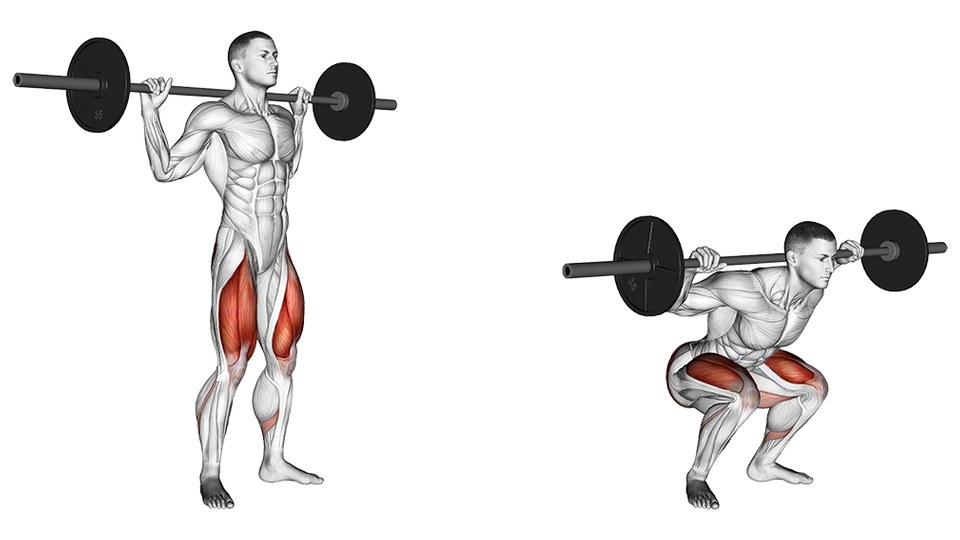
A barbell back squat is a bilateral squat performed with a barbell resting across the upper back. It trains the quadriceps — the three vasti in particular — along with the gluteus maximus and the adductors. The hamstrings also work during the lift, as hip extensors, without being one of the muscles it builds.
How do you perform a barbell back squat?
Set up
- Set the bar around mid-chest height and the safety arms just below your squat depth. Load both sides evenly and secure the plates with collars.
- Get under the bar, rest it on the muscle of your upper back rather than your neck, and use a grip that lets you pull it firmly into place.
- Stand up to unrack, take one or two steps back, then set your feet between hip and shoulder width with the toes turned out naturally.
Execution
- Take a breath, hold it, and brace your midsection before you move.
- Bend your hips and knees together to squat between your feet. Keep your knees in line with your toes and the bar balanced over midfoot.
- Descend under control until your hips are at least level with your knees, stopping before your lower back rounds.
- Drive the floor away to stand, then breathe and reset. After the set, walk the bar into both uprights and check that it is over both hooks before lowering it.
Common mistakes
Knees collapsing inward on the way up
Distinct from the knees travelling forward, which is normal. Barring the knees from passing the toes lowers the torque at the knee and raises it sharply at the hip, so it is a trade rather than a safety measure. Inward collapse is a different thing: the knee leaving the line of the foot under load, usually because the weight is heavier than the hips can control.
Losing the brace at the bottom
The breath is what holds the trunk rigid. Letting it go at the bottom is where the back position is usually lost, which is also where the lift becomes something other than a squat.
Wandering out of the rack
Two steps back and one to even up your stance is a walkout. Anything past that is loaded work that does nothing for the set, and a long walk out can leave you tired before rep one.
Counting the squat as your hamstring work
The hamstrings work during a squat without growing much from it. If you want the back of the thigh trained, programme a hip hinge or a leg curl as well. See the scientific studies ↓
Where it fits in a session
Early in a lower-body session, before machine and isolation work, while you are fresh enough to hold position under load.
The back squat carries more sets per session in our own logs than the machine leg exercises do, which fits how it is usually programmed: a short session with more attention on this one. If the back of the thigh is a goal, programme it separately — a leg curl or a hip-hinge movement — rather than assuming the squat covers it.
Muscles worked
Primary
Secondary
Schematic surface view. Some muscles are partly visible or not shown.
Grouped by what the training evidence measured, not ranked: the MRI trial this page leans on tested each muscle group against its own baseline and never compared one against another, so no ordering is claimed here.
The hamstrings are under secondary because they were measured and did not grow, but they stay on the list because they do work during the lift, as hip extensors. Rectus femoris is there for a different reason: one trial measured no growth and a second did find it, so that one is unsettled rather than settled either way.
The trunk extensors and the calves are absent because neither trial measured them, which is not the same as ruling them out.
What lifters actually do
About two in three regular RepCount users have logged a barbell back squat, and it turns up in just under one workout in ten. What separates it from the machine leg work is the set count: a squat session averages a little over four sets of it, where leg extensions, leg curls and the leg press sit closer to three. Those sessions average a little over six exercises. The company it keeps is that same machine work — leg extensions in more than four of every ten squat sessions, leg curls in about three in ten, then calf raises and the leg press in roughly a quarter each. The one free-weight movement anywhere near the top is the straight-leg deadlift, in about one squat session in nine.
Most often trained alongside
Share of barbell back squat sessions that also include each exercise.
- Leg extensions42.2%
- Leg curls30.9%
- Calf raises25.3%
- Leg press23%
- Straight-leg deadlifts10.8%
Figures come from workouts tracked in RepCount.
What the evidence says
Two MRI training trials measured what a squat actually grows, and both were read in full for this page. Together they speak to the two questions worth asking about the muscles-worked list: whether the squat trains the hamstrings, and whether the adductors belong on it at all.
Kubo, Ikebukuro and Yata (2019) put seventeen untrained young men through ten weeks of squat training, twice a week, split into a full-squat group of eight and a half-squat group of nine, and measured whole-muscle volume by MRI before and after. Knee extensor volume rose 4.9% in the full-squat group and 4.6% in the half-squat group, both significant, with no difference between the groups (p = 0.812). Adductor volume rose 6.2% against 2.7%, and gluteus maximus 6.7% against 2.2%, and for both of those the full-squat group's advantage was significant (p = 0.026 and p = 0.008). The hamstrings did not move. Table 3 lists all four constituents — biceps femoris short head, biceps femoris long head, semitendinosus, semimembranosus — essentially unchanged in both groups, with p values from 0.129 to 0.911. Rectus femoris did not change either.
What that does not mean is that the hamstrings are idle. Three of the four cross both the hip and the knee, so they extend the hip and flex the knee, and a squat asks them to do the first while the second is being reversed. The exception is the short head of biceps femoris, which crosses the knee only. The paper's own explanation, which it takes from earlier work rather than measuring itself, is that hamstring length barely changes through a squat, so they contract close to isometrically. Active, but not stimulated to grow.
The second trial complicates that rather than confirming it. Bloomquist and colleagues (2013) trained seventeen male sports science students — screened to exclude regular squatters and strength-sport athletes, but not otherwise untrained — for twelve weeks, deep squats through 0-120 degrees of knee flexion against shallow squats through 0-60, with MRI cross-sections at nine sites down the thigh. Front-thigh area grew at every measured site in the deep group and at the two most proximal sites in the shallow group. For the back of the thigh it reports an increase at one site, in the DEEP group, and none in the shallow group. Kubo's own discussion summarises it as finding no hamstring change in either group, and that is not what it says. So the honest reading is not that two trials agree the hamstrings never grow. It is that one trial measuring whole-muscle volume found no change anywhere, and another measuring slices found a change at one slice out of nine. Small and localised at most. That reading is ours, from the two papers; neither paper states it.
On depth, these two trials are less contradictory than they look, and neither overturns the common advice to squat to at least parallel. Kubo's shallow condition was 90 degrees of knee flexion, roughly parallel, and against that the extra depth bought no additional quadriceps volume but clearly more adductor and gluteus maximus growth. Bloomquist's shallow condition was 60 degrees, well above parallel, and against that the deeper squat did produce more front-thigh growth. Kubo makes the comparison itself, noting that the shallow arms of the earlier studies went only to 50-60 degrees against its own 90 — though it also puts weight on those studies having measured fewer muscles and fewer slices than it did. Past roughly parallel, what more depth added in these trials showed up at the hip rather than the knee.
Two numbers on this page invite a comparison that nobody tested. Both trials measured each muscle group against its own baseline and against the other training group; neither asked whether the adductors grew more than the quadriceps did, so 6.2% being a larger number than 4.9% is not a finding.
Nor is there an answer on the rectus femoris. Kubo found no change in it. Kojic and colleagues (2022), eighteen untrained university students, nine of them women, seven weeks of parallel back squats measured by ultrasound, found all four quadriceps muscles grew significantly, rectus femoris included, with no significant difference between the four. Different measurement, different population, opposite result. That question is open.
The limits are real. Both training trials ran seventeen participants, both used young men who were not regular squatters, and ten to twelve weeks is a short window. Only Kubo's men were untrained; Bloomquist screened its sports-science students for regular squatting and strength-sport participation rather than for training of any kind. Kubo held stance at about shoulder width and noted it did not standardise how far the toes were turned out, so its findings describe a fairly conventional stance rather than every way a squat can be set up. And neither trial measured the trunk extensors or the calves, so claims about those are untested here in either direction.
Variations
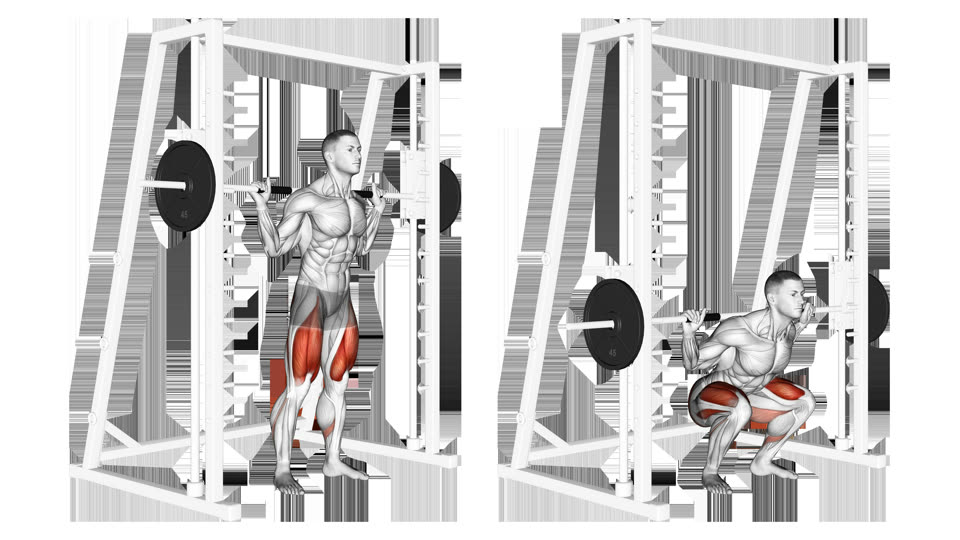
- Smith machine squatSame pattern on a fixed bar path, so balance is removed and the setup is easier to keep identical between sets.
- Low-bar back squat — Bar sits lower on the back and the torso leans further forward. A bar position rather than a different lift.
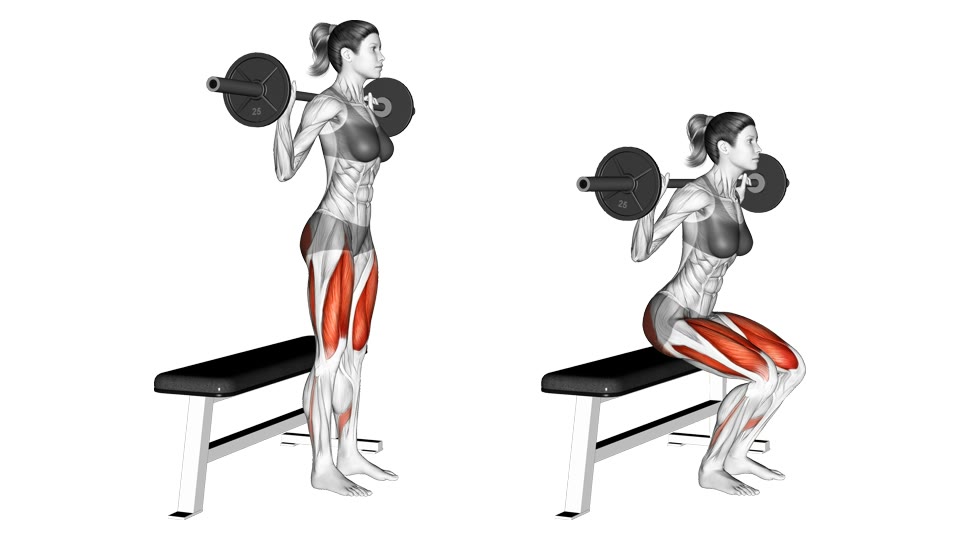
- Pause squatHolds the bottom position for a count before standing, which removes any bounce out of the hole.
Articles
- A two-day full-body workout plan for a busy week
- A 3-day barbell workout plan for beginners
- A five-day PPLUL split with five saved routines
- A four-day upper/lower split with clear progression
- Squat alternatives for gym and home
- Best quad exercises: choose a useful combination
- Hack squat alternatives for gym and home
- Hip thrust alternatives for gym and home
- Leg press alternatives for gym and home
- A 3-day workout split you can set up and follow
Related tools
Frequently asked questions
What muscles does the barbell back squat work?
The quadriceps — chiefly the three vasti — along with the gluteus maximus and the adductors. In the MRI trial that measured all four groups by whole-muscle volume, knee extensor, adductor and gluteus maximus volume all increased over ten weeks of training, while hamstring volume did not change in either training group. That trial did not measure the trunk extensors or the calves, so this page makes no claim about those in either direction.
Do squats work your hamstrings?
They use them without growing them, on the evidence available. Three of the four cross both the hip and the knee, so they act as hip extensors while you stand up out of a squat. But in an MRI trial of ten weeks of squat training, all four hamstring muscles were unchanged in both the full-squat and half-squat groups. A second trial measuring cross-sections at nine points down the thigh found one site that increased, in its deep group only. If the back of your thigh is a goal, the evidence says programme something for it rather than counting the squat.
Do squats work the adductors?
Yes. Adductor volume rose 6.2% over ten weeks of full-depth squat training and 2.7% with half squats, a significant difference between the two. Anatomically this is unsurprising: the adductor magnus has a hamstring portion running from the ischial tuberosity to the femur that extends the thigh rather than only pulling it inward. One caveat the paper states itself — it could not separate adductor magnus from adductor longus and brevis on the scans, so the growth belongs to the group rather than to one muscle.
Does squatting deeper build more muscle?
It depends what you are comparing it with and which muscle you mean. Against a squat to roughly parallel, going deeper added no extra quadriceps volume in the trial that tested it, but it did produce significantly more adductor and gluteus maximus growth. Against a much shallower squat, stopping at 60 degrees of knee flexion, the deeper squat also produced more front-thigh growth. Nothing here argues against squatting until your hips are at least level with your knees. What it refines is what the extra depth past that point appears to buy, which is hip muscle rather than quads.
Do squats grow all four heads of the quadriceps?
The three vasti, yes, consistently. The rectus femoris is genuinely unsettled. One trial measuring muscle volume by MRI found no change in it after ten weeks of squatting at either depth; another, measuring cross-sectional area by ultrasound after seven weeks of parallel squats, found it grew too, with no significant difference between the four. Different methods and different participants, opposite answers, and no honest way to pick one.
Should the bar sit high or low on your back?
That is a preference, not a technique point, and nothing in the evidence read for this page bears on it. A higher bar keeps the torso more upright and a lower one leans it further forward; both are back squats and both are widely used. The same goes for how wide you stand and how far your toes point out. The illustration on this page is drawn square-on, so it does not show a bar position at all, and the stance it shows is not a recommendation.
How do lifters actually program the back squat?
From workouts tracked in RepCount: when it shows up it gets a little over four sets, noticeably more than the machine leg exercises, which sit closer to three. The sessions average a little over six exercises, and the company it keeps is mostly machines — leg extensions in more than four of every ten squat sessions, leg curls in about three in ten, then calf raises and the leg press. That is the shape of a session built around one heavy lift with accessory work after it.
Is a 100 kg squat good?
It depends on your bodyweight, how long you have trained and how deep you squat, and this page has no data on any of those. What is actually answerable is whether the weight is doing its job: whether you can hit your target reps at a consistent depth with the bar over your midfoot, and whether that weight is higher than it was a few months ago.
Sources
- Kubo K, Ikebukuro T, Yata H. Effects of squat training with different depths on lower limb muscle volumes. Eur J Appl Physiol. 2019;119(9):1933-1942. https://doi.org/10.1007/s00421-019-04181-y
- Bloomquist K, Langberg H, Karlsen S, Madsgaard S, Boesen M, Raastad T. Effect of range of motion in heavy load squatting on muscle and tendon adaptations. Eur J Appl Physiol. 2013;113(8):2133-2142. https://doi.org/10.1007/s00421-013-2642-7
- Kojic F, Ranisavljev I, Obradovic M, Mandic D, Pelemis V, Paloc M, Duric S. Does Back Squat Exercise Lead to Regional Hypertrophy among Quadriceps Femoris Muscles? Int J Environ Res Public Health. 2022;19(23):16226. https://pmc.ncbi.nlm.nih.gov/articles/PMC9737272/
- Launico MV, Sinkler MA, Nallamothu SV. Anatomy, Bony Pelvis and Lower Limb: Femoral Muscles. StatPearls. https://www.ncbi.nlm.nih.gov/books/NBK500008/
- Hu Y, Raja A. Anatomy, Bony Pelvis and Lower Limb, Hamstring Muscle. StatPearls. https://www.ncbi.nlm.nih.gov/books/NBK546688/
- Fry AC, Smith JC, Schilling BK. Effect of knee position on hip and knee torques during the barbell squat. J Strength Cond Res. 2003;17(4):629-633. https://pubmed.ncbi.nlm.nih.gov/14636100/
- Illmeier G, Rechberger JS. The Limitations of Anterior Knee Displacement during Different Barbell Squat Techniques: A Comprehensive Review. J Clin Med. 2023;12(8):2955. https://pmc.ncbi.nlm.nih.gov/articles/PMC10143703/
- Elzanie A, Borger J. Anatomy, Bony Pelvis and Lower Limb, Gluteus Maximus Muscle. StatPearls. https://www.ncbi.nlm.nih.gov/books/NBK538193/