Seated leg press
Also called horizontal leg press, seated leg press machine.
What is a seated leg press?
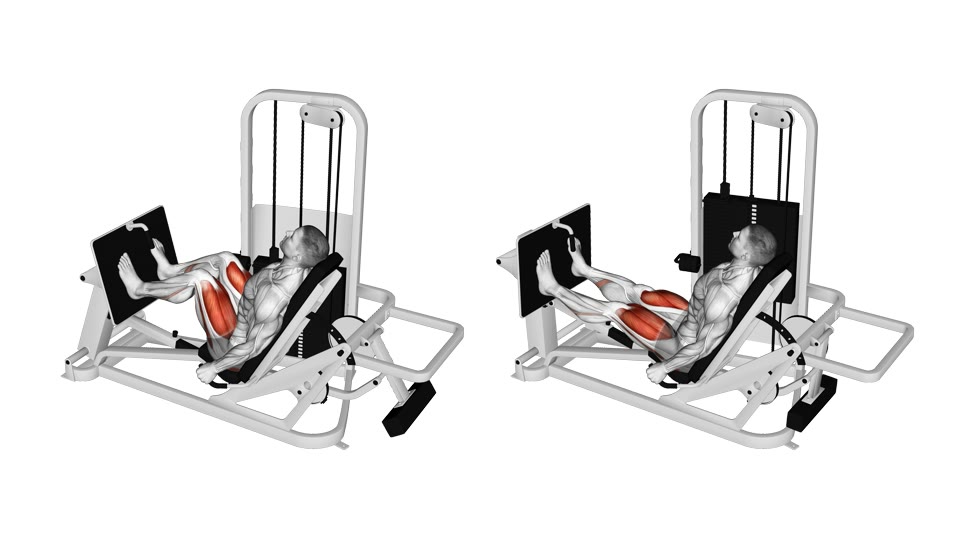
A seated leg press is a machine exercise in which you push a platform away while your back and hips remain supported. It trains the quadriceps, glutes and adductors through combined knee and hip extension.
How do you perform a seated leg press?
Set up
- Adjust the seat so you can begin with bent knees while your back and hips stay fully supported.
- Place both feet flat on the platform around shoulder width, with the knees pointing in the same direction as the toes.
Execution
- Press the platform away by extending the knees and hips while keeping the heels down and the pelvis against the pad.
- Stop with the legs nearly straight without forcing the knees into a hard lock.
- Return under control until you reach a comfortable depth without the pelvis curling away from the backrest.
Common mistakes
Lowering until the pelvis rolls up
Use the deepest range that keeps the back and hips supported rather than forcing a machine-dependent depth.
Letting the knees collapse inward
Keep each knee tracking with its foot throughout the press and return.
Pushing through the toes
Keep the heels in contact so the whole foot remains stable on the platform.
Where it fits in a session
Use it as a main lower-body press or after squats and hinges for additional leg work.
Record the seat and foot settings so depth and load remain comparable.
Muscles worked
Primary
Secondary
Schematic surface view. Some muscles are partly visible or not shown.
The seated press extends the knees and hips against a guided platform; exact contribution changes with the machine, foot position and range.
Variations
- Single-leg seated press — Uses the same machine one leg at a time.
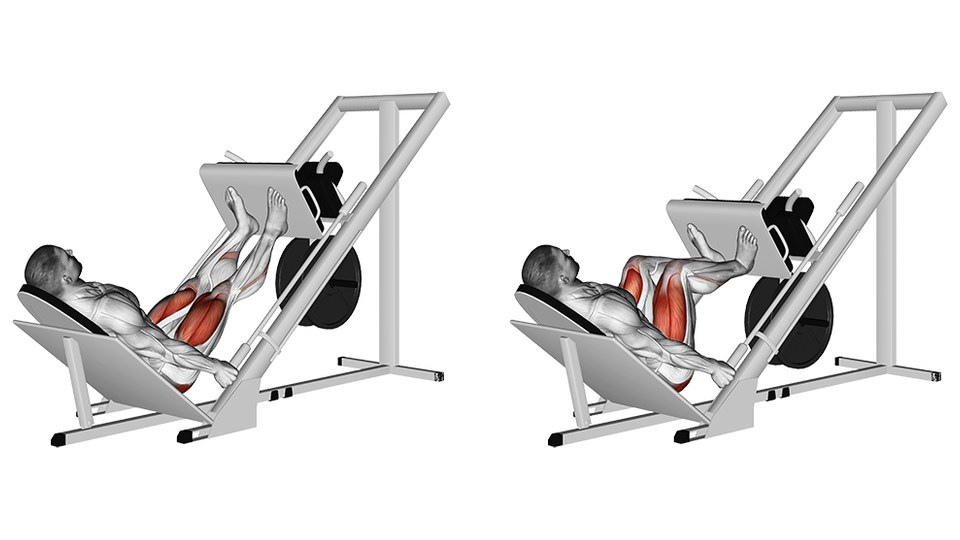
- Vertical leg press — Presses a platform upward while the torso lies beneath it.
Related tools
Frequently asked questions
What muscles does the seated leg press work?
It trains the quadriceps, glutes and adductors as the knees and hips extend. Hamstrings assist and help control the position.
How deep should you go?
Lower until you reach a comfortable depth while the whole foot stays planted and the pelvis remains against the backrest.
Should you lock your knees?
Finish with the legs nearly straight, but do not drive into a forceful hard lock.
Is a seated leg press the same as a 45-degree leg press?
Both are guided knee-and-hip presses, but the machine angle, seat and load path differ enough that lifters usually record them separately.