Leg press
Also called 45 degree leg press, sled leg press, machine leg press.
What is a leg press?
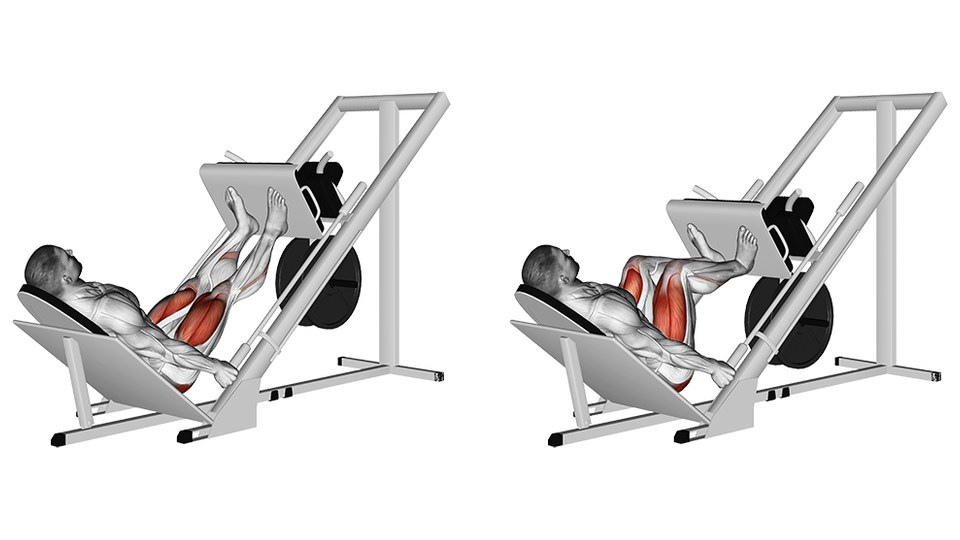
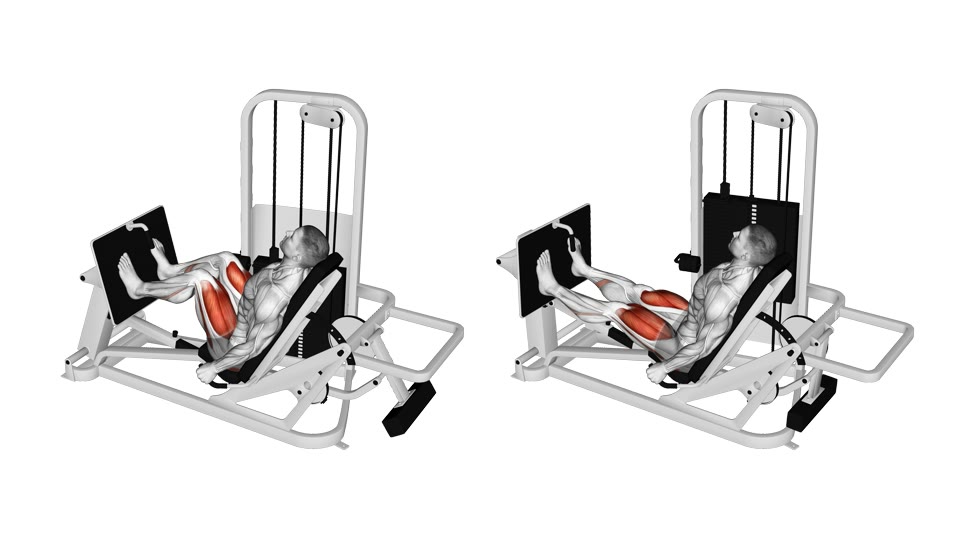
The leg press is a machine exercise in which you push a platform or sled away by extending your hips and knees. It trains the quadriceps together with the gluteus maximus and adductor magnus. The seat supports your torso while your legs move the load.
How do you perform a leg press?
Set up
- Adjust the seat or backrest so you can reach the platform comfortably, then set the safety stops to a depth you can control.
- Sit back with your whole back and hips against the pad.
- Place both feet flat on the platform about hip width apart, with your toes and knees pointing in the same direction.
Execution
- Press the sled away, then release the safety catches while keeping a slight bend in your knees.
- Lower the sled under control and stop before your hips or lower back lift from the pad.
- Push through your whole foot until your legs are almost straight, without forcefully locking your knees.
- After the last rep, keep the sled under control, re-engage the catches, and make sure they are secure before you relax.
Common mistakes
Chasing depth until the pelvis rolls off the pad
Keep your hips and lower back against the pad as you lower the sled. If you must roll your pelvis to go farther, stop earlier. The depth study below did not test pelvic rounding or injury risk. See the scientific studies ↓
Pushing with the heels only, or the toes only
Rolling onto one end of the foot moves the platform contact away from where you can actually brace against it. Push through the whole foot.
Rearranging your feet every set to hit a different muscle
Foot-height, stance-width and toe-angle findings are mixed, and electrical activity is not a growth result. Start with a position that lets you push comfortably with your feet planted and hips against the pad. See the scientific studies ↓
Treating the leg press as a complete quadriceps exercise
Direct comparisons favor knee extensions for rectus femoris growth, while leg presses also train the hips. Knee extensions can complement the press when developing that quadriceps head is a priority. See the scientific studies ↓
Where it fits in a session
Early in a lower-body session, or after a barbell squat as the main machine work.
The supported position makes the leg press useful for lower-body training without the balance demands of a free-standing lift. Knee extensions can complement it when rectus femoris development is a priority.
Muscles worked
Primary
Secondary
Schematic surface view. Some muscles are partly visible or not shown.
The three vasti, gluteus maximus and adductor magnus grew in the MRI trial discussed below. The rectus femoris responded less than it did to knee extensions; that does not establish zero growth from every leg press programme. Hamstring gains were modest in that trial. The soleus is listed for its role in holding the ankle against the platform, based on anatomy rather than a calf-growth measurement. These findings come from specific protocols and are not a ranking of every machine or stance.
What lifters actually do
About seven in ten regular RepCount users have logged a leg press at some point, and it appears in roughly one workout in twelve. When it shows up it is part of a full lower-body session of about six exercises, usually for three or four sets, and it is rarely the whole of what is being trained: leg extensions appear in more than half of leg press sessions, leg curls in about two in five, and calf raises and squats in roughly a quarter each. The pattern in the logs is that lifters treat the leg press as one machine among several on a leg day rather than as the session's main lift.
Most often trained alongside
Share of leg press sessions that also include each exercise.
- Leg extension57.6%
- Leg curl40.3%
- Calf raise27.4%
- Squat25.3%
- Seated calf raise13.7%
Figures come from workouts tracked in RepCount.
Scientific studies on the leg press
The leg press can grow the thighs and hips, but its effects differ between muscles. Training studies help answer which muscles grow and whether extra depth helps; studies of electrical muscle activity give a more limited picture of foot placement.
Leg presses and knee extensions can complement each other: knee extensions have produced more rectus femoris growth in direct comparisons, while the leg press also trains the hips. The research does not establish one foot position or maximum depth as best for everyone.
Does the leg press grow all four quadriceps heads equally?
The clearest difference is the rectus femoris, the quadriceps head that crosses both the hip and knee. In a 12-week study of 17 untrained adults, its volume increased by 13.2% after knee extensions and 1.1% after leg presses. The smaller change was not statistically clear, which does not prove that leg pressing produces no growth.
The other three heads, collectively called the vasti, grew after both exercises without a clear difference between them. A separate eight-week study of 30 trained participants also favored knee extensions for rectus femoris growth. However, its vastus lateralis results favored the leg press. The exercises therefore have overlapping benefits without being interchangeable.
Adding knee extensions is a reasonable way to give the rectus femoris more direct work. These trials do not show that everyone needs both exercises or establish the ideal combination of sets.
Study details: two direct comparisons
Kinoshita and colleagues assigned one leg to knee extensions and the other to leg presses. Participants trained twice weekly for 12 weeks, with five sets of ten and progressively adjusted loads. MRI measured whole-muscle volume. The press used a horizontal seated machine with knee movement from 90 degrees of flexion to straight; the exact findings need not transfer to every sled or depth.
Burke and colleagues studied trained participants for eight weeks and measured regional hypertrophy. We read its complete publisher abstract, not the full methods or tables, so do not quote percentage gains from secondary accounts. Ema’s separate acute experiments found lower rectus femoris electrical activity during leg pressing than knee extensions; that helps explain the comparison but is not itself a growth measurement.
What about the glutes, adductors and hamstrings?
In Kinoshita’s trial, leg pressing increased gluteus maximus volume by 15.4% and adductor magnus volume by 6.2%, with greater gains than knee extensions. Both muscles help extend the hip, which the leg press requires as you push the platform away.
Hamstring growth was smaller: 3.1% after leg pressing and 1.5% after knee extensions, without a statistically clear difference between exercises. That is a reason to keep expectations for hamstring development modest, rather than to say the hamstrings do nothing.
These are results from one small trial in beginners on a particular machine. They describe what happened in that programme, not the growth you should expect personally.
Sources
Can foot placement target a particular muscle?
Changing foot height, width and toe angle are different comparisons, and the electrical-activity studies do not give them one consistent answer. In 14 women, Da Silva found greater quadriceps activity with lower feet and greater gluteus maximus activity with higher feet at the heavier tested load. In another study of ten trained women, changing stance width or toe angle produced no clear quadriceps difference.
Electrical activity during a set is not a measurement of muscle gained over months. These findings do not establish a reliable foot-placement rule for growth. A comfortable position that lets you keep your feet planted and hips against the pad remains a practical starting point.
Study details: different variables and incomplete evidence
Da Silva’s comparison used loads of 40% and 80% of one-rep maximum; the complete abstract was read. Martín-Fuentes tested foot rotation and stance width at a fixed mid-platform height. Its ten-person study found a gluteus medius difference between straight and turned-out feet at maximum intended speed, even though the quadriceps comparisons were not statistically clear. A later study by the same group also reported no clear stance-width or rotation effect.
The 2020 systematic review found substantial variation between methods and results. Searches also located a five-person preliminary foot-height growth report, so claiming nobody has studied growth would be incorrect. Its full publication format and methods were not verified here, and it does not support a prescription in this guide.
Does going deeper build more quadriceps?
One eight-week trial found similar quadriceps thickness gains when trained lifters used about 100 degrees of knee flexion or their deepest individual range. Both ranges included substantial knee bending; this was not a comparison of shallow repetitions against full ones.
The result does not establish that depth never matters, or that either range is safer. Use a depth you can control while keeping your hips and lower back against the pad. That remains a coaching limit rather than a safety conclusion tested by this growth study.
Study details: the actual ranges compared
Larsen and colleagues studied 23 resistance-trained participants, with each person training one leg in each range. The comparison was approximately 5–100 degrees versus 5–154 degrees of knee flexion on average. Participants performed four sets to failure twice weekly for eight weeks. Ultrasound measured thickness at several thigh sites.
The Bayesian analyses supported similar gains between the tested ranges over this period. We read the complete abstract; the full-text publisher link returned 403. The abstract does not provide evidence about injuries or long-term differences.
Variations
- Single-leg pressOne leg at a time on the same machine, which stops the stronger side carrying the set.
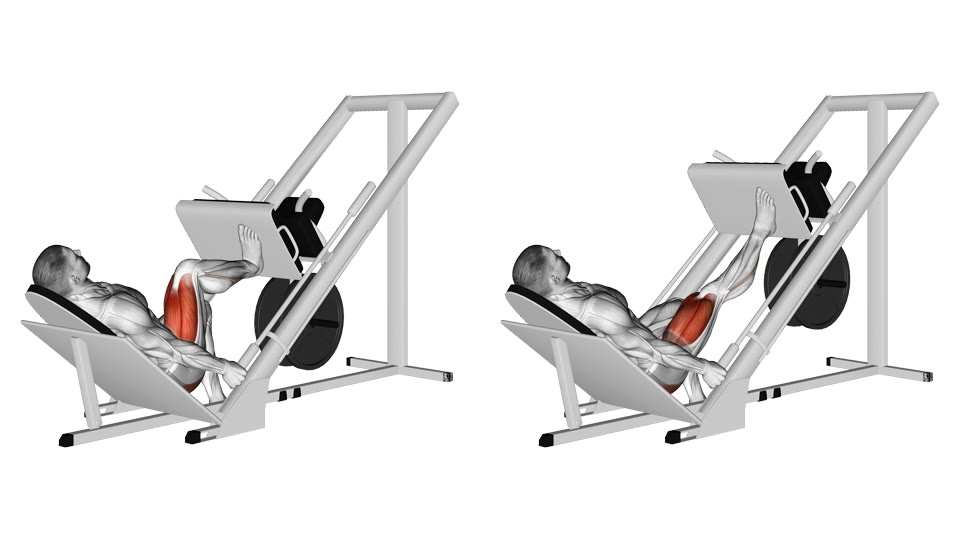
- Linear leg press — Sled runs on a straight horizontal track instead of an angled one.
- Horizontal leg press — Same horizontal push, named after the machine's travel rather than its seat.
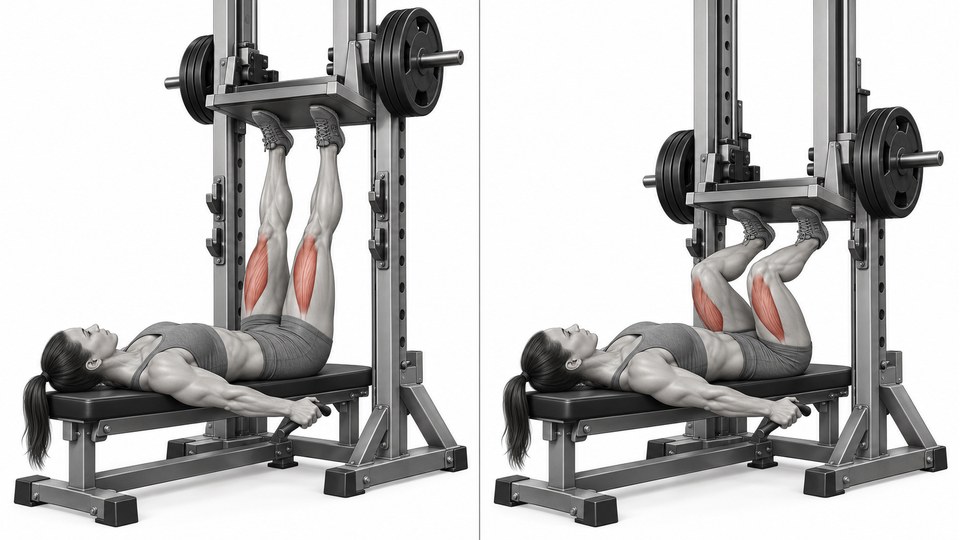
- Vertical leg pressLying on your back pressing the platform straight upward. A different machine, not a foot-position change.
Exercise alternatives
Choose a leg press replacement that fits your equipment and your workout, with clear tradeoffs for machine squats, free weights, and single-leg exercises.
Use free weights
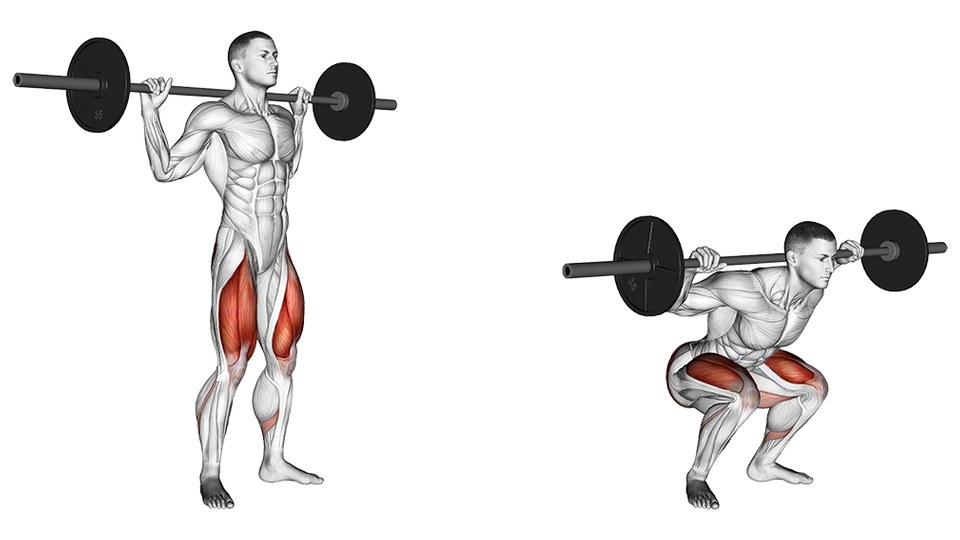
Barbell back squat
Barbell and rack
You support and balance the load yourself.
Keep a guided movement
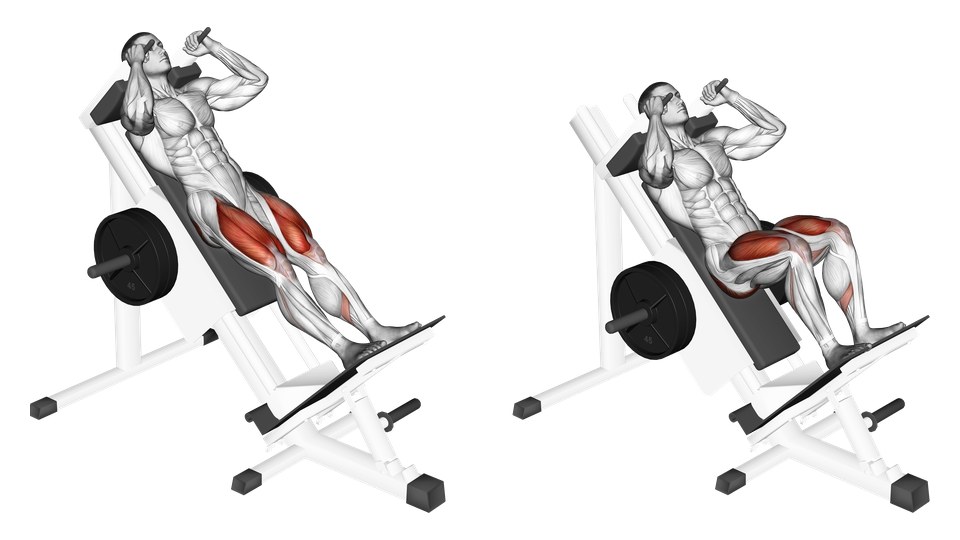
Hack squat
Back support
A padded sled, with the load at your shoulders.
Use free weights
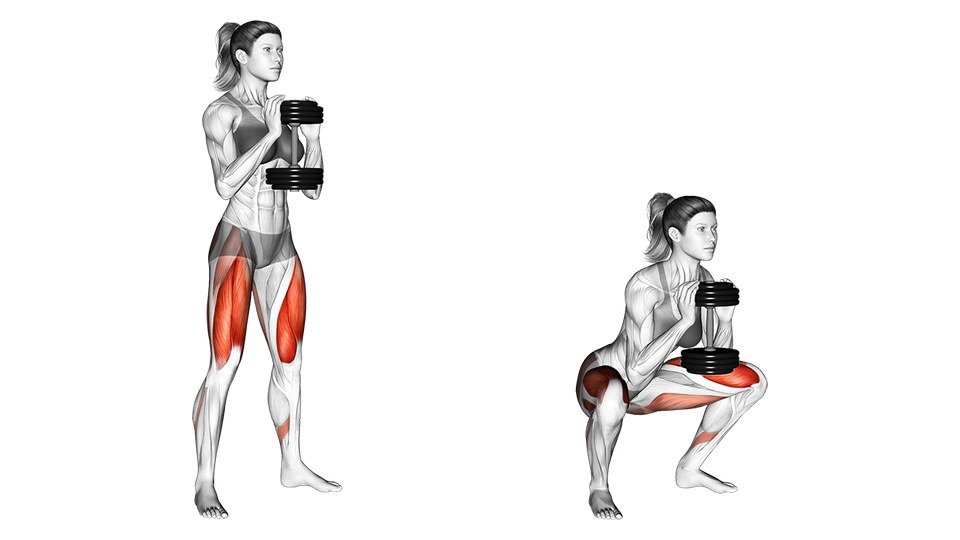
Goblet squat
One dumbbell
Simple setup; your grip may limit the load.
Train one side at a time
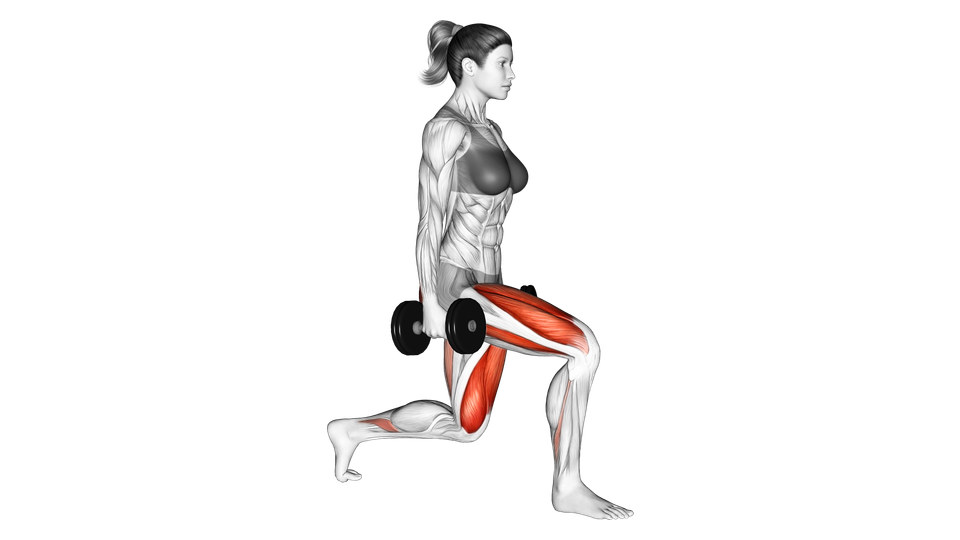
Dumbbell split squat
Both feet on the floor
An option when your dumbbells are light for squats.
Articles
- A two-day full-body workout plan for a busy week
- A five-day PPLUL split with five saved routines
- A four-day upper/lower split with clear progression
- Squat alternatives for gym and home
- Best quad exercises: choose a useful combination
- Hack squat alternatives for gym and home
- Leg extension alternatives: what can replace it?
- A 3-day workout split you can set up and follow
Related tools
Frequently asked questions
What muscles does the leg press work?
The quadriceps, gluteus maximus and adductor magnus are the main muscles listed here. The rectus femoris has responded less than the other quadriceps heads in a direct comparison with knee extensions, and hamstring gains were modest. The soleus helps hold the ankle against the platform; the growth trial did not measure the calf muscles.
Does the leg press work the rectus femoris?
It is involved, but knee extensions have produced more growth in direct comparisons. One small trial in beginners found a 1.1% change after leg pressing that was not statistically clear, compared with 13.2% after knee extensions. This does not prove that leg presses can never grow the rectus femoris.
Do I still need leg extensions if I do leg presses?
They can complement each other, particularly if rectus femoris development is a priority. Two direct comparisons favored knee extensions for that muscle, while the leg press also trains the hips. Neither trial establishes that everyone needs both or how best to divide training volume between them.
Does foot placement on the leg press change which muscles you work?
It can change the movement, but activity findings differ by the specific comparison. One study favored lower feet for quadriceps activity and higher feet for gluteus maximus activity. Others found no clear quadriceps difference when changing width or toe angle. Those are not all tests of the same variable, and activity does not establish a growth advantage. Choose a position you can control comfortably.
How far down should you go on the leg press?
Lower as far as you can control while keeping your hips and lower back against the pad. One eight-week study found similar quadriceps gains at about 100 degrees of knee flexion and at a deeper individual range. It did not compare very shallow repetitions, test pelvic rounding, or measure injuries.
Does the leg press work your hamstrings?
The hamstrings can contribute, but growth was modest in the MRI trial discussed here: 3.1% after leg pressing, without a clear advantage over knee extensions. This does not establish zero benefit, but it gives little reason to treat the leg press as your main hamstring exercise.
Should you lock your knees out at the top of a leg press?
Follow the instruction to finish with the legs almost straight without forcefully locking the knees. The biomechanical study cited here estimated knee forces during different squat and leg-press techniques; it did not test whether locking out causes injuries. Its force estimates cannot settle that safety question.
Is the leg press as good as squats?
They are different ways to train the lower body. The cited biomechanical comparison measured muscle activity and knee forces, not muscle growth over a programme, so it cannot rank them for hypertrophy. Choose according to the movement you want to practise, the equipment available and the rest of your training.
Is the leg press worth doing?
It can train several large thigh and hip muscles in a supported position. Whether it earns a place depends on your goals and the other exercises in your programme. If rectus femoris or hamstring development is a priority, the studies here suggest considering complementary exercises.
Sources
- Kinoshita M, Maeo S, Kobayashi Y, et al. Hypertrophic Effects of Single- versus Multi-Joint Exercise: A Direct Comparison between Knee Extension and Leg Press. Med Sci Sports Exerc. 2026;58(7):1566-1580. https://pmc.ncbi.nlm.nih.gov/articles/PMC13215645/
- Ema R, Sakaguchi M, Akagi R, Kawakami Y. Unique activation of the quadriceps femoris during single- and multi-joint exercises. Eur J Appl Physiol. 2016. https://pubmed.ncbi.nlm.nih.gov/27032805/
- Martín-Fuentes I, Oliva-Lozano JM, Muyor JM. Evaluation of the Lower Limb Muscles' Electromyographic Activity during the Leg Press Exercise and Its Variants: A Systematic Review. Int J Environ Res Public Health. 2020. https://pmc.ncbi.nlm.nih.gov/articles/PMC7369968/
- Martín-Fuentes I, Oliva-Lozano JM, Muyor JM. Influence of Feet Position and Execution Velocity on Muscle Activation and Kinematic Parameters During the Inclined Leg Press Exercise. Sports Health. 2022. https://pmc.ncbi.nlm.nih.gov/articles/PMC9112713/
- Martín-Fuentes I, Oliva-Lozano JM, Muyor JM. Muscle Activation and Kinematic Analysis during the Inclined Leg Press Exercise in Young Females. Int J Environ Res Public Health. 2020. https://pmc.ncbi.nlm.nih.gov/articles/PMC7700405/
- Escamilla RF, Fleisig GS, Zheng N, et al. Effects of technique variations on knee biomechanics during the squat and leg press. Med Sci Sports Exerc. 2001. https://pubmed.ncbi.nlm.nih.gov/11528346/
- Da Silva EM, Brentano MA, Cadore EL, De Almeida AP, Kruel LF. Analysis of muscle activation during different leg press exercises at submaximum effort levels. J Strength Cond Res. 2008. https://pubmed.ncbi.nlm.nih.gov/18545207/
- Larsen S, Wolf M, Schoenfeld BJ, et al. Knee flexion range of motion does not influence muscle hypertrophy of the quadriceps femoris during leg press training in resistance-trained individuals. J Sports Sci. 2025. https://pubmed.ncbi.nlm.nih.gov/40113586/
- Kojic F, Ranisavljev I, Obradovic M, et al. Does Back Squat Exercise Lead to Regional Hypertrophy among Quadriceps Femoris Muscles? Int J Environ Res Public Health. 2022. https://pmc.ncbi.nlm.nih.gov/articles/PMC9737272/
- Bordoni B, Varacallo MA. Anatomy, Bony Pelvis and Lower Limb: Thigh Quadriceps Muscle. StatPearls. https://www.ncbi.nlm.nih.gov/books/NBK513334/
- Elzanie A, Borger J. Anatomy, Bony Pelvis and Lower Limb, Gluteus Maximus Muscle. StatPearls. https://www.ncbi.nlm.nih.gov/books/NBK538193/
- Jeno SH, Launico MV, Schindler GS. Anatomy, Bony Pelvis and Lower Limb: Thigh Adductor Magnus Muscle. StatPearls. https://www.ncbi.nlm.nih.gov/books/NBK534842/
- Hu Y, Raja A. Anatomy, Bony Pelvis and Lower Limb, Hamstring Muscle. StatPearls. https://www.ncbi.nlm.nih.gov/books/NBK546688/
- Binstead JT, Varacallo MA. Anatomy, Bony Pelvis and Lower Limb: Calf. StatPearls. https://www.ncbi.nlm.nih.gov/books/NBK459362/
- Burke R, Piñero A, Mohan AE, et al. Exercise Selection Differentially Influences Lower Body Regional Muscle Development. J Sci Sport Exerc. Online 2024;7:449–459 (2025). https://link.springer.com/article/10.1007/s42978-024-00299-4