Shrugs
Also called barbell shrug, barbell shrugs, shrug.
What is a shrugs?
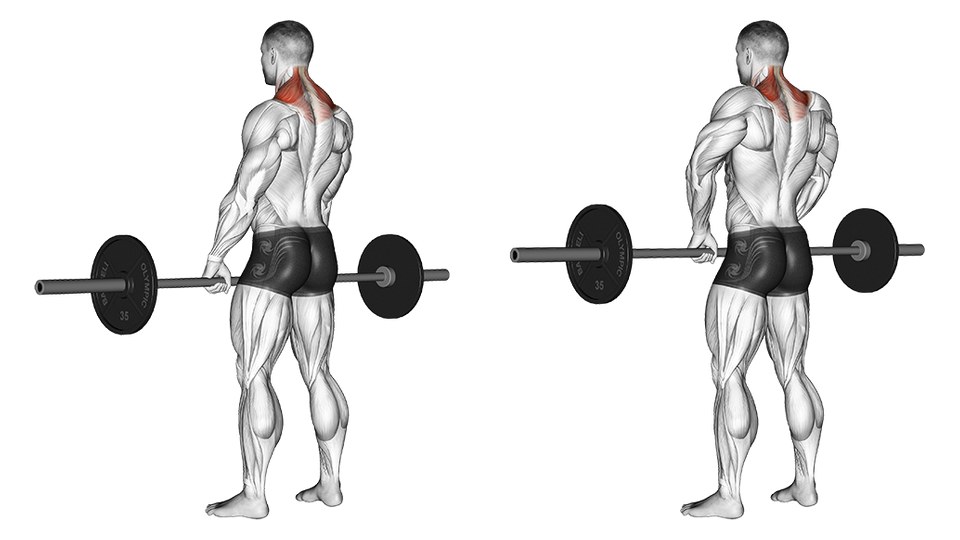
Barbell shrugs train shoulder-blade elevation. Hold a bar in front of your thighs with straight arms, raise your shoulders toward your ears and lower them under control; the upper trapezius is the main target.
How do you perform a shrugs?
Set up
- Stand tall with your feet about hip width and hold the bar in front of your thighs with an overhand grip.
- Straighten your arms, brace your torso and let your shoulders settle without rounding forward.
Execution
- Raise both shoulders straight up as high as you can without bending your elbows or moving your head forward.
- Pause briefly at the top without rolling the shoulders.
- Lower the shoulders under control to the starting position, keeping the bar close to your body.
Common mistakes
Rolling the shoulders
The loaded job is elevation. Circling the shoulders adds motion without improving the top position.
Bending the elbows
Curling the bar shortens the shrug and shifts effort toward the arm flexors. Let the hands act as hooks.
Bouncing through the bottom
Leg or torso momentum moves the bar before the shoulder blades do. Lower fully and start each rep from a still position.
Where it fits in a session
Use shrugs after heavier pulling or as direct trapezius work near the end of an upper-body session.
Use the same grip and pause standard each time so added load does not quietly replace range.
Muscles worked
Primary
Secondary
Schematic surface view. Some muscles are partly visible or not shown.
The upper trapezius and levator scapulae elevate the shoulder blades. The forearm flexors hold the bar rather than raising the shoulders.
Variations
- Dumbbell shrug — Holds one dumbbell at each side, so the weights do not pass in front of the thighs.
- Trap-bar shrug — Uses neutral handles beside the body inside a trap bar.
- Cable shrug — Uses a low cable instead of a free bar.
Related tools
Frequently asked questions
What muscles do barbell shrugs work?
The upper trapezius is the main target and the levator scapulae assists shoulder-blade elevation. The forearms work to hold the bar.
Should you roll your shoulders during shrugs?
No. Raise the shoulders straight up and lower them on the same path. Rolling does not add useful resistance to the elevation you are training.
How high should you shrug?
Raise your shoulders as high as you can while your elbows stay straight, your head stays stacked and your torso does not bounce.
Do you need straps for shrugs?
Not always. If your grip ends the set before your shoulders do, straps are an option; keep your setup consistent when comparing logged loads.
Sources
- Ourieff J, Scheckel B, Agarwal A. Anatomy, Back, Trapezius. StatPearls. https://www.ncbi.nlm.nih.gov/books/NBK518994/