
Side-lying hip adduction
Also called side lying hip adduction, lying hip adduction, side-lying inner-thigh raise.
What is side-lying hip adduction?
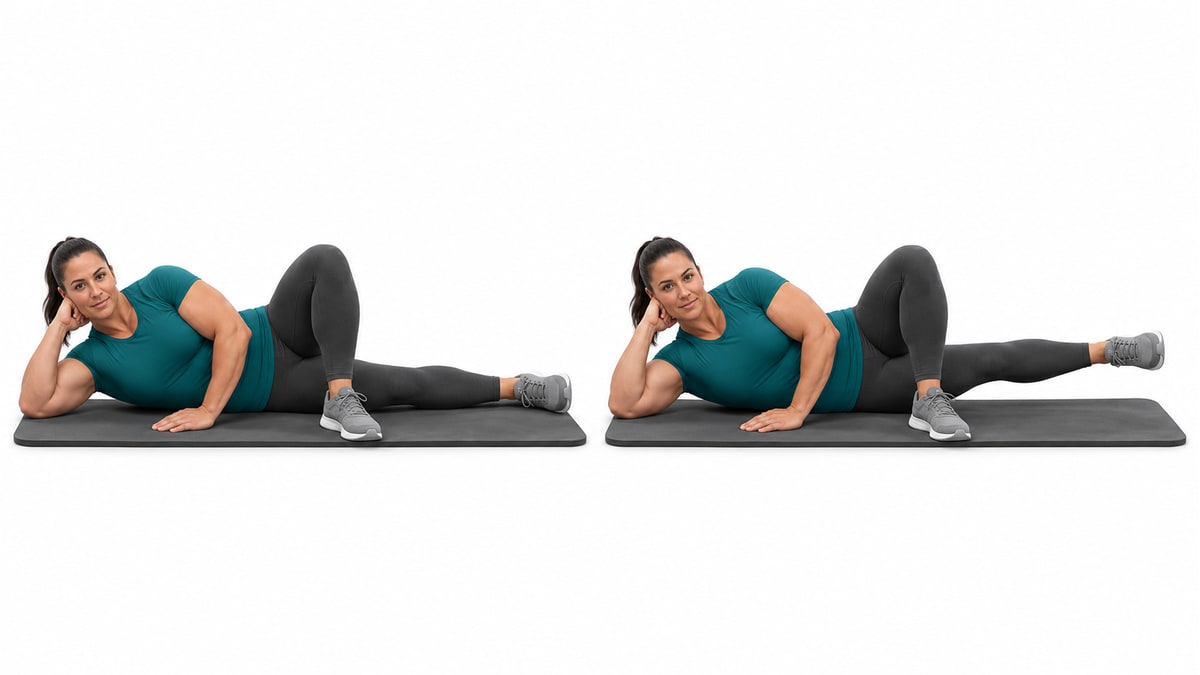
Side-lying hip adduction is a bodyweight inner-thigh exercise in which you lie on one side and raise the bottom leg. The upper foot rests on the floor in front of you, leaving the lower leg free to move while your torso and pelvis stay on the floor.
How to do side-lying hip adduction
Set up
- Lie on your side on a mat, with your head supported by your lower arm and your shoulders and hips stacked.
- Bend your upper knee and plant that foot on the floor in front of your lower knee. Keep the bottom leg straight, in line with your torso, with its kneecap facing forward.
Execution
- Keep the upper foot planted and lift the straight bottom leg a short distance from the mat. Leave your hips resting on the floor.
- Stop the lift before your pelvis rolls or your waist bends to raise the foot farther.
- Lower the leg gently to the mat and repeat without swinging it forward or back.
- After your reps, rest the lower leg on the mat and uncross the upper leg. Roll onto your other side, rebuild the setup and repeat with the new bottom leg.
Common mistakes
Raising the upper leg
That changes the movement to hip abduction. Here the leg nearest the mat lifts, while the upper foot stays planted in front.
Rolling backward to lift higher
The foot can travel farther because your whole body has moved. Shorten the lift until your shoulders and hips keep their side-on position.
Leaving the upper leg across the lifting path
The bottom leg needs space to rise. Reposition the upper foot in front of the lower knee before starting the next rep.
Where it fits in a session
Use it as direct inner-thigh work in a lower-body session.
Count reps for each leg separately. Keep the upper-foot position and the controlled lifting range consistent between sets.
Muscles worked
Primary
Secondary
- None listed in this guide
Schematic surface view. Some muscles are partly visible or not shown.
The inner-thigh adductors lift the lower leg toward the body's midline. The target is the group, not one singled-out adductor.
Variations
- Hip adduction machineA seated machine resists bringing both thighs together instead of lifting one leg from the floor.
- Standing cable hip adductionAn ankle cable resists the inward movement of one leg while you stand on the other.
Frequently asked questions
Which leg moves in side-lying hip adduction?
The bottom leg moves. Bend the upper knee and put that foot on the floor in front of your lower knee, then lift the straight lower leg. Lifting the upper leg away from the lower one is side-lying hip abduction.
What muscles does side-lying hip adduction work?
It works the inner-thigh adductors, including adductor longus, adductor brevis, adductor magnus, gracilis and pectineus. These muscles bring the thigh inward at the hip; the guide does not rank their contribution.
How high should I lift the lower leg?
Use a small lift that you can reverse smoothly while the pelvis stays still. Getting the foot clear of the mat is enough to perform the movement. Raising it farther by rolling your body or hiking the hip changes the setup.
Where should the upper leg go?
For this version, bend the upper knee and put that foot on the floor ahead of your lower knee. Move it far enough forward that it does not obstruct the straight leg's lift, while keeping your hips stacked.
Is this the same as a Copenhagen plank?
No. In this exercise your torso and pelvis rest on the floor while the bottom leg lifts. A Copenhagen plank supports the upper leg on a bench and holds the body above the floor. Use the setup for the exercise you are doing, and record the two as different exercises in your training log.
Sources
- Launico MV, Sinkler MA, Nallamothu SV. Anatomy, Bony Pelvis and Lower Limb: Femoral Muscles. StatPearls. Updated 2023 Oct 24. https://www.ncbi.nlm.nih.gov/books/NBK500008/