Side plank
Also called side bridge, forearm side plank.
What is a side plank?
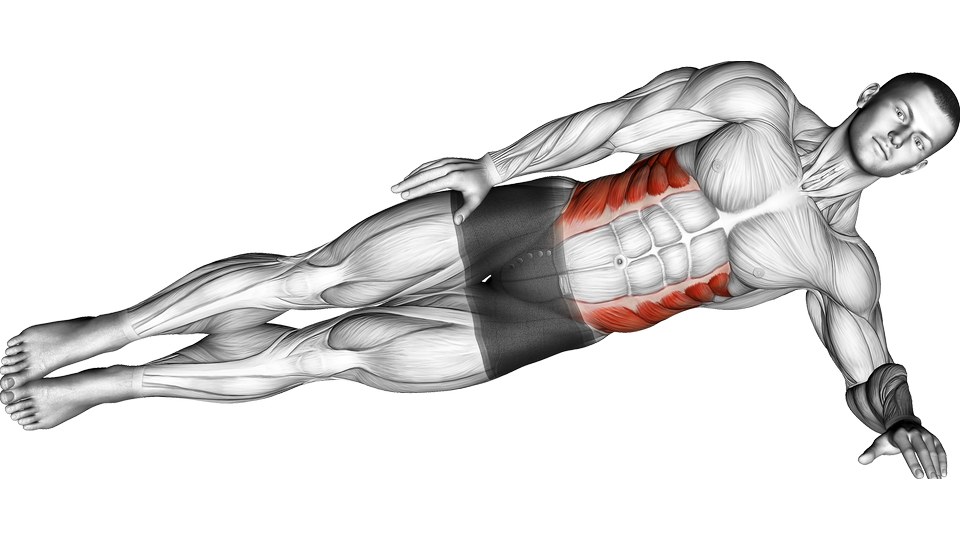
A side plank is a bodyweight hold performed on one forearm and the side of one foot. The obliques resist sideways bending while you keep your shoulders, hips, knees and ankles in one line.
How do you perform a side plank?
Set up
- Lie on one side with your legs straight and your feet stacked.
- Place your lower elbow under your shoulder and rest your forearm on the floor.
- Brace your midsection and keep your head in line with your spine.
Execution
- Press through your forearm and the edge of your lower foot to lift your hips from the floor.
- Hold a straight line from your head through your hips to your ankles without rotating forward or back.
- Lower under control, then repeat for the same duration on the other side.
Common mistakes
Letting the hips sag
A dropped hip shortens the hold and turns a straight-body position into a bent one.
Rolling the chest toward the floor
Rotation changes the task from resisting sideways bending to balancing in a twisted position.
Shrugging into the supporting shoulder
Actively pressing the floor away creates a steadier shoulder position for the hold.
Where it fits in a session
Core work near the end of a session or between exercises that do not tax the trunk heavily.
Choose a duration you can hold with the hips level and repeat evenly on both sides. Shorten the lever by using the lower knee when full-length holds lose position.
Muscles worked
Primary
Secondary
Schematic surface view. Some muscles are partly visible or not shown.
The obliques hold the trunk against sideways bending while the rest of the midsection helps keep the body rigid.
Variations
- Kneeling side plank — Uses the lower knee as the bottom support to shorten the lever.
- Side plank with leg raise — Adds a controlled lift of the upper leg while the trunk stays still.
- High side plank — Uses a straight supporting arm instead of the forearm.

Frequently asked questions
What muscles does a side plank work?
It mainly trains the internal and external obliques to resist sideways bending. The rectus abdominis and other trunk muscles help keep the torso rigid.
Should my elbow be directly under my shoulder?
Yes. Starting with the elbow under the shoulder keeps the supporting forearm close to vertical and gives you a repeatable setup.
Should I stack or stagger my feet?
The illustration shows stacked feet. Staggering them is a reasonable way to widen the base if balance, rather than trunk strength, ends the hold.
How long should I hold a side plank?
Long enough to challenge the position without letting the hips drop or the chest rotate. End the set when you can no longer keep the same body line, and use that clean duration to track progress.
Why do side planks on both sides?
Each side works separately. Matching the setup and intended duration gives both sides the same training opportunity without assuming they must perform identically.