
Dumbbell side bend
Also called dumbbell side bends.
What is a dumbbell side bend?
A dumbbell side bend is a standing exercise that moves your trunk sideways while you hold one dumbbell at your side. It trains the obliques. This guide shows a bend away from the weighted hand, followed by a controlled return to upright.
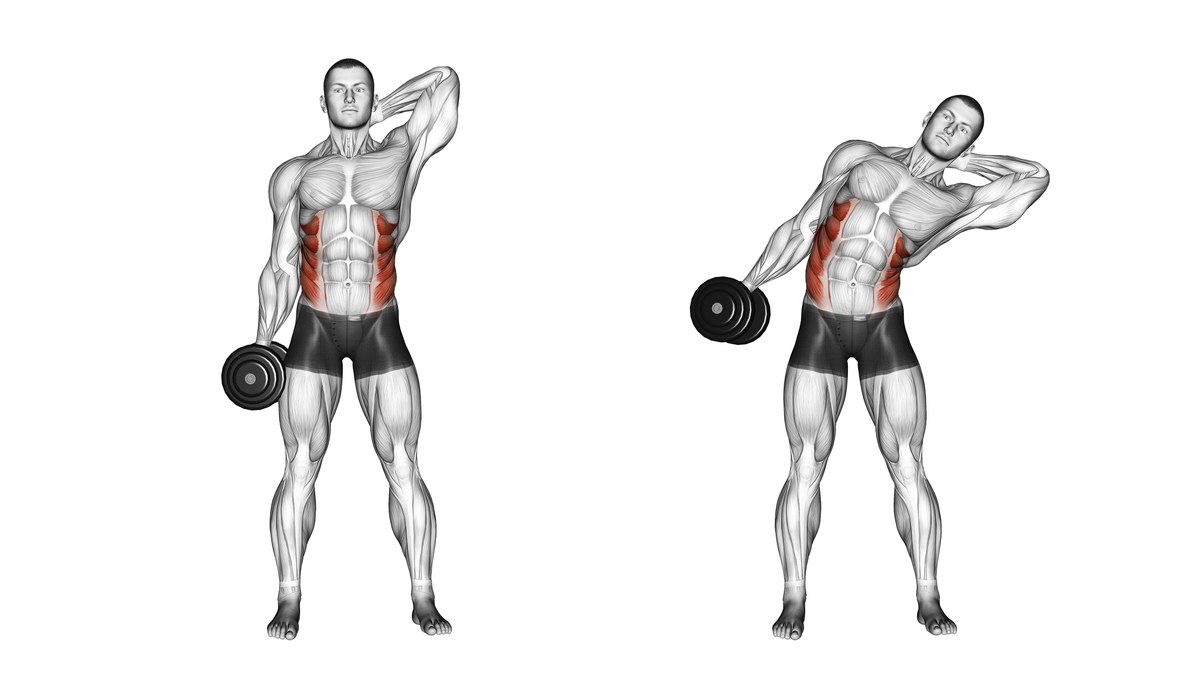
How do you perform a dumbbell side bend?
Set up
- Take a light dumbbell in your right hand and stand with your feet about shoulder-width apart. Let the weight hang beside your right thigh with that arm straight.
- Rest your left fingertips lightly behind your head without pulling on it. Brace your middle and start with your chest over your hips.
Execution
- Bend your trunk to the left, away from the dumbbell, keeping your chest facing forward and your hips over your feet.
- Stop at a comfortable sideways bend while the weighted arm stays long and both feet stay planted.
- Return slowly to upright as the dumbbell lowers beside your right thigh. Pause there instead of swinging through to the right.
- Finish the planned reps and set the dumbbell down under control. Repeat with the weight in your left hand, bending to the right.
Common mistakes
Rocking the whole body sideways
If your hips slide far to one side or a foot lifts, make the bend smaller and reduce the load until you can stay planted.
Dropping back to the starting position
Keep the return as deliberate as the bend. A weight you cannot lower steadily is too heavy for this version.
Pulling the head with the free hand
Keep that hand light. Rest it on your hip instead if you find yourself tugging your neck.
Where it fits in a session
Use it as an accessory when your session calls for loaded sideways trunk movement.
Start with a weight and range you can repeat without rocking or dropping back to upright. Use the same load and planned reps with each hand. Once those reps stay controlled, add a small amount of weight rather than chasing a deeper bend. Record the dumbbell's weight and reps per side.
Muscles worked
Primary
Secondary
- None listed in this guide
Schematic surface view. Some muscles are partly visible or not shown.
The obliques contribute to sideways bending of the trunk, also called lateral flexion. They form part of the abdominal wall.
Variations
- Smaller-range dumbbell side bend — Use a lighter weight and a shallower bend while learning the movement. Keep the same controlled return to upright.
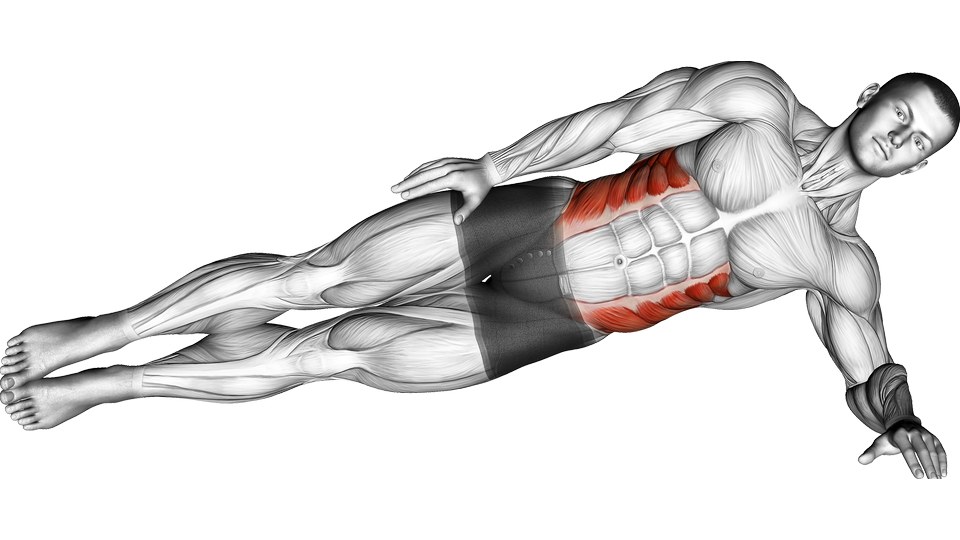
- Side plankA bodyweight alternative that holds the trunk still on one forearm and the side of a foot.
- Suitcase carryWalk upright with one dumbbell at your side instead of deliberately bending the trunk. Keep it as a separate exercise in your log.
Frequently asked questions
Which way do I bend when the dumbbell is in my right hand?
In the version shown here, bend left, away from the weight, then return to upright. Switch the weight to your left hand and bend right for the other side.
What muscles does a dumbbell side bend work?
The internal and external obliques at the sides of your abdomen contribute to the sideways trunk movement. This is not a way to isolate just one of them.
Does my free hand have to go behind my head?
No. That is the position in the illustration and video. You can rest the free hand on your hip instead; keep it there throughout the set and avoid pulling on your head.
How far should I bend?
Use a range you can reverse smoothly while both feet stay planted and your chest keeps facing forward. You do not need to reach the dumbbell toward the floor. Start smaller if you lose that control.
Why does the demonstration stop at upright?
It shows one way to do the exercise: bend away from the weight, then return to the starting stance. Other versions bend toward the weighted hand or move across upright. Keep your chosen range consistent when comparing sets.
Should I hold a dumbbell in each hand?
Use one for this guide. Finish a set with it in one hand, then swap hands. Holding two weights is a different loading setup from the demonstration.
How is this different from a side plank?
A dumbbell side bend moves the trunk sideways while you stand. A side plank is a hold with your body supported on one forearm and the side of a foot. Track the moving reps and the hold separately.
Sources
- OpenStax. Anatomy and Physiology 2e, section 11.4: Axial muscles of the abdominal wall, and thorax. https://openstax.org/books/anatomy-and-physiology-2e/pages/11-4-axial-muscles-of-the-abdominal-wall-and-thorax