
Single-arm cable chest press
Also called one-arm cable chest press.
What is a single-arm cable chest press?
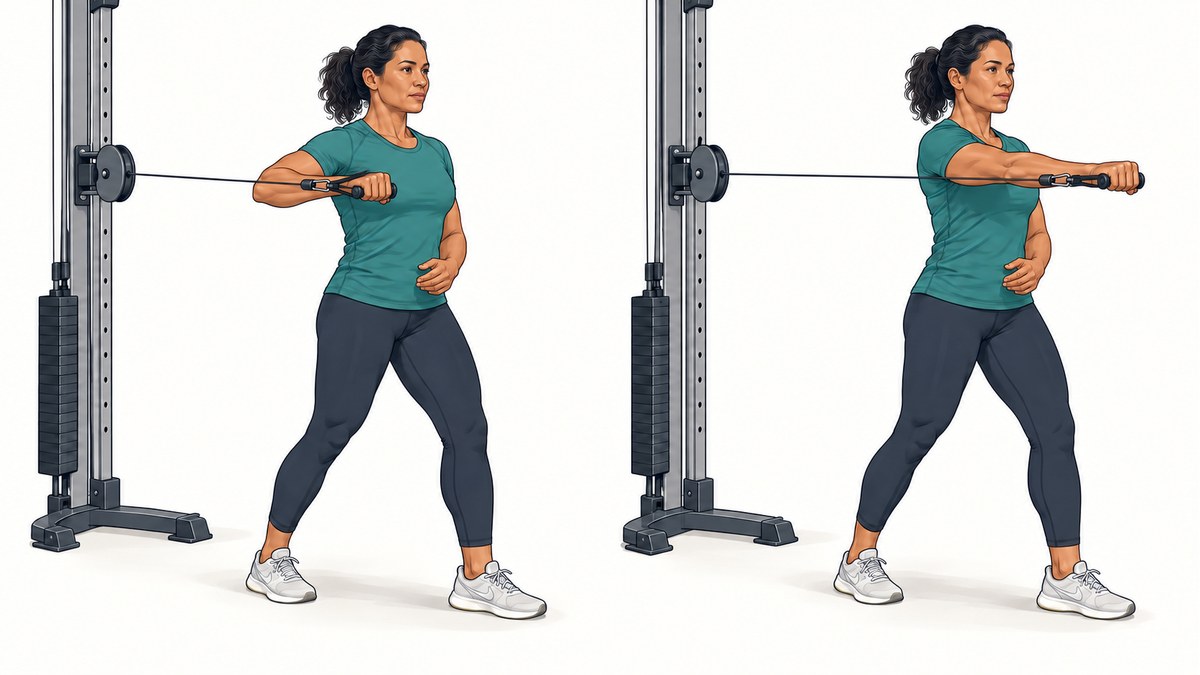
The single-arm cable chest press is a standing chest press using one handle with the pulley behind you. You press forward with one arm while keeping your hips and shoulders facing ahead. It works the chest, front shoulder and triceps on the pressing side.
How to do a single-arm cable chest press
Set up
- Set one pulley around mid-chest height, attach a single handle and choose a light starting weight. Check that the handle is clipped on securely.
- Take the handle in your working hand, bring it close to your chest and turn to face away from the machine. Step forward until the cable is taut.
- Put the opposite foot ahead, leaving space between your feet for balance. Hold the handle beside your chest, palm facing down, with a straight wrist and your elbow a little below shoulder height. Face your hips and shoulders forward.
Execution
- Brace your midsection and press the handle forward in line with the working shoulder. Straighten your elbow without turning your torso or pushing off your back foot.
- Finish with the arm comfortably straight, then bring the handle back slowly to the side of your chest. Stop the return before your shoulder is pulled into a position you cannot control; repeat the same path.
- Complete your reps, then step back toward the machine with the handle close to your chest until the stack settles. Change hands, mirror your stance and repeat on the other side.
Common mistakes
Turning the press into a torso twist
Keep your shoulders and hips facing the same direction throughout the rep. If the cable turns you as you return, lower the weight or reset your stance before continuing.
Reaching too far behind the body
Use the handle position beside your chest as your return point. Do not let the stack drag your elbow farther back to chase a bigger stretch.
Snapping the handle back
Guide it back at a pace you can stop. If the weight stack crashes or pulls you backward, reduce the load and regain control.
Where it fits in a session
Use it as a chest press in an upper-body session.
Start with the side that is harder to control, then match its controlled reps on the other side. Record the pulley height and use the same setup when comparing loads between sessions.
Muscles worked
Primary
Secondary
Schematic surface view. Some muscles are partly visible or not shown.
What research says about standing presses
A small study compared heavy standing cable pressing with bench pressing.
Use a repeatable stance and a load you can control. A bench-press number does not set your cable-press target.
Why can balance limit a heavy press?
In 14 recreationally trained men, Santana and colleagues found higher activity in the left abdominal muscles during a right-arm standing cable press than during bench pressing. Their results suggest that balance and torso control can limit standing pressing. The comparison was with a two-arm barbell bench press, not a two-arm cable press. These were acute tests of maximal effort, not measurements of muscle growth, core strength or injury risk after training.
Sources
Variations
Frequently asked questions
What muscles does the single-arm cable chest press work?
The pectoralis major, the main chest muscle, works with the anterior deltoid at the front of the shoulder and the triceps at the back of the upper arm.
How high should I set the pulley?
Start around mid-chest height. Adjust it so you can hold the handle beside your chest and press forward with your elbow below shoulder height, without shrugging or bending your wrist.
Should I rotate my torso as I press?
Keep your torso facing ahead for the version taught here. Turn down the weight if you cannot press and return without twisting; a deliberate rotational press is a different movement.
Which foot goes in front?
Start with the foot opposite your working arm in front. The exact step length is a comfort choice: use enough space between your feet to stay steady, then mirror that stance for the other arm.
Is this the same as a standing cable chest press?
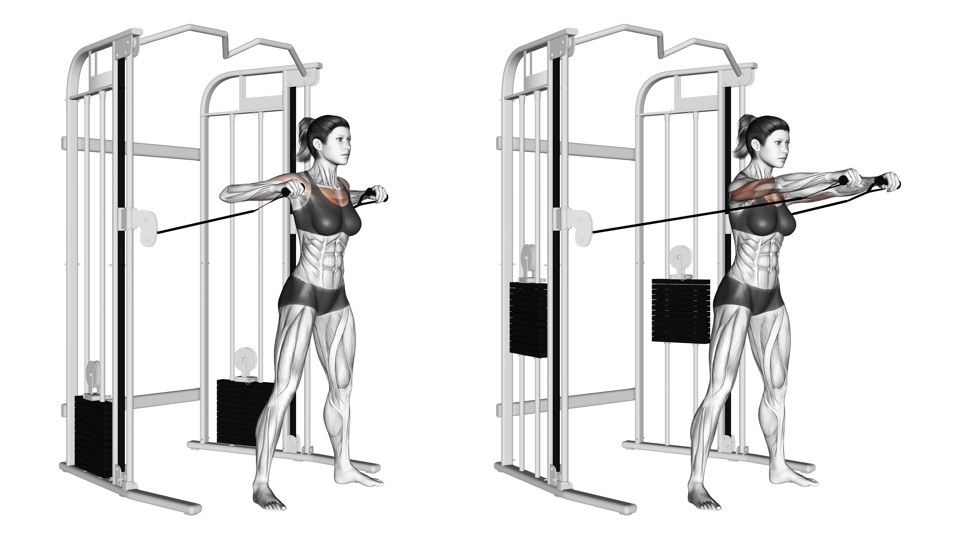
This version uses one handle and trains one side at a time. Our standing cable chest press guide uses two handles pressed together. Keep separate records of the weight and reps for each setup.
How heavy should I go?
Use a load you can press and return without moving your feet or turning your torso. Finish the set when you can no longer keep that control; the stack number is less useful if each rep uses a different body position.
Sources
- Betts JG et al. Anatomy and Physiology 2e, 11.5 Muscles of the pectoral girdle and upper limbs. OpenStax, 2022. https://openstax.org/books/anatomy-and-physiology-2e/pages/11-5-muscles-of-the-pectoral-girdle-and-upper-limbs
- Santana JC, Vera-Garcia FJ, McGill SM. A kinetic and electromyographic comparison of the standing cable press and bench press. J Strength Cond Res. 2007;21(4):1271-1277. https://pubmed.ncbi.nlm.nih.gov/18076235/