Standing cable chest press
Also called standing cable press.
What is Standing cable chest press?
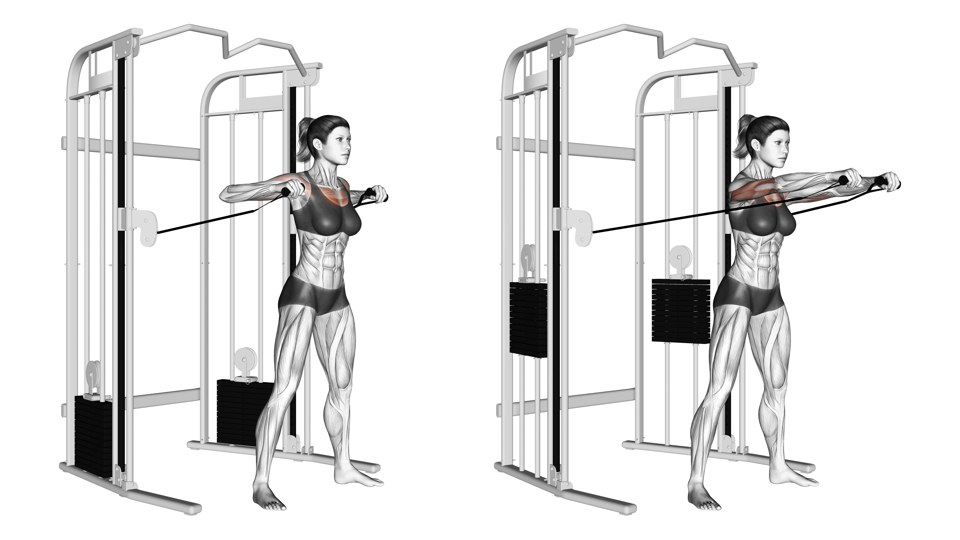
The standing cable chest press pushes two handles forward with the pulleys behind you. It trains the chest, front shoulders and triceps while you hold the standing position.
How to do Standing cable chest press
Set up
- Attach handles to two pulleys around chest height, take one in each hand and face away from the machine.
- Step forward into a stable stance, with one foot ahead if you prefer, and hold the handles beside your chest with the elbows below shoulder height.
Execution
- Press both handles forward until the arms are long in front of your chest.
- Keep your feet planted and your ribs over your pelvis rather than arching backward.
- Bring the handles back slowly to the same starting position.
Common mistakes
Leaning into each repetition
Keep your feet planted and your ribs over your pelvis rather than arching backward.
Letting one handle spring back
Keep hold of both handles throughout the return and release tension before putting them down.
Where it fits in a session
Place it with other chest presses in an upper-body session, before direct arm work if pressing is the priority.
Use a manageable load while learning how to brace against the cables. Record pulley height and stance so you can repeat the setup.
Muscles worked
Primary
Secondary
Schematic surface view. Some muscles are partly visible or not shown.
Variations
Frequently asked questions
Is this a cable fly?
No. The press bends and straightens the elbows; a fly keeps a fairly steady elbow angle.
Why use a split stance?
It gives a stable starting position against the cable pull. The illustration uses a more even stance; choose the stance you can hold throughout the set.
Sources
- Betts JG et al. Anatomy and Physiology 2e, 11.5 Muscles of the pectoral girdle and upper limbs. OpenStax, 2022. https://openstax.org/books/anatomy-and-physiology-2e/pages/11-5-muscles-of-the-pectoral-girdle-and-upper-limbs