Single-leg calf raise
Also called one-leg calf raise, single-leg heel raise.
What is a single-leg calf raise?
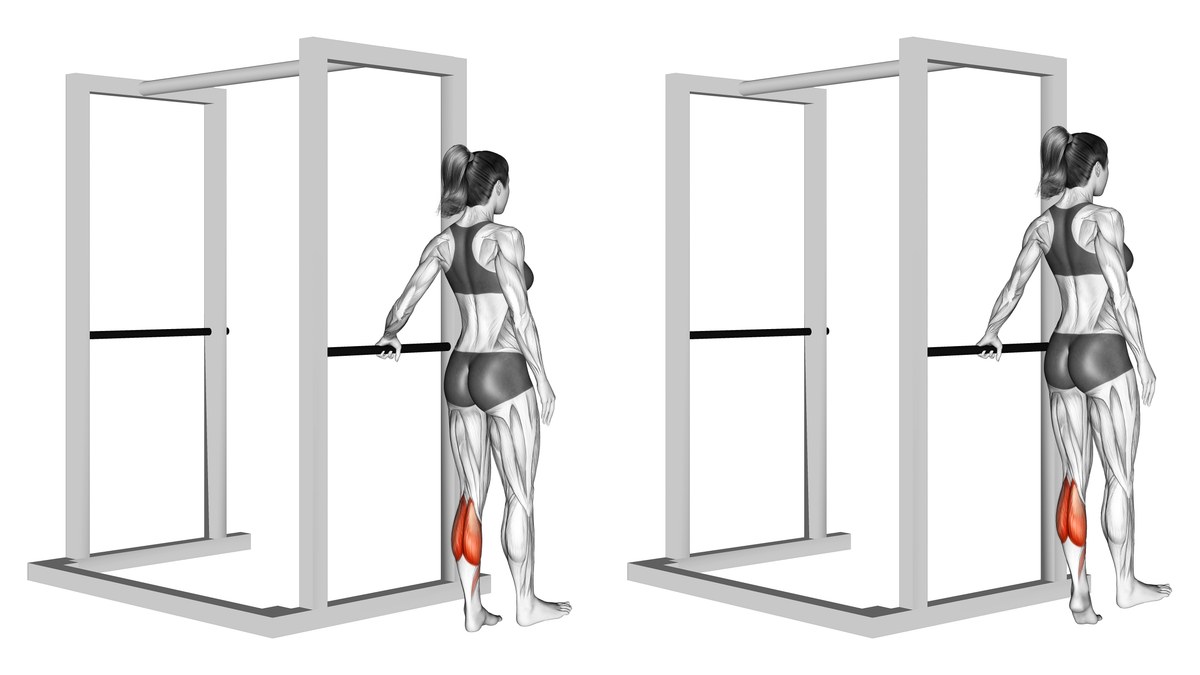
A single-leg calf raise lifts your heel while you stand on one foot with the working knee straight. It trains the gastrocnemius and soleus in the calf. This guide starts with bodyweight on the floor and a handhold for balance; a step or a dumbbell can be added later.
How do you perform a single-leg calf raise?
Set up
- Stand on a level floor beside a fixed rail or sturdy support, with one hand resting on it.
- Shift onto one foot and lift the other clear of the floor. Stand upright with the working knee straight.
Execution
- Press through the ball of your supporting foot to raise your heel as far as you can without bending the knee or leaning into the handhold.
- Lower slowly until your heel rests gently on the floor.
- Repeat on that leg, then put both feet down and switch sides.
Common mistakes
Pushing off with the other foot
Keep the free foot clear for the whole repetition. If it touches down to help you rise, reset before continuing.
Turning the repetition into a knee dip
Bending and straightening the working knee makes it harder to keep the heel raise consistent. Keep that leg long as the ankle moves.
Dropping onto the heel and bouncing back up
Bring the heel down quietly and begin the next rise under control. Shorten the set if you can no longer lower smoothly.
Where it fits in a session
Use it for calf work in a lower-body session or whenever your plan calls for a machine-free calf raise.
Begin with bodyweight and count repetitions for each leg. Use the same handhold and heel range when comparing sessions. Add a small dumbbell only after you can repeat the movement without help from the free foot or support.
Muscles worked
Primary
Secondary
- None listed in this guide
Schematic surface view. Some muscles are partly visible or not shown.
The gastrocnemius is the visible calf muscle, with the soleus underneath. Both help point the foot downward at the ankle, the action that raises your heel when the forefoot stays on the floor.
Variations
- Standing calf raiseThe broader straight-knee calf raise family, including versions performed on both legs.
Frequently asked questions
What muscles does a single-leg calf raise work?
It works the gastrocnemius and soleus in the calf. These muscles move the foot downward at the ankle. With the ball of the foot planted, that action lifts the heel.
Should I use the floor or a step?
Start on the floor as described here. A sturdy step is an option once you are comfortable with the movement: place the ball of the working foot on its edge and keep a fixed handhold within reach. The heel can then lower below the forefoot. Use a range you can control rather than forcing a deep stretch.
Can I hold a dumbbell?
Yes. Hold one dumbbell beside your hip and keep the other hand on a fixed support. Start light enough to keep the same upright position and controlled heel movement. This is a loaded progression of the single-leg version; you do not need to change to two legs.
What if I cannot rise on one leg yet?
Use both feet for now, keeping a hand on a support. Work on smooth raises and controlled lowering before trying one leg again. Avoid turning every repetition into a pull with your arms.
Where should I hold the other leg?
Hold the free foot off the floor without pressing it into the working leg. It can sit a little forward, as in the illustration, or behind you with the knee bent. Keep the working knee straight whichever position you choose.
Sources
- Betts JG, Young KA, Wise JA, et al. Anatomy and Physiology 2e. OpenStax; 2022. Section 11.6: Appendicular muscles of the pelvic girdle and lower limbs. https://openstax.org/books/anatomy-and-physiology-2e/pages/11-6-appendicular-muscles-of-the-pelvic-girdle-and-lower-limbs