Standing calf raise
Also called calf raise, standing calf raises, straight-knee calf raise, machine calf raise.
What is a standing calf raise?
A standing calf raise is ankle plantarflexion performed with the knee straight: you rise onto the balls of your feet against load, then lower until the heels drop below them. It trains the two muscles of the calf, the gastrocnemius and the soleus, which join into the Achilles tendon at the heel. The gastrocnemius crosses the knee as well as the ankle, so how much of the work it takes depends on knee angle, and a straight knee keeps it longer at that joint. A machine, a smith machine, a barbell, a dumbbell in one hand or nothing but a step will all load it — the equipment is a preference, the straight knee is not.
How do you perform a standing calf raise?
Set up
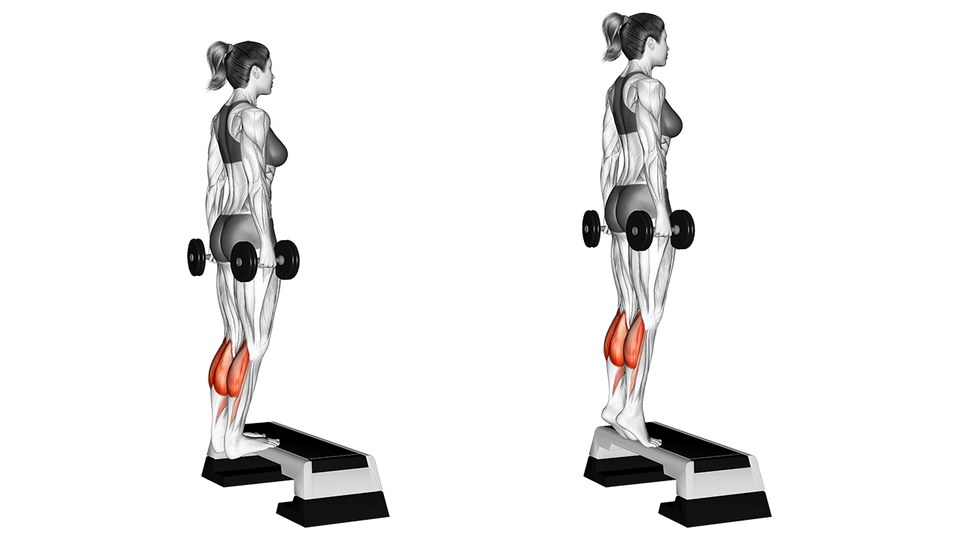
- Hold a dumbbell and place each forefoot on a step so your heels can move freely.
- Set your feet about hip width apart and stand tall with your knees straight, using a rail for balance if needed.
Execution
- Lower your heels until you feel your calves stretch, keeping your knees straight.
- Pause at the bottom without bouncing.
- Drive through the balls of your feet and rise as high as you can.
- Pause briefly at the top, then lower under control.
Common mistakes
Bouncing out of the bottom
The Achilles tendon stores elastic energy on the way down and gives it back on a fast reversal. The reps get easier and the numbers get bigger while the muscle does less, which is how a calf raise ends up loaded far past what the lifter can actually control.
Letting the knees bend during the rep
Changing knee angle changes the gastrocnemius’s length at the knee and can turn the repetition into a different movement. Keep the chosen knee position steady. Studies comparing straight-knee and 90-degree bent-knee work do not tell us what a small bend within one repetition does to growth.
Top-range partials that never lower the heel
The heel never drops, so the calf misses the lowered-heel portion supported by the range-of-motion research. This differs from deliberate bottom-range partials, which have produced growth in training studies.
Rolling onto the outside edge of the foot as the set gets hard
As the ankle tires the weight tends to drift out toward the little toe. That loads the joint in the inverted position it sprains from, and it quietly moves the work off the calf.
Pulling up on the machine handles or the rail
The arms unload the shoulders, so the weight on the stack is no longer the weight on the calves. Every session after that compares against a number that was never true.
Adding weight instead of adding range
Ankle range is the cheapest progression available on this movement and the first thing people give up. If the heel is not dropping below the ball of the foot at the bottom, the load is not the limiting factor.
Where it fits in a session
At the end of a lower-body session, after the squats, presses and machine work, or bolted onto any other session — it needs a step and a couple of minutes.
Calf raises cost almost nothing to recover from, so if you want more calf work the cheaper move is a second short exposure in the week rather than more sets on the one leg day. Reps are short and quick, so a set that looks long on paper can be over in twenty seconds; the pause at the top and the slow lowering are what make a set of twelve actually take a while. RepCount logs show about three sets when the exercise appears, which is a description of what people do, not a target.
Muscles worked
Primary
Secondary
Schematic surface view. Some muscles are partly visible or not shown.
The gastrocnemius and soleus are the two large muscles of the calf and together they are the triceps surae, joining into one tendon at the heel. They are listed as a pair rather than ranked against each other: their relative contributions change with knee and ankle position, and the anatomy does not support putting one above the other for this movement in general. The secondary list is the muscles that plantarflex alongside them while their named job is something else — turning the foot in, turning it out, flexing the big toe. Plantaris is on it as a secondary plantarflexor, with the caveat that it is absent in up to one person in ten.
What lifters actually do
Calf raises are a leg-day add-on rather than a habit of their own. More than half of regular RepCount users have logged them, and they appear in about one workout in fifteen. What the logs show is which company they keep, and it is not the squat: leg extensions are in close to 58% of calf-raise sessions and leg curls in over 43%, against about 36% for squats and 35% for the leg press. Calves get bolted onto the machine end of a lower-body day, typically three sets, in a session of around six or seven exercises — a shorter session than most.
Most often trained alongside
Share of standing calf raise sessions that also include each exercise.
- Leg extension57.9%
- Leg curl43.5%
- Squat35.6%
- Leg press35.1%
- Straight-legged deadlift10.4%
Figures come from workouts tracked in RepCount.
Scientific studies on the standing calf raise
Calf-training studies have tested knee position, the part of the repetition you use, loading and toe angle. Some used standing machines; others used calf presses on a leg press. That matters when applying the results to the dumbbell version shown here.
Straight-knee calf work can grow both main calf muscles. Keep the lowered-heel portion of the movement: it has stronger support than repetitions confined to the top. A range of loads can work, while toe-angle findings are too limited to dictate everyone’s stance.
Does standing train both calf muscles?
Yes. In a 12-week MRI study of 14 untrained adults, standing raises grew both the gastrocnemius, the visible calf muscle, and the soleus underneath it. Standing produced greater growth than seated raises in both gastrocnemius heads, without a clear difference in soleus growth.
A separate trial in 30 trained participants favored a straight-leg toe press over seated raises for the inner gastrocnemius head. Its outer-head and soleus comparisons were inconclusive. These findings support straight-knee work for overall calf growth; they do not establish that everyone also needs seated raises.
Study details: knee position and measurement
Kinoshita’s participants trained each leg differently twice weekly: standing with the knee straight versus seated with the knee bent to 90 degrees. MRI measured whole-muscle volume. Burke’s eight-week trial measured muscle thickness and used a toe press for its straight-knee condition. We read Burke’s complete abstract, not its full methods. Neither comparison tested whether combining the exercises beats matched standing work.
Do you need to complete every repetition all the way up?
Full repetitions work, but a controlled partial near the bottom is different from bouncing through the top. In an eight-week study of 42 young women, bottom-half calf presses produced greater inner-gastrocnemius growth than full or top-half repetitions. For the outer head, bottom-half repetitions beat top-half repetitions but did not clearly beat full range.
That trial used a horizontal leg press, so it does not settle the ideal range for every standing setup. It supports keeping the lowered-heel portion, rather than adding weight while losing that part of the movement. Full range remains a useful default; the study does not show that all partial repetitions are ineffective.
Study details: bottom-range work and fatigue
Kassiano compared ankle movement from 25 degrees of dorsiflexion to 25 degrees of plantarflexion, the bottom half up to neutral, and the top half from neutral. Ultrasound measured both gastrocnemius heads after three weekly sessions. The complete abstract was read.
A 2026 standing-machine trial in 16 untrained men compared full-range sets with half as many sets extended by bottom-range partials after full-range failure. Both approaches produced about 8% growth in gastrocnemius thickness over ten weeks. This was a different comparison: set counts differed, and its volume calculation counted full and partial repetitions alike. It does not establish that extending every set always produces extra growth.
Do calves need high repetitions to grow?
Not according to a direct loading comparison. Twenty-six untrained men completed eight weeks of both seated and standing raises, using 6–10 reps on one leg and 20–30 on the other. Both loading approaches produced similar gains in calf thickness.
The sets were taken to the point where another complete repetition was not possible. This supports using different loads for hard calf training; it does not show that an easy high-rep set matches a hard heavy one. Because both exercises were included, the result cannot be attributed to standing raises alone. The study also gives no reason to prescribe high reps specifically for the soleus based on its usual fiber composition.
Sources
Can pointing the toes change which part grows?
One nine-week trial in 22 young men found a difference: toes-out calf presses favored growth of the inner gastrocnemius head, while toes-in favored the outer head. Both heads grew in all three tested positions, including toes forward.
The clear comparisons were between toes-in and toes-out; they did not establish that either beats toes forward. The exercise used a horizontal leg press, and the study did not measure soleus growth. This is a reason to keep foot angle open as an option, not a strong basis for prescribing a special stance on every standing raise.
Sources
Variations
- Smith machine calf raise — Bar on the back with a block under the feet, when there is no calf machine.
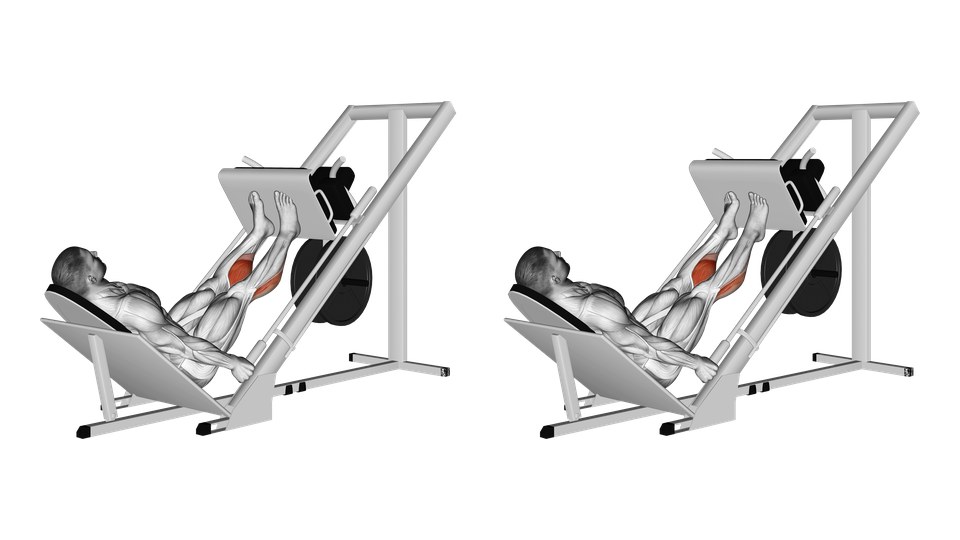
- Leg press calf pressFeet low on the sled, knees close to straight, pushing through the balls of the feet.
- Single-leg dumbbell calf raise — One dumbbell, one leg on a step. Needs no machine and exposes a side difference.
- Donkey calf raise — Hips hinged forward with the load over the hips, knees still straight.
- Bodyweight calf raise on a step — The version that needs nothing. Progresses by moving to one leg.
Articles
Related tools
Frequently asked questions
What muscles does a standing calf raise work?
The two large muscles of the calf: the gastrocnemius, which is the pair of heads you can see, and the soleus, which lies underneath it. Together they are called the triceps surae and they join into the Achilles tendon at the heel. Deeper in, and along the outside of the leg, the tibialis posterior, the fibularis longus and the flexor hallucis longus all contribute to plantarflexion while their named jobs are turning the foot in, turning it out and flexing the big toe. The plantaris joins in too, in the people who have one — it is missing in up to one person in ten.
What is the difference between a standing and a seated calf raise?
Standing raises keep the knee straight; seated raises bend it. The gastrocnemius crosses the knee and ankle, while the soleus crosses only the ankle. Direct training comparisons favor straight-knee work for gastrocnemius growth without showing a clear soleus advantage for seated work. Standing raises therefore train both muscles, and the studies do not establish that everyone needs both exercises.
Should I point my toes in or out?
Use a comfortable position as your starting point. One small leg-press calf trial found more inner-head growth with toes out and more outer-head growth with toes in, but neither was established as better than toes forward. Those results do not isolate one head or establish a best angle for standing dumbbell raises.
Do I need a calf raise machine?
No. What the movement needs is an edge to hang the heel off so the ankle gets its full range, and a way to add load over time. A machine, a smith machine, a barbell on the back, a dumbbell in one hand or a step and one leg all satisfy both. An illustration can only show one of them, which is the artwork making a choice, not a recommendation.
Should I do calf raises on one leg or both?
Either — this one is preference, not technique. One leg at a time gets you a serious load with a single dumbbell and shows up a side that is lagging. Both legs together is faster and takes a barbell or a machine well. Nothing here favours one, so pick the one your gym makes easy.
How many sets of calf raises do people actually do?
When calf raises show up in a RepCount workout it is usually around three sets, in a lower-body session of roughly six or seven exercises. That is an observation about what lifters log, not a recommendation.
Are calf raises worth doing?
More than half of regular RepCount users have logged them, and they turn up in about one workout in fifteen. The pattern in the logs is a leg-day add-on rather than a session of its own: the exercises they most often appear beside are leg extensions and leg curls, ahead of squats and the leg press. Lifters treat them as the thing tacked onto the machine end of a lower-body day.
Sources
- Bordoni B, Varacallo MA. Anatomy, Bony Pelvis and Lower Limb: Gastrocnemius Muscle. StatPearls. https://www.ncbi.nlm.nih.gov/books/NBK532946/
- Binstead JT, Varacallo MA. Anatomy, Bony Pelvis and Lower Limb: Calf. StatPearls. https://www.ncbi.nlm.nih.gov/books/NBK459362/
- Corcoran NM, Varacallo MA. Anatomy, Bony Pelvis and Lower Limb: Tibialis Posterior Muscle. StatPearls. https://www.ncbi.nlm.nih.gov/books/NBK539913/
- Lezak B, Varacallo MA. Anatomy, Bony Pelvis and Lower Limb: Calf Peroneus Longus Muscle. StatPearls. https://www.ncbi.nlm.nih.gov/books/NBK546650/
- Murdock CJ, Munjal A, Agyeman K. Anatomy, Bony Pelvis and Lower Limb: Calf Flexor Hallucis Longus Muscle. StatPearls. https://www.ncbi.nlm.nih.gov/books/NBK539776/
- Kinoshita M et al. Triceps surae muscle hypertrophy is greater after standing versus seated calf-raise training 2023. https://pmc.ncbi.nlm.nih.gov/articles/PMC10753835/
- Burke R et al. Exercise Selection Differentially Influences Lower Body Regional Muscle Development 2024. https://link.springer.com/article/10.1007/s42978-024-00299-4
- Kassiano W et al. Greater Gastrocnemius Muscle Hypertrophy After Partial Range of Motion Training Performed at Long Muscle Lengths. 2023. https://pubmed.ncbi.nlm.nih.gov/37015016/
- Nunes JP et al. Different Foot Positioning During Calf Training to Induce Portion-Specific Gastrocnemius Muscle Hypertrophy. 2020. https://pubmed.ncbi.nlm.nih.gov/32735428/
- Schoenfeld BJ et al. Do the anatomical and physiological properties of a muscle determine its adaptive response to different loading protocols? 2020. https://pmc.ncbi.nlm.nih.gov/articles/PMC7186566/
- Goli A et al. Does Performing Partial Repetitions Beyond Momentary Failure Enhance Muscle Hypertrophy in Volume-Load-Equated Calf-Raise Resistance Training? 2026. https://pmc.ncbi.nlm.nih.gov/articles/PMC13075556/