
Sled rope pull
Also called hand-over-hand sled pull, rope sled pull, stationary sled pull.
What is a sled rope pull?
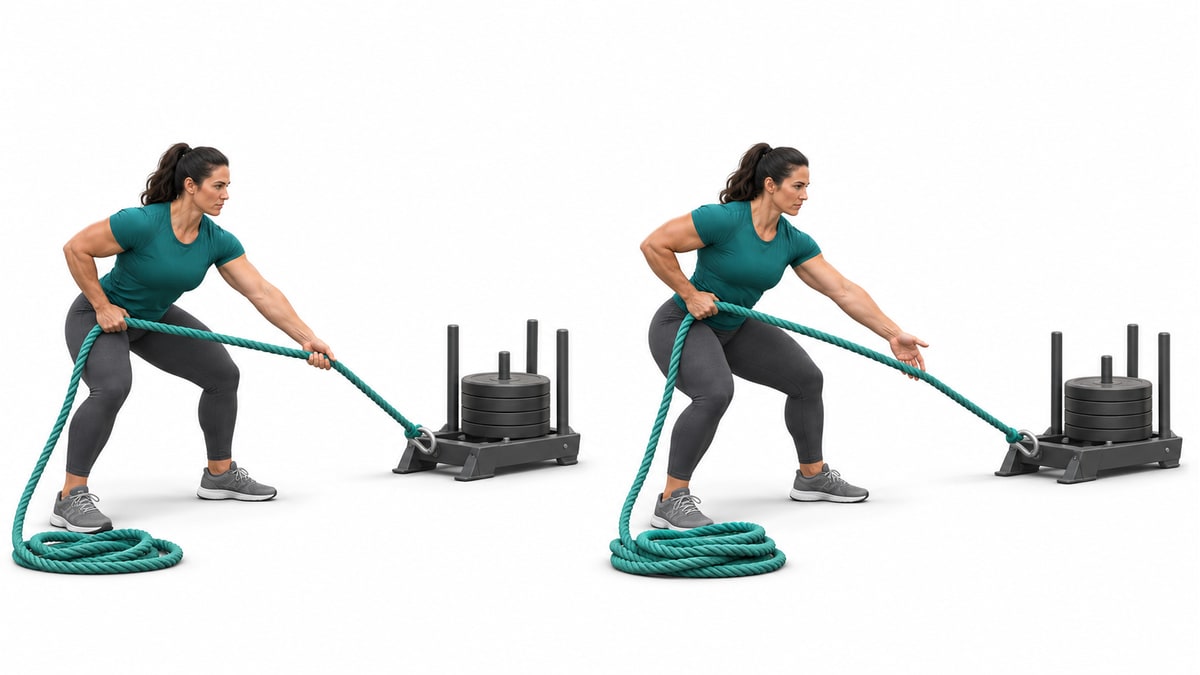
A sled rope pull brings a loaded sled toward you through a series of alternating hand pulls. You face the sled with your feet planted, drawing the rope toward your hips as the other hand reaches for the next grip. This hand-over-hand version differs from walking backward while holding sled straps or handles.
How do you perform a sled rope pull?
Set up
- Use a sled and pulling rope intended to work together. Load the sled evenly and connect the rope to its approved pulling point as the maker directs. Clear a straight travel lane and space beside you for the loose rope.
- Extend the rope along the lane and stand facing the sled at its free end. Set your feet about shoulder-width apart, bend your knees slightly and sit your hips back into a steady stance with your trunk braced.
- Hold the rope with one hand ahead of the other and gently take up the slack. Keep the rope free of loops around your hands, wrists or body.
Execution
- Draw the forward hand toward the hip on that side. As it pulls, reach ahead with the other hand and close your grip before releasing the hand that has just finished.
- Continue exchanging hands while keeping your feet planted and your torso controlled. Let the rope you have pulled fall beside you, away from your feet; stop if the pile starts to obstruct your stance.
- Finish the pull while there is still space between you and the sled. Keep hold until it has stopped, then set the slack rope down before stepping clear.
- With the sled at rest, use its intended handles to reposition it if you are doing another length. Lay out the rope again and clear the lane before restarting; leave the equipment settled after your final pull.
Common mistakes
Turning each pull into a backward walk
That changes the movement into a walking drag. For this stationary version, choose a load you can move with alternating arm pulls while your feet stay in place.
Snatching at a slack rope
A sudden tug can pull you out of your stance. Take up the slack first, then move the sled with controlled pulls instead of throwing your torso backward to start it.
Letting loose rope collect around the feet
You need clear footing while pulling and when stepping away. Stop the sled and set the rope down before sorting a pile that blocks your feet; do not step through loops under tension.
Where it fits in a session
Use this version when your session calls for stationary hand-over-hand sled pulling.
Select a load that allows repeatable pulls and secure hand changes without walking backward or losing your stance.
Muscles worked
Primary
Secondary
Schematic surface view. Some muscles are partly visible or not shown.
The lats help draw the upper arms back, and the three elbow flexors bend the arms during each pull. Finger flexors hold the rope while the abdominal muscles help steady the trunk. The primary muscles are listed together, without an activation ranking; the legs support the planted stance rather than taking repeated backward steps in this version.
Variations
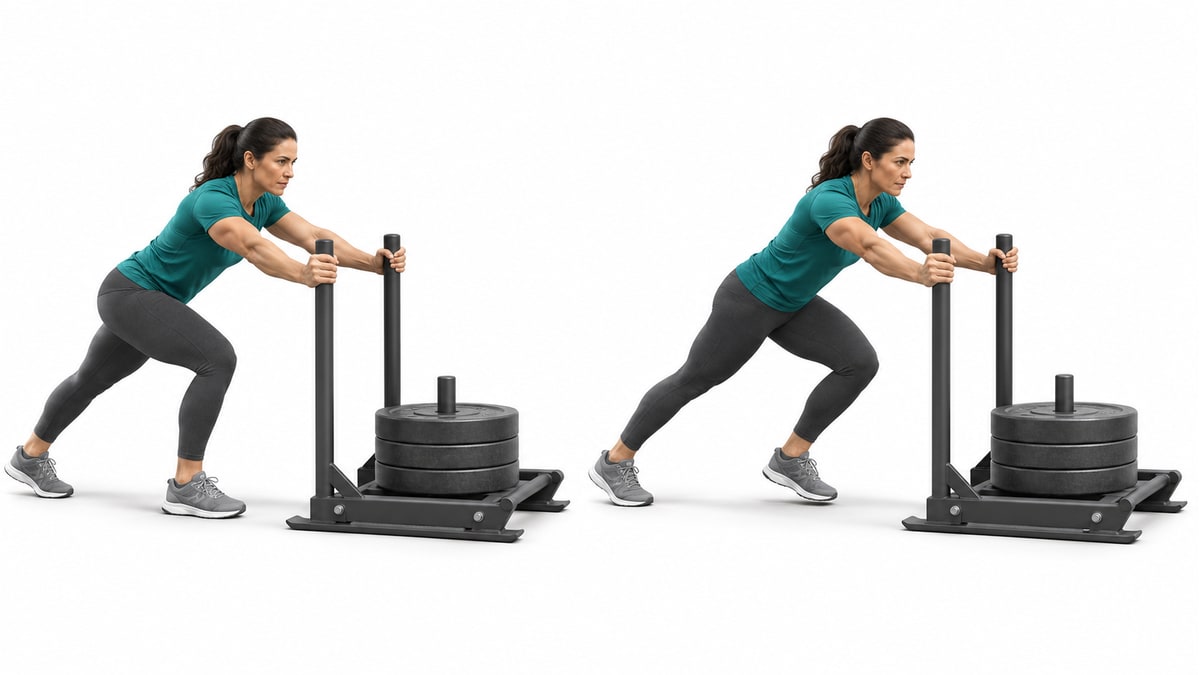
- Sled pushDrive the sled away through its handles while taking alternating steps; it shares the equipment family but has a different movement pattern.
Frequently asked questions
What muscles does a sled rope pull work?
The lats help bring each upper arm back, while the biceps, brachialis and brachioradialis bend the elbow. The finger flexors hold the rope, and the abdominal muscles help keep the trunk steady. The legs support your stance here; this is not a claim that one muscle produces a fixed share of the effort.
Is a sled rope pull the same as a reverse sled drag?
No. In this guide, your feet stay planted while your hands repeatedly pull in the rope and the sled approaches you. A reverse sled drag uses backward steps while you keep hold of straps, handles or a rope. A two-hand sled row, with both arms pulling together, is another setup.
Should I wrap the rope around my hands?
Keep it unwrapped so either hand can open freely during a change of grip. Hold the rope directly and use equipment intended for sled pulling. If the rope slips before you can make controlled pulls, reduce the load and check the rope and connection rather than tying yourself to it.
How heavy should the sled be?
Choose a load you can start smoothly and keep moving without losing your footing or repeatedly throwing your body backward. Adjust by the quality of the actual pulls rather than trying to reach a particular plate total at the expense of your position.
Can I use my legs during the rope pull?
The legs hold your stance, and a small natural weight shift is fine. This guide keeps the feet in place and teaches alternating arm pulls. If you deliberately drive backward with steps or use large repeated hip movements, you are choosing a different sled-pulling technique and should set up for that version.
Sources
- Jeno SH, Varacallo MA. Anatomy, Back, Latissimus Dorsi. StatPearls. Updated 2023. https://www.ncbi.nlm.nih.gov/books/NBK448120/
- Betts JG, et al. Anatomy and Physiology 2e, 11.5: Muscles of the Pectoral Girdle and Upper Limbs. OpenStax. https://openstax.org/books/anatomy-and-physiology-2e/pages/11-5-muscles-of-the-pectoral-girdle-and-upper-limbs
- Betts JG, et al. Anatomy and Physiology 2e, 11.4: Axial Muscles of the Abdominal Wall and Thorax. OpenStax. https://openstax.org/books/anatomy-and-physiology-2e/pages/11-4-axial-muscles-of-the-abdominal-wall-and-thorax