Smith machine split squat
What is a Smith machine split squat?
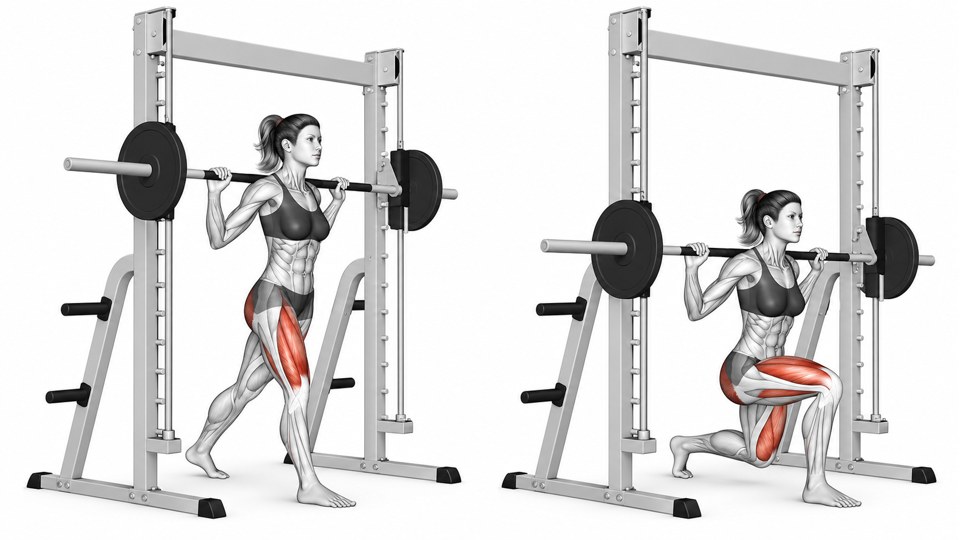
The Smith machine split squat is a stationary split squat with the bar guided by rails. Keep the front foot flat and the rear forefoot on the floor as you lower and rise. It trains the quadriceps and gluteus maximus; the rear foot stays on the floor rather than on a bench.
How do you perform a Smith machine split squat?
Set up
- Set the bar just below shoulder height and the safety stops just below your planned depth. Test the hooks with an unloaded bar.
- Set the bar across your upper back, grip it on both sides and take a staggered stance. Keep your front foot flat and your rear heel lifted, with the toes on the floor.
- Brace your trunk, stand tall and rotate the bar to release the hooks.
Execution
- Bend both knees and lower smoothly, keeping the front knee aligned with the foot.
- Stop at a depth you can control without lifting the front heel or twisting your hips.
- Press through the front foot to stand. Complete your reps, lock the bar securely and switch legs.
Common mistakes
Setting the front foot too close
If the heel lifts or the bottom feels cramped, reset your stance before the next set.
Moving your feet between repetitions
This is a stationary split squat. Keep both foot positions fixed until you have secured the bar and are ready to change sides.
Dropping quickly into the bottom
A controlled descent lets you keep the same foot pressure and depth on each repetition.
Where it fits in a session
Use it as a single-leg exercise in a lower-body session.
Choose a load that lets you use the same controlled depth on both sides. Start with the side that needs more practice and match its reps on the other side.
Muscles worked
Primary
Secondary
- None listed in this guide
Schematic surface view. Some muscles are partly visible or not shown.
The quadriceps straighten the front knee, while the gluteus maximus extends the front hip.
Variations
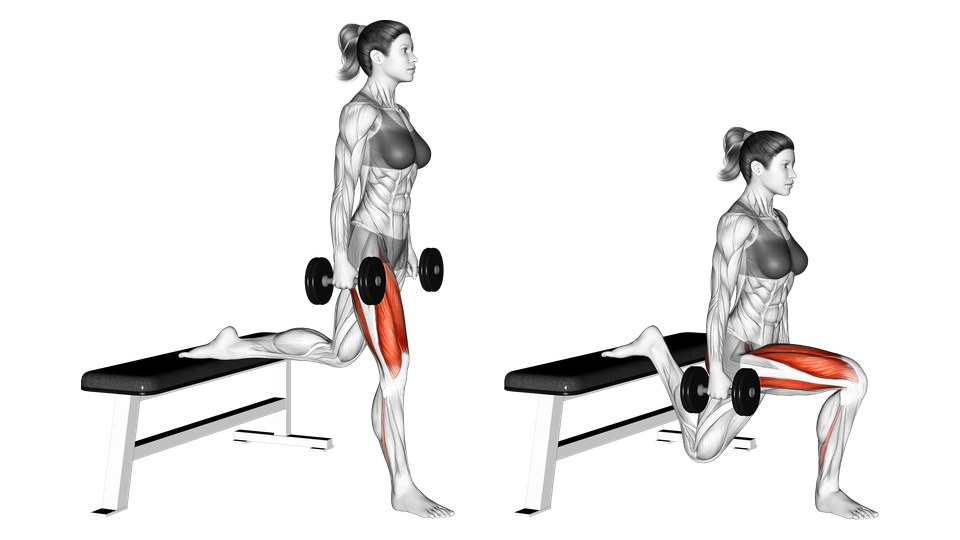
- Smith machine Bulgarian split squat — Combines the guided bar with a rear foot raised on a bench; a separate exercise from this floor version.
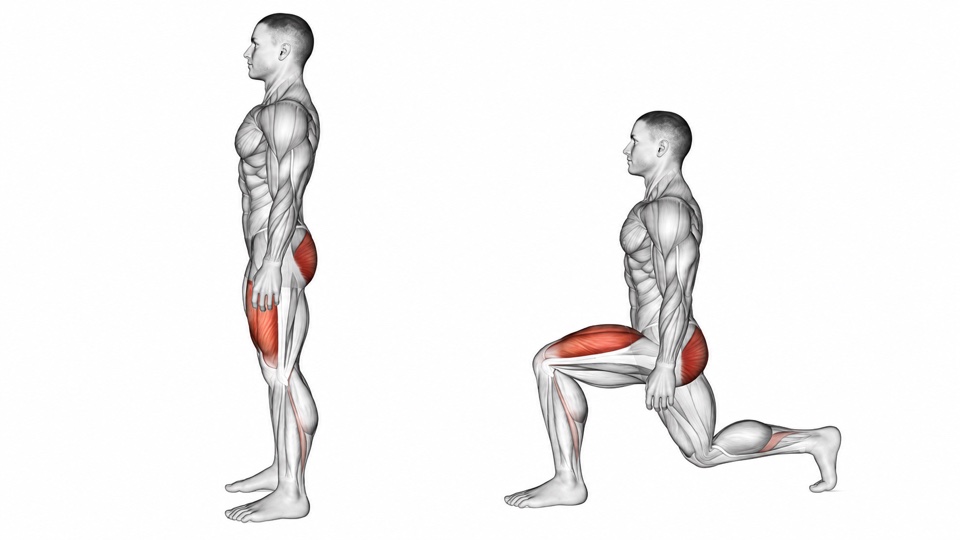
- Reverse lungeSteps backward and returns between repetitions instead of keeping a fixed split stance.
Related tools
Frequently asked questions
What muscles does the Smith machine split squat work?
It trains the quadriceps and gluteus maximus. These muscles straighten the front knee and extend the hip as you rise.
Is this a Bulgarian split squat?
No. Both feet contact the floor in this version, with the rear heel raised. A Bulgarian split squat puts the rear foot on a bench or another raised support.
How far apart should my feet be?
Use a stance that lets you lower while keeping the front heel down and the rear forefoot in contact with the floor. Leave some width between the feet so you are not balancing on a tightrope.
Should I step between repetitions?
Keep the feet in place for the entire set. Secure the bar before you switch legs. Stepping backward and returning on each repetition makes it a reverse lunge.
Sources
- Adel Elzanie and Judith Borger. Anatomy, Bony Pelvis and Lower Limb, Gluteus Maximus Muscle. StatPearls, updated 2023. https://www.ncbi.nlm.nih.gov/sites/books/NBK538193/
- Bruno Bordoni and Matthew A. Varacallo. Anatomy, Bony Pelvis and Lower Limb: Thigh Quadriceps Muscle. StatPearls, updated 2023. https://www.ncbi.nlm.nih.gov/sites/books/NBK513334/