Dumbbell bench press
Also called dumbbell press, flat dumbbell press, dumbbell chest press, DB bench press.
What is a dumbbell bench press?
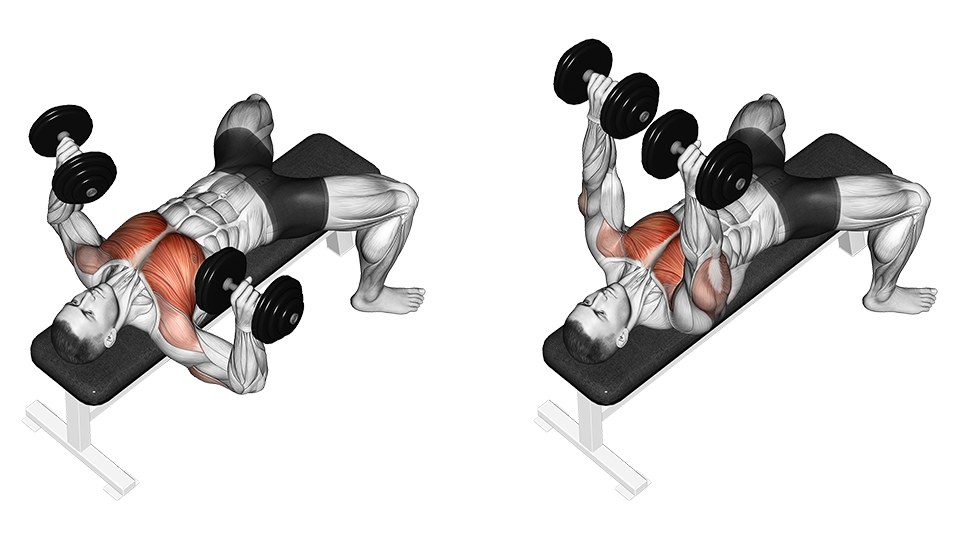
The dumbbell bench press is a flat-bench press performed with a dumbbell in each hand. It trains the pectoralis major, with the front of the shoulder and the triceps working alongside it. Each arm presses and controls its own weight along its own path, so both pressing strength and control matter.
How do you perform a dumbbell bench press?
Set up
- Set the bench flat, sit at the end and rest one dumbbell on each thigh.
- Use your knees to guide the dumbbells up as you lie back, then hold them over your shoulders.
- Plant your feet, keep your backside on the bench and pull your shoulder blades back and down. Start with your arms straight.
Execution
- Lower the dumbbells under control, keeping your wrists straight and your elbows angled down rather than flared out flat.
- Stop when your upper arms reach the line of your torso, or sooner if you cannot keep your shoulders set comfortably.
- Press the dumbbells back over your shoulders to straight arms, letting them move slightly together without banging.
- After the final rep, bring the dumbbells to your chest, raise your knees to meet them and use your thighs to help you sit up instead of dropping the weights out to the sides.
Common mistakes
Flaring the elbows out flat at the bottom
That takes the arm into extension and external rotation under load. Pectoralis major tendon tears are rare, but around half of the reported ones are sustained in weight-bearing exercise with the loaded arm in exactly that position. Dumbbells make the position easier to reach than a barbell does, because nothing stops the hands at chest level.
Chasing depth because the dumbbells allow it
Below the point where your upper arms reach the line of your torso you are in the same end-range position as the mistake above, reached on purpose rather than by accident. Whether the extra range buys anything at the chest is not something this page has measured; what it costs at the shoulder is. Let where you can hold the shoulder blades down set the bottom, not where the dumbbells stop.
Letting the shoulders roll forward at the top to push the dumbbells together
The extra travel comes from the shoulder blades sliding forward, not from the arm pressing any further, and it costs you the stable base the whole press is driven from. On a lift with nothing to rack, that base is worth more than the inch.
Picking the dumbbells up off the floor while lying down, or dropping them out sideways at the end
Both put a heavy weight on one arm at a bad angle with nobody able to help. There is no spotter on a dumbbell press and no bar to rack, so getting in and getting out are part of the lift, not etiquette around it.
Going up in weight before you can control the bottom
With a barbell both hands share one path; here each arm has its own, so your working load is capped by what you can stop and stabilise at the chest. Load past that and the lowering becomes a fall you catch, which removes the half of the rep you were training for.
Letting the heels lift or the feet wander mid-set
The feet are the base you push against, and chasing them around mid-rep is attention that should be going into the press. Feet up on the bench is a different thing — a deliberate choice, usually to keep the lower back flat — and not an error, but it is a worse trade here than on a barbell: you are getting two loaded dumbbells into and out of position with no spotter and nothing to rack.
Where it fits in a session
First or second in a pressing session. This is a main lift rather than accessory work, and the entry into position alone is enough reason not to meet it tired.
Progression is lumpier than on a barbell: most racks jump 2 to 2.5 kg per dumbbell, which is 4 to 5 kg across the pair, so adding reps within a range before adding weight will get you further than trying to add load every session. Sets in the region of six to twelve reps suit it better than heavy low-rep work, mostly because the getting-in and getting-out problem grows faster than the weight does.
Muscles worked
Primary
Secondary
Schematic surface view. Some muscles are partly visible or not shown.
The pectoralis major is what the press is for. Its action at the shoulder is flexion, adduction and medial rotation of the arm, which is the arc the dumbbells travel between the chest and lockout. The anterior deltoid flexes the arm alongside it and the triceps extends the elbow, so both are unavoidable parts of the movement rather than optional additions — and nothing in the anatomy ranks those two against each other, so they are listed together rather than ordered. Holding two independent weights also adds a stabilising demand a barbell does not have, but which muscles meet it is not a question an anatomy reference answers, so nothing is listed as a target on that basis.
What lifters actually do
Just under half of regular RepCount users have logged a flat dumbbell press at some point, and it appears in about one workout in twenty. When it shows up it sits in a session of roughly seven exercises, most often beside the incline dumbbell press, lateral raises, pushdowns, the dumbbell shoulder press and triceps extensions — a dumbbell push day. It carries slightly more sets than any of those five, though the gap is small enough to read as a tie. The clearer signal is who is missing: the flat barbell bench press is not in that list, while other chest movements in the same data sit alongside the barbell bench in a third to nearly half of their sessions. Lifters seem to reach for this one as the session's main press rather than as something to add after a barbell one.
Most often trained alongside
Share of dumbbell bench press sessions that also include each exercise.
- Pushdowns20.9%
- Triceps extensions15.2%
Figures come from workouts tracked in RepCount.
Scientific studies on the dumbbell bench press
Dumbbells change both how much weight a lifter can handle and the activity of the muscles involved. Those findings answer different questions: a heavier lift does not automatically mean more chest work or more growth.
Track dumbbell and barbell pressing separately. Small studies found lower dumbbell loads, but that did not translate into uniformly lower chest activity. Neither maximum-load tests nor muscle-activity readings establish which version produces more muscle growth.
Should my dumbbell and barbell loads match?
There is no reason to expect them to. In 12 resistance-trained men, the combined dumbbell maximum was lower than the barbell maximum. A separate study of 19 trained men also found a lower combined dumbbell load when testing the most weight they could lift for ten repetitions.
These are group comparisons, not a conversion rule for your next set. Each arm has to press and control its own dumbbell, while a bar connects the hands. Strength, practice and technique all matter; the research does not divide the barbell lift into “strength” and the dumbbell lift into “control.”
Do dumbbells produce more chest activity?
The answer differed between two studies. During the maximum-lift comparison, chest and front-shoulder electrical activity did not clearly differ between dumbbells and a barbell. Dumbbells produced higher biceps activity and lower triceps activity.
In the repeated-set study, participants performed four sets to failure with each exercise’s tested ten-repetition maximum, resting two minutes between sets. Dumbbell pressing produced higher measured chest activity than barbell pressing, alongside higher biceps and lower triceps activity.
These were different participants and protocols. The contrast does not prove that repetition range caused the difference, and neither study measured muscle growth. Higher chest EMG in one test is not a reason to declare dumbbells universally better.
Variations
- Incline dumbbell bench pressBench raised, so the press runs more up than across. Its own exercise in the app rather than a setting on this one.
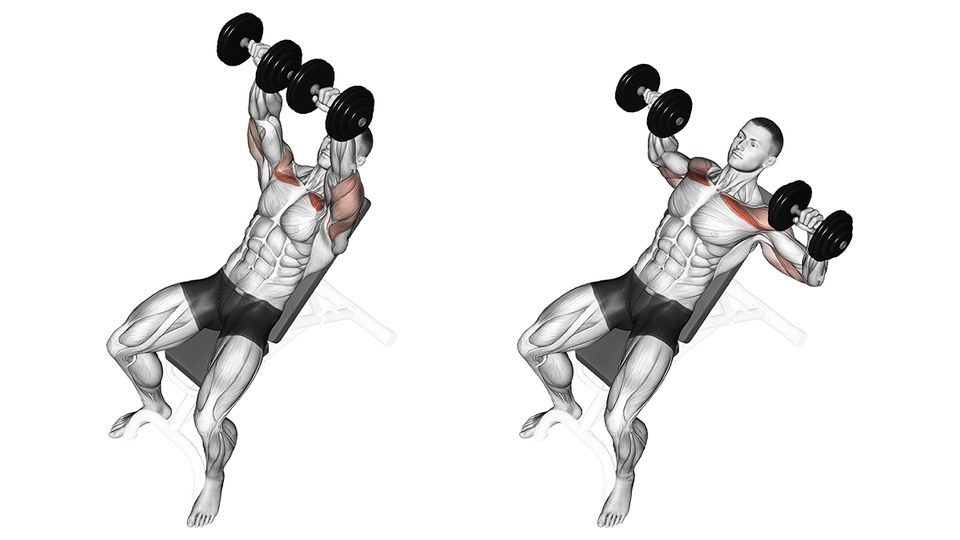
- Decline dumbbell bench press — Bench angled down, which makes getting into position alone harder than on any other version.
- Neutral grip dumbbell bench press — Palms facing each other for the whole rep. A grip choice rather than a different movement.
- Single arm dumbbell bench press — One dumbbell at a time, so the torso has to resist being twisted off the bench.
- Dumbbell floor pressLying on the floor, so the upper arms stop when they touch down and the bottom range is fixed for you.
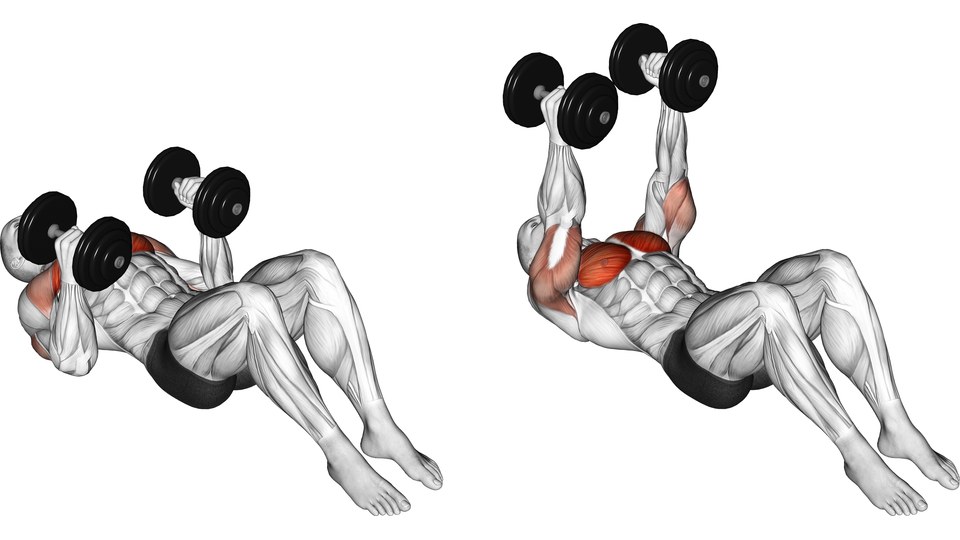
- Dumbbell squeeze press — Dumbbells held pressed together throughout, usually neutral grip.
Articles
Related tools
Frequently asked questions
What muscles does the dumbbell bench press work?
The pectoralis major, with the front of the deltoid and the triceps brachii working alongside it. The pectoralis major flexes, adducts and medially rotates the arm at the shoulder, which together describe the arc the dumbbells travel. The anterior deltoid flexes the arm with it, and the triceps extends the elbow, which is the other half of a press. Nothing in the anatomy says which of those last two does more, so treat them as co-workers rather than a ranking.
Is the dumbbell bench press better than the barbell bench press?
Neither is established as universally better. A barbell connects the hands and often allows a heavier total load; dumbbells give each arm its own path. The studies reviewed here measured load and muscle activity, not which exercise produces more chest growth. Choose the version that fits your training and that you can set up, perform and finish under control.
How much should I dumbbell bench press compared to my barbell bench?
There is no universal conversion rule. Small studies found lower total loads with dumbbells, but a group average is not a target for an individual lifter. Track the exercises separately, remembering that one dumbbell’s weight is only half the combined load. Choose a weight you can lower and press through a consistent range, and compare your progress within that exercise.
Should my palms face forward or toward each other?
Either, and anything between. Palms forward, angled inward at around 45 degrees, and fully facing each other are all normal ways to do this lift, and nothing settles which is right for you. It is a preference. Any illustration can only show one of them, so read the picture as an example rather than as the instruction, and pick the grip your shoulders and wrists are happiest with.
How far down should the dumbbells go?
About to where your upper arms reach the line of your torso, and further only if your shoulders are genuinely comfortable there. Dumbbells will let you keep going, which reads like a free advantage over a barbell but is really an unmarked decision. Pectoralis major tears are rare, but around half of the reported ones happen in weight-bearing exercise with the arm pulled back and rotated outward under load, which is the end of exactly this range. Let the point where you can still hold your shoulder blades down and back set the bottom.
Do the dumbbells need to touch at the top?
No. Letting them drift toward each other at the top is fine and follows the natural arc of the press. Banging them together is not worth it: it knocks your hands out of position, and reaching for it usually means rolling the shoulders forward off the bench, which trades the base you press from for an inch of travel that comes from the shoulder blades rather than the arms.
How do I get heavy dumbbells into position by myself?
Sit on the end of the bench with a dumbbell on each thigh, then lie back and kick one knee at a time so each dumbbell arrives over the shoulder. Coming out, bring them back to your chest, tuck your chin and sit up with them. That entry and exit is a skill of its own, and it is worth learning with a weight you do not care about before it becomes the thing standing between you and a heavy set.
Is the dumbbell bench press worth doing?
Just under half of regular RepCount users have logged it at some point, and it turns up in about one workout in twenty. The five movements it most often sits beside are the incline dumbbell press, lateral raises, pushdowns, the dumbbell shoulder press and triceps extensions, and it carries slightly more sets per session than any of them — by a margin small enough to call a tie. What stands out instead is who is missing: the flat barbell bench press is not on that list, where it sits near the top of the equivalent list for every other chest movement we looked at. That looks like the profile of a session's main press rather than something added on after one.
Sources
- Solari F, Burns B. Anatomy, Thorax, Pectoralis Major Major. StatPearls. https://www.ncbi.nlm.nih.gov/books/NBK525991/
- Elzanie A, Varacallo MA. Anatomy, Shoulder and Upper Limb, Deltoid Muscle. StatPearls. https://www.ncbi.nlm.nih.gov/books/NBK537056/
- Tiwana MS, Sinkler MA, Bordoni B. Anatomy, Shoulder and Upper Limb, Triceps Muscle. StatPearls. https://www.ncbi.nlm.nih.gov/books/NBK536996/
- Saeterbakken AH, van den Tillaar R, Fimland MS. A comparison of muscle activity and 1-RM strength of three chest-press exercises with different stability requirements. 2011. https://pubmed.ncbi.nlm.nih.gov/21225489/
- Farias DA, Willardson JM, Paz GA, Bezerra ES, Miranda H. Maximal Strength Performance and Muscle Activation for the Bench Press and Triceps Extension Exercises Adopting Dumbbell, Barbell, and Machine Modalities Over Multiple Sets. 2017. https://doi.org/10.1519/JSC.0000000000001651