
Standing dumbbell calf raise
Also called dumbbell calf raise, calf raises with dumbbells, dumbbell standing calf raise.
What is a standing dumbbell calf raise?
A standing dumbbell calf raise is a two-leg heel raise with a dumbbell hanging at each side. You keep your legs straight and lift your heels while the balls of your feet stay supported. It trains the gastrocnemius and soleus at the back of your lower legs, without needing a calf raise machine.
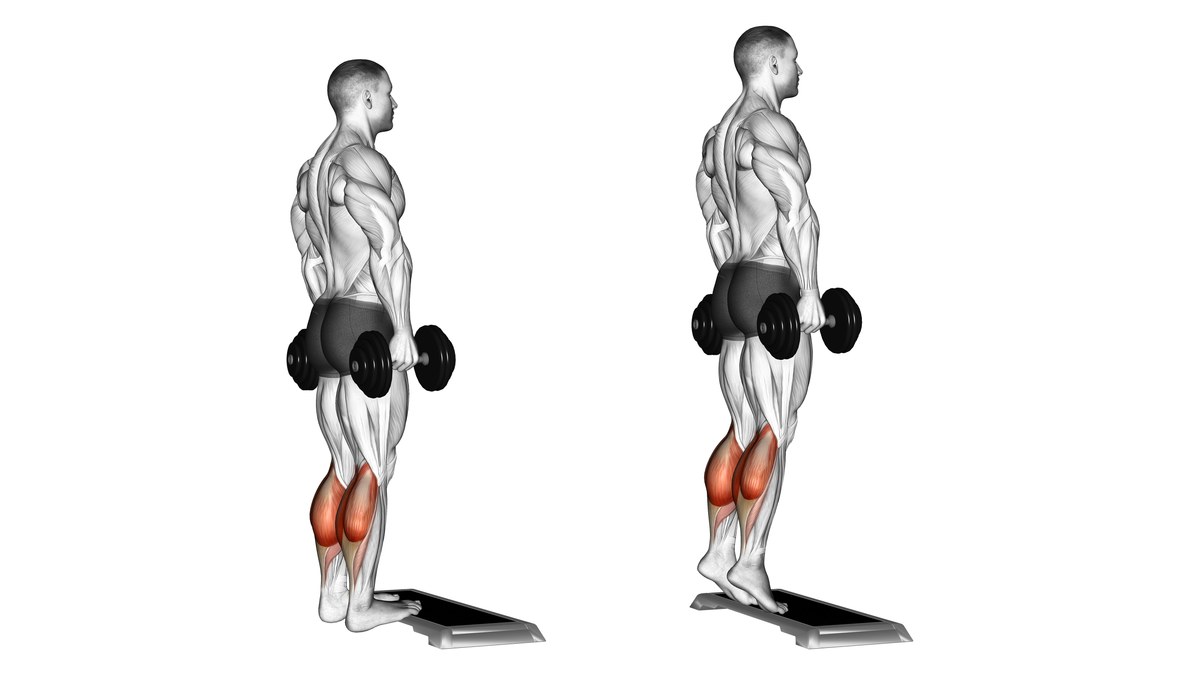
How do you perform a standing dumbbell calf raise?
Set up
- Place a firm exercise step on a level, nonslip surface. Choose dumbbells you can hold while standing steadily.
- Hold the dumbbells beside your thighs and step onto the platform. Set your feet about hip-width apart, with both forefeet firmly supported and your heels clear of the edge. Stand tall with straight knees, without forcing them backward.
Execution
- Let both heels lower to a comfortable starting depth while keeping your torso upright and your knees still.
- Lift your heels together as far as you can without losing balance, keeping pressure spread across the balls of both feet.
- Bring your heels back down slowly to the same depth. Settle at the bottom before starting the next repetition.
- At the end of the set, step down carefully onto the floor before putting the dumbbells down.
Common mistakes
Picking weights you cannot stand still with
If the dumbbells pull you off balance before the first repetition, reduce the load or use the supported option described below. Start each set with a setup you can hold steadily.
Dipping at the knees to push upward
Keep the leg position you chose at setup. If every heel raise starts with a knee dip, lighten the dumbbells and practise moving at the ankles.
Dropping into the next repetition
Slow the descent enough to choose where it ends. Do not let the heels fall into a stretch or rebound straight into the next lift.
Where it fits in a session
Use this as calf work after your main lower-body exercises, or wherever calf raises fit in your planned session.
Keep the step, heel depth and support consistent while you build up your repetitions. Add a small amount of weight when you can repeat the movement without swaying, bouncing or cutting the heel travel short.
Muscles worked
Primary
Secondary
- None listed in this guide
Schematic surface view. Some muscles are partly visible or not shown.
The gastrocnemius forms the visible upper calf, with the soleus underneath. Both muscles act at the ankle to raise the heel.
Frequently asked questions
Do I need a step for dumbbell calf raises?
No. You can start with both feet on a flat floor, raise your heels and lower them until they touch down again. A step leaves room for your heels to move below the forefeet, as the illustration shows. Use a stable step only when you can control that extra travel; do not chase depth by rocking backward.
What if I cannot balance with a dumbbell in each hand?
Put the weights down before changing your setup. Try the floor version with one dumbbell beside you and your free hand resting on a fixed rail or other sturdy support. Keep both feet working together. If you still cannot stay steady, practise without a dumbbell first.
How heavy should the dumbbells be?
Begin with a pair you can hold securely through controlled repetitions. The useful starting weight is one that lets you keep the same heel movement from the first rep to the last. If your grip slips, you sway or you need a knee dip to get up, end the set and choose lighter weights.
Is this the same as a single-leg calf raise?
This guide keeps both feet on the support and raises both heels together. In a single-leg calf raise, one foot stays off the support while the other leg performs the movement. Keep that variation separate from this two-leg version rather than shifting onto one side as a set gets harder.
Sources
- Texas Tech University Health Sciences Center El Paso. Anatomy Tables: Leg & Foot, gastrocnemius and soleus rows. https://anatomy.ttuhscep.edu/schemes/leg_tables.html
- Abuqubo R, Graefe SB, La Rose J. Anatomy, Bony Pelvis and Lower Limb: Leg Posterior Compartment. StatPearls; updated May 13, 2026. https://www.ncbi.nlm.nih.gov/sites/books/NBK537340/