
Tate press
Also called dumbbell Tate press.
What is a Tate press?
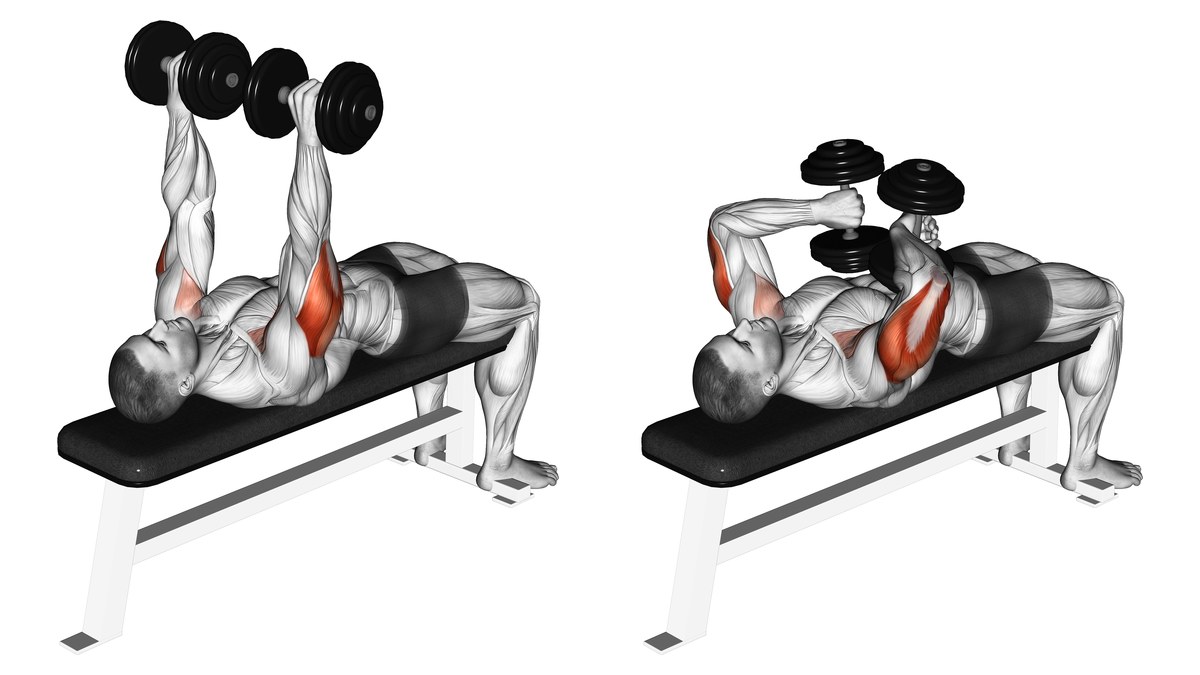
A Tate press is a lying dumbbell triceps extension in which the elbows point sideways and the weights fold inward toward the chest. You straighten your elbows to lift the dumbbells again, keeping the upper arms in roughly the same place. It trains the triceps at the back of the upper arms.
How do you perform a Tate press?
Set up
- Sit at the end of a flat bench with a light dumbbell on each thigh, then lie back with your head and upper back supported and feet firmly on the floor.
- Bring the weights above your chest with straight arms, palms facing your feet and thumbs pointing toward one another.
- Keep the weights close together and settle your shoulders against the bench.
Execution
- Bend your elbows out to the sides, folding the dumbbells inward toward your upper chest.
- Stop just before the inner ends reach your chest, keeping your shoulders against the bench and the weights clear of your face.
- Straighten your elbows to lift the weights above your chest, then repeat along the same path.
Common mistakes
Turning the repetition into a dumbbell bench press
Lowering the upper arms beside the bench changes the movement. Keep them in roughly their starting position and let the elbows bend outward.
Dropping the weights onto the chest
Keep holding their weight as you approach the bottom. If you cannot reverse the movement smoothly, use lighter dumbbells or stop a little higher.
Forcing the elbows wider as you lower
Use a path you can repeat comfortably. If the position hurts your shoulder or elbow, stop the set rather than forcing the weights farther down.
Where it fits in a session
Use it as triceps assistance after the main pressing work in an upper-body or arm session.
Begin with dumbbells you can lower and raise without changing the arm path. Keep the same bench and bottom position as you add repetitions; add weight once that movement stays repeatable through the set.
Muscles worked
Primary
Secondary
- None listed in this guide
Schematic surface view. Some muscles are partly visible or not shown.
The triceps straighten the elbows as the dumbbells rise. The muscle is listed as a whole; this guide does not rank its three heads.
Variations
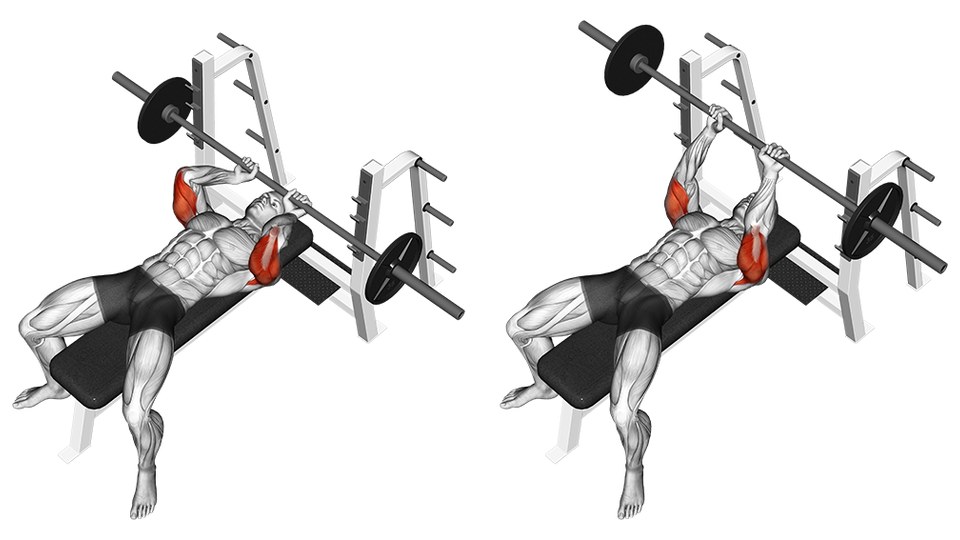
- Lying triceps extensionThe weight travels toward or past the head rather than folding inward toward the chest.
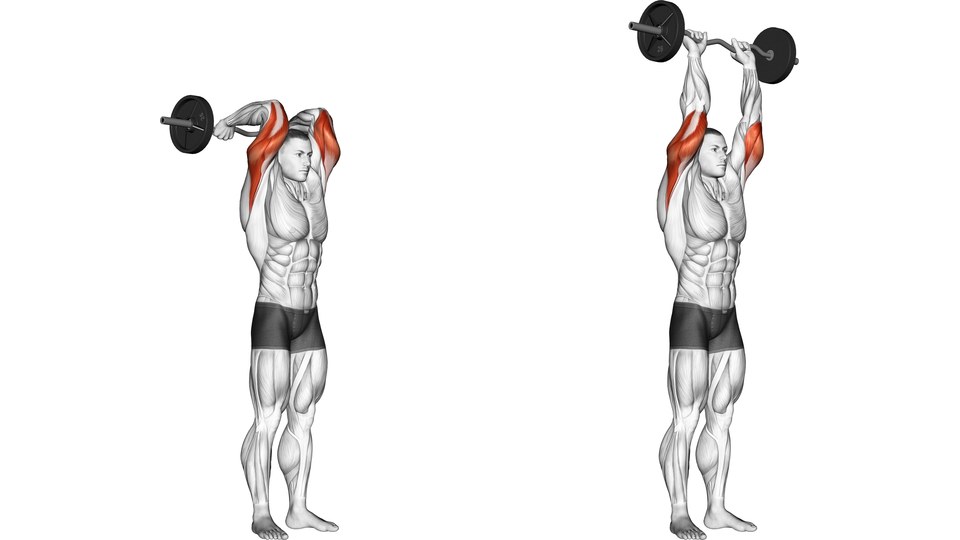
- Overhead triceps extensionThe upper arms are raised beside the head and the weight lowers behind it.
Frequently asked questions
What muscles does the Tate press work?
It trains the triceps, which straighten the elbows. Keep the upper arms steady instead of adding a large shoulder movement to finish each repetition.
Is a Tate press the same as a skull crusher?
They are different lying triceps extensions. In the Tate press, your elbows point outward and the dumbbells fold toward your chest. In a skull crusher, the weight lowers toward or past your head. Keep a separate record of each movement's weights and repetitions.
Should the dumbbells touch my chest?
This guide stops just short of contact so you control the turn without resting the weights on your chest. A light touch is another coaching choice; do not bounce or let the dumbbells drop onto you.
Where should my feet go?
Use the floor if you can plant your feet comfortably. If the bench is too high, use stable blocks under your feet. The illustration uses the low bench base as foot support; you do not need to copy that detail.
How heavy should I go?
Start with a light pair while learning the inward path. The weight is too heavy for this version if you need to lower the upper arms into a bench press or cannot keep the dumbbells away from your face. Build from clean repetitions rather than your pressing weight.
Sources
- Tiwana MS, Sinkler MA, Bordoni B. Anatomy, Shoulder and Upper Limb, Triceps Muscle. StatPearls, updated 2023. https://www.ncbi.nlm.nih.gov/sites/books/NBK536996/