
Toe-touch crunch
Also called toe touches, floor toe reach.
What is a toe-touch crunch?
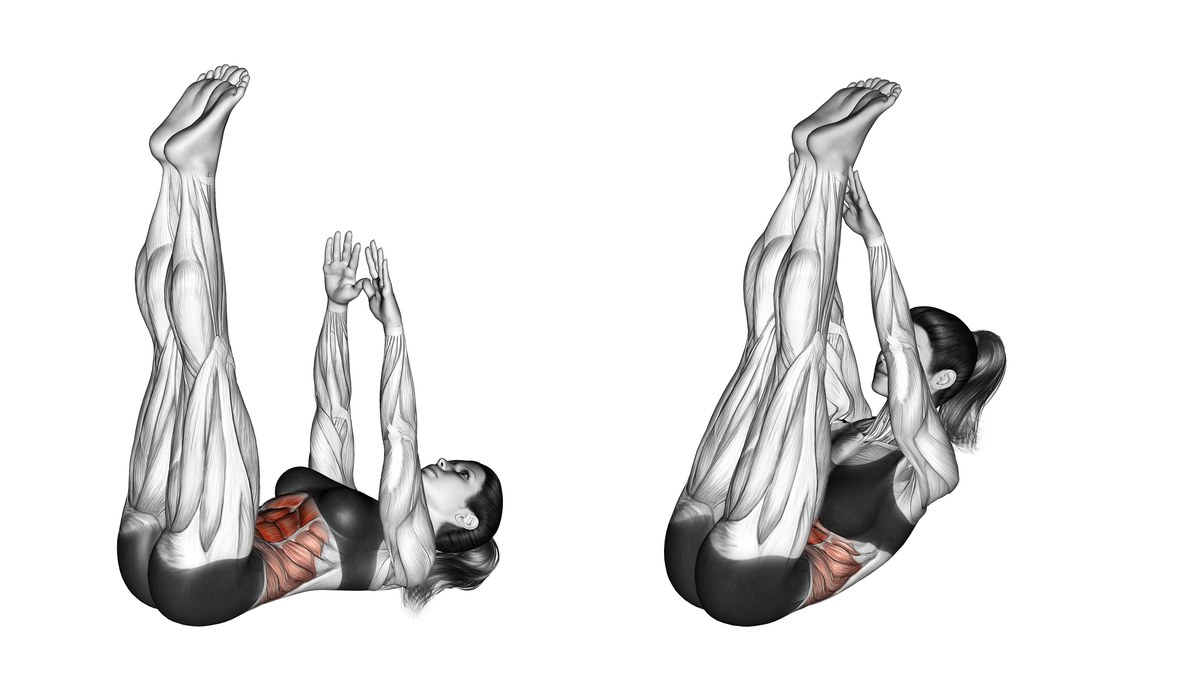
A toe-touch crunch is an abdominal exercise done lying on your back with your legs raised. Reach toward your toes as you curl your shoulder blades off the floor, then lower while keeping your legs up. It trains the rectus abdominis. The reach gives you a direction; touching your toes is optional.
How do you perform a toe-touch crunch?
Set up
- Lie on your back on a mat, with your head and shoulders resting down.
- Raise both legs so your feet are above your hips. Keep a small bend in your knees rather than forcing them straight.
- Extend your arms toward the ceiling, with your hands lined up toward your feet.
Execution
- Breathe out and curl your shoulder blades off the mat, reaching both hands toward your toes while your hips stay down.
- Stop at a controlled crunch. Keep your legs still and your chin clear of your chest; touching your toes is optional.
- Lower your head and shoulders gently to the mat without dropping your legs, then repeat.
Common mistakes
Swinging the legs toward your hands
Moving the target makes contact easier but changes the rep. Set your legs, then reach.
Sitting all the way up
This version uses a small shoulder-blade lift with the hips down. End the rep before you rock onto your sitting bones.
Throwing the arms forward
A quick arm swing can hide a very small curl. Keep the reach smooth and shorten the range if needed.
Where it fits in a session
Use it in the abdominal work you have planned for the session.
Choose a number of reps that lets you keep the legs still and lower each crunch gently. End the set when you need to swing or sit up to keep reaching; use the feet-down crunch if the raised-leg position is the part you cannot maintain.
Muscles worked
Primary
Secondary
- None listed in this guide
Schematic surface view. Some muscles are partly visible or not shown.
Variations
- CrunchA useful regression when holding your legs up makes the curl hard to control. Put both feet on the floor with your knees bent and perform the shoulder-blade lift without the toe reach.
- Toe-touch crunch with softer knees — Bend your knees a little more and shorten the reach while keeping your legs raised. Treat this as an adjustment to the same rep rather than forcing straight knees or toe contact.
Frequently asked questions
Do I have to touch my toes?
No. Reach toward them and stop when you have completed a controlled crunch. Fingertips may only reach your shins or ankles. Do not throw your arms, swing the legs toward you or sit up farther just to make contact.
Do my knees need to be completely straight?
No. Keep a comfortable bend rather than forcing them straight. A little more knee bend and a shorter reach are reasonable adjustments. If holding your legs up stops you controlling the crunch, put your feet down and use a standard crunch.
Is this the same as a standing toe touch?
No. A standing toe touch starts on your feet and folds forward toward the floor. This guide covers the lying abdominal exercise: the legs are already raised while the shoulders curl up toward them.
How is a toe-touch crunch different from a V-up or sit-up?
In this crunch, your legs stay raised between reps and you lift your shoulders in a small curl. A V-up brings the legs and torso up together from a more extended position. A sit-up raises much more of the torso toward sitting. Keep this version to the smaller curl.
Sources
- Flynn W, Vickerton P. Anatomy, Abdomen and Pelvis: Abdominal Wall. StatPearls. Updated July 24, 2023. https://www.ncbi.nlm.nih.gov/books/NBK551649/
- Betts JG, et al. Anatomy and Physiology 2e. Section 11.4: Axial Muscles of the Abdominal Wall, and Thorax. OpenStax; 2022. https://openstax.org/books/anatomy-and-physiology-2e/pages/11-4-axial-muscles-of-the-abdominal-wall-and-thorax