Upright row
Also called barbell upright row, standing upright row.
What is an upright row?
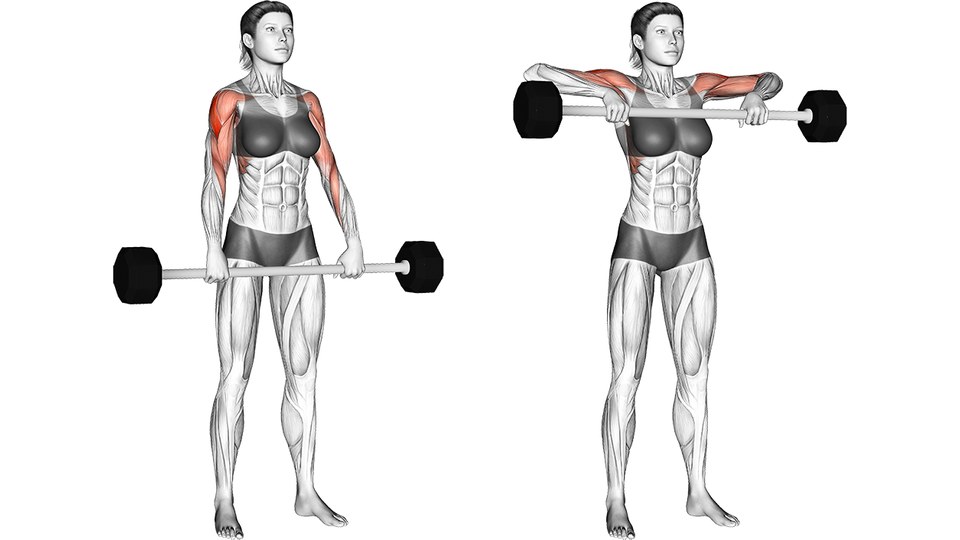
An upright row is a standing pull in which you raise a barbell close to your body with your elbows moving out to the sides. It trains the lateral deltoids and trapezius, with the front deltoids and elbow flexors assisting. The top position is not a fixed height: stop where the movement remains comfortable rather than forcing the bar toward your chin.
Muscles worked
- lateral deltoid
- trapezius
- anterior deltoid
- biceps brachii
- brachialis
- brachioradialis
The lateral deltoid raises the upper arm while the trapezius moves and supports the shoulder blade. The elbow flexors assist as the elbows bend, but the exercise is normally used for the shoulders and upper back rather than as a curl.
Variations
- Dumbbell upright row — Each hand can find its own path instead of being fixed to one bar.
- Cable upright row — Uses a low cable and keeps resistance through the whole pull.
- EZ-bar upright row — The angled bar changes the wrist position while the movement stays the same.
- Wide-grip upright row — Moves the hands farther apart and usually shortens how high the bar travels.
Frequently asked questions
What muscles does the upright row work?
The main muscles are the lateral deltoid and trapezius. The anterior deltoid assists at the shoulder, while biceps brachii, brachialis and brachioradialis help bend the elbows as the bar rises.
How high should I pull an upright row?
There is no height you must reach. Around lower-chest to shoulder height is enough for a recognisable rep, and stopping sooner is sensible if the shoulder feels pinched or painful. Do not force the bar toward your chin merely to make the rep look complete.
Are upright rows bad for your shoulders?
Not automatically, but they are uncomfortable for some people. A small observational study found an association between signs of shoulder impingement and performing upright rows above shoulder height; it did not show that the exercise caused those signs. Use a comfortable range and choose another movement if changing the load, grip and stopping point does not help.
What grip should I use for an upright row?
Start around shoulder width. A narrower or wider grip changes the path and how high the bar can travel, so small adjustments are reasonable if they make the movement feel smoother. Keep both wrists in a position you can hold without bending them sharply.
Can I do upright rows with dumbbells?
Yes. Dumbbells let each hand move independently, which may feel more natural than fixing both hands to one bar. The same basic action applies: elbows move out and up, the weights stay close, and the rep stops at a comfortable height.
Sources
- Elzanie A, Varacallo MA. Anatomy, Shoulder and Upper Limb, Deltoid Muscle. StatPearls. https://www.ncbi.nlm.nih.gov/books/NBK537056/
- Ourieff J, Scheckel B, Agarwal A. Anatomy, Back, Trapezius. StatPearls. https://www.ncbi.nlm.nih.gov/books/NBK518994/
- Kolber MJ, Cheatham SW, Salamh PA, Hanney WJ. Characteristics of shoulder impingement in the recreational weight-training population. J Strength Cond Res. 2014. https://pubmed.ncbi.nlm.nih.gov/24077379/