Walking
Also called fitness walking, treadmill walking, brisk walking.
What is walking?
Walking is a form of cardio built from the natural gait you use to move on foot. It can be done outdoors or on a treadmill, and its pace and duration depend on why it is part of the session.
How do you walk for exercise?
Set up
- Choose a clear walking surface and footwear that feels secure.
Execution
- Stand upright and look ahead, with your shoulders relaxed and your arms free to swing.
- Walk with a natural stride, placing each foot where you can stay balanced and letting your arms swing comfortably.
- Keep the stride controlled as the surface or treadmill setting changes, and slow or stop if you lose your balance.
Common mistakes
Watching your feet the whole time
Looking down continuously makes it harder to see the route or people ahead. Glance down when the surface calls for it, then look forward again.
Forcing a longer stride
Reaching farther than feels natural can make each step less stable. Let the foot land where you can move smoothly and stay balanced.
Letting a treadmill setting pull you out of position
If you have to reach for the rails or chase the belt, change the setting until you can walk under control again.
Where it fits in a session
Walking can be used before or after lifting, on its own, or as part of another cardio session.
Match the route, treadmill settings, pace and duration to the purpose of the session rather than treating one prescription as correct for every kind of walking.
Muscles worked
- quadriceps
- hamstrings
- calves
- gluteus maximus
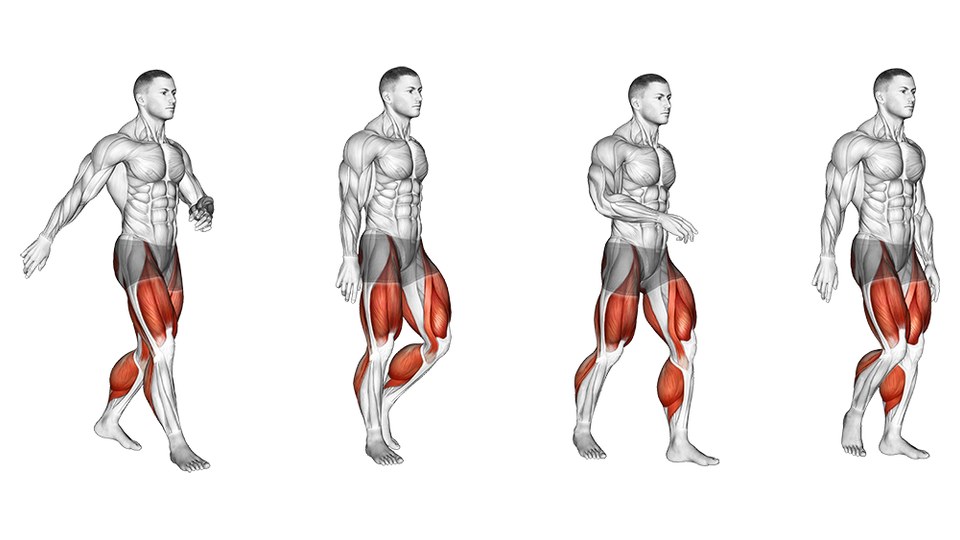
Walking is a whole-body gait rather than a muscle-isolation exercise. The quadriceps, hamstrings, calves and gluteus maximus each contribute during different parts of a stride, so the list is not a ranking of which works hardest.
Variations
- Outdoor walking — Uses the natural changes in the route and surface around you.
- Treadmill walking — Uses a moving belt with speed and incline controlled at the console.
- Hill walking — Adds uphill and downhill sections without changing the basic gait.
- Walking with poles — Uses a pole in each hand while you walk.
Related tools
Frequently asked questions
What muscles does walking work?
The quadriceps, hamstrings, calves and gluteus maximus all contribute to walking. The quadriceps help control and straighten the knee, the hamstrings help control the leg as it swings, the calves help move the body forward over the foot, and the gluteus maximus helps extend the hip.
Is treadmill walking different from outdoor walking?
The movement is still walking, but the setting changes. A treadmill gives you a predictable surface and console-controlled speed and incline; outdoors, the route sets the turns, gradients and surface changes.
How fast should I walk?
There is no single pace that fits every session. A warm-up, cool-down, easy aerobic walk and race-training walk have different purposes, so use the pace called for by the plan you are following.
How long should I walk?
Duration depends on why you are walking and how it fits with the rest of your training. Record the time or distance if either is useful for the plan, but the guide does not prescribe one target for every purpose.
Should I walk before or after lifting?
Either can make sense. Walking may be part of a warm-up, a cool-down or a separate cardio session; its place depends on what the session is meant to accomplish.
Sources
- Bordoni B, Varacallo M. Anatomy, Bony Pelvis and Lower Limb: Thigh Quadriceps Muscle. StatPearls. https://www.ncbi.nlm.nih.gov/books/NBK513334/
- Hu Y, Raja A. Anatomy, Bony Pelvis and Lower Limb, Hamstring Muscle. StatPearls. https://www.ncbi.nlm.nih.gov/books/NBK546688/
- Binstead JT, Varacallo M. Anatomy, Bony Pelvis and Lower Limb: Calf. StatPearls. https://www.ncbi.nlm.nih.gov/books/NBK459362/
- Elzanie A, Borger J. Anatomy, Bony Pelvis and Lower Limb, Gluteus Maximus Muscle. StatPearls. https://www.ncbi.nlm.nih.gov/books/NBK538193/