Treadmill
Also called treadmill walking, treadmill running, running machine.
What does treadmill training do?
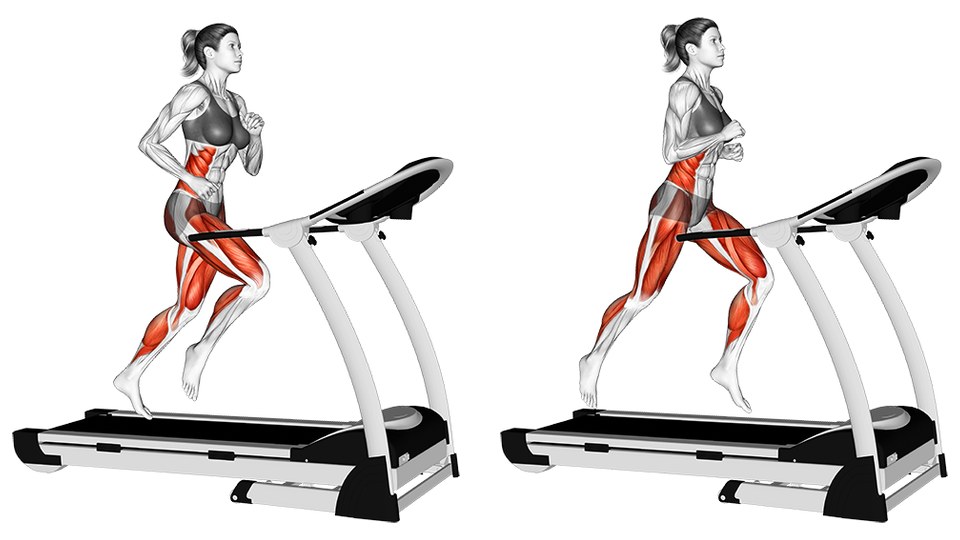
A treadmill is a motorised belt you walk or run on, with the speed and the incline set at the console. The training effect is cardiovascular first, and the legs share the work stride by stride rather than any one muscle carrying a load: quadriceps and calves around foot contact and push-off, hamstrings slowing the leg as it swings through, hip flexors and shin carrying it forward, hip abductors keeping the pelvis level each time you are on one foot. Raising the incline is what brings the glutes in — on the flat they do very little. Effort is dosed in minutes, pace and incline rather than in sets and reps, which is also how lifters log it: in RepCount it shows up as one entry inside an ordinary gym session, not as a session of its own.
How do you use a treadmill?
Set up
- Hold the handrails, start the belt at a speed you can step onto safely, and step on one foot at a time.
Execution
- Once you are steady, let go of the rails and walk or run upright near the middle of the belt.
- Adjust the speed and incline for the session you planned, keeping a natural stride you can control.
- When you are finished, stop the belt with the controls and step off only after it has stopped.
Common mistakes
Holding the handrails once the speed or incline is up
Leaning on the rails carries part of your bodyweight for you, so the incline you dialled in is not the incline you are walking, and it pulls you into a hunched, forward-leaning stride. If you cannot let go, the setting is too much rather than your grip being useful.
Reaching the front foot out to keep up with the belt
Landing with the foot ahead of your hips brakes you on every step, through a nearly straight leg. Take shorter, quicker steps, or slow the belt until your feet land underneath you again.
Stepping straight onto a belt already at speed
The belt pulls your first foot backwards from under you before the second one is down, which is how people go off the back. Start it slow from the rails and bring the speed up once you are walking.
Same speed, same incline, same minutes, every session
An effort you never nudge stops asking anything new of you, the same way a weight you never add to does. Move one variable at a time over weeks — pace, incline or duration — rather than all three at once.
Where it fits in a session
Five to ten easy minutes before you lift, or after the weights — or on its own day — when the cardio is the point rather than the warm-up.
Dose it in minutes and effort, not sets and reps. Easy means you could hold a conversation; make it harder by raising pace or incline, one at a time, across weeks.
Muscles worked
- quadriceps
- hamstrings
- gluteus maximus
- gluteus medius
- gastrocnemius
- soleus
- tibialis anterior
- iliopsoas
A muscle-target list is a poor description of a treadmill, and it is worth saying so plainly: nothing here is targeted the way a curl targets the elbow flexors, each stride loads the leg with a share of your own bodyweight, and the training effect is cardiovascular before it is muscular. These are listed as co-actors rather than ranked because the anatomy gives each one a phase of the stride rather than a share of the work — quadriceps and calves around foot contact and push-off, hamstrings slowing the leg late in its swing, tibialis anterior clearing the foot off the ground, iliopsoas driving the leg through, gluteus medius holding the pelvis level every time you are on one foot. The one ranking the anatomy does support is a negative one: on a flat belt the gluteus maximus does little, and it is the incline that brings it in. Within the calf the split runs the other way round from the usual assumption — the soleus does the sustained plantarflexion of walking, and the gastrocnemius takes over in the faster, more explosive stride of running.
What lifters actually do
About one RepCount lifter in five has logged treadmill work, and it turns up in roughly 3% of workouts — but when it does, it is almost never the workout itself. A treadmill entry sits inside a session of six or seven exercises and is recorded as a single entry rather than in sets, and what it sits beside is machine leg work: leg extensions, leg presses and leg curls, with pulldowns and bench press close behind. That is the shape of a warm-up or a finisher attached to a lifting session rather than of a run for its own sake.
Most often trained alongside
Share of treadmill sessions that also include each exercise.
- Leg extension13.9%
- Leg press12.4%
- Pulldowns12.1%
- Leg curl10%
- Bench press9.9%
Figures come from workouts tracked in RepCount.
Variations
- Incline treadmill walk — Raises the demand at walking speed, and is what brings the glutes and calves into the stride.
- Treadmill intervals — Hard efforts alternated with easy walking, with the belt setting the pace rather than your willingness to hold it.
- Curved manual treadmill — No motor — the belt moves only as you drive it, so the effort is higher at any given pace.
- Walking pad — A low, console-light belt built for slow walking, usually under a desk rather than in a gym.
Frequently asked questions
What muscles does a treadmill work?
All the muscles of the stride, each in its own phase: quadriceps and calves around foot contact and push-off, hamstrings slowing the leg late in its swing, tibialis anterior lifting the foot clear of the ground, iliopsoas driving the leg forward, and gluteus medius holding the pelvis level while you are on one foot. None of them is loaded the way a lift loads a muscle — each stride is a share of your own bodyweight, repeated — and the main training effect is cardiovascular.
Does incline change which muscles work?
Yes, and more than speed does. The gluteus maximus contributes little to walking on a flat surface; anatomy references note that flat walking is barely affected even when the muscle cannot fire at all, and that it comes into play walking uphill, climbing stairs and running. The soleus likewise does its heaviest work in sustained efforts such as walking uphill. Incline is how a treadmill reaches the glutes and the calves.
Should I walk or run on the treadmill?
That is a preference, not a technique point — pick the one you will actually keep doing. Running gets more work done per minute; incline walking raises the demand without the impact, which suits anyone easing back into cardio or training around sore legs. The stride is the same movement either way, so the muscles involved do not change, only how hard and how fast they work.
Does the treadmill build leg muscle?
Not to any real extent. Each stride loads the leg with a fraction of your bodyweight, which is a long way from the loading that drives muscle growth, and the muscles are working in short bursts through a phase of the stride rather than under a load through a range. RepCount's own logs point the same way: lifters who record treadmill work put it in the same session as leg extensions, leg presses and leg curls rather than in place of them.
Should I do the treadmill before or after lifting?
Both are common and both work. A short easy stint before you lift is a warm-up; anything long or hard fits better after the weights, or on another day, so it is not eating into your leg training. In RepCount the treadmill almost always appears inside a lifting session rather than as the session itself, so most lifters are already treating it as the bookend rather than the workout.
How should I log treadmill work?
As a single entry with the time, plus distance or incline if you want something to progress against — not as sets and reps. That is already how it gets logged in practice: a treadmill entry is one logged set almost every time it appears, where a lift is several.
Is the treadmill worth doing if I lift?
About one RepCount lifter in five has logged treadmill work, and it turns up in roughly 3% of workouts — used, but rarely the point of the session. When it appears it sits in a session of six or seven exercises, most often alongside machine leg work, pulldowns and bench press. That is the profile of a warm-up or a finisher, and it is a reasonable way to get some conditioning in without giving up a training slot to it.
Sources
- Bordoni B, Varacallo M. Anatomy, Bony Pelvis and Lower Limb: Thigh Quadriceps Muscle. StatPearls. https://www.ncbi.nlm.nih.gov/books/NBK513334/
- Hu Y, Raja A. Anatomy, Bony Pelvis and Lower Limb, Hamstring Muscle. StatPearls. https://www.ncbi.nlm.nih.gov/books/NBK546688/
- Elzanie A, Borger J. Anatomy, Bony Pelvis and Lower Limb, Gluteus Maximus Muscle. StatPearls. https://www.ncbi.nlm.nih.gov/books/NBK538193/
- Shah A, Bordoni B. Anatomy, Bony Pelvis and Lower Limb, Gluteus Medius Muscle. StatPearls. https://www.ncbi.nlm.nih.gov/books/NBK557509/
- Bordoni B, Varacallo M. Anatomy, Bony Pelvis and Lower Limb: Gastrocnemius Muscle. StatPearls. https://www.ncbi.nlm.nih.gov/books/NBK532946/
- Binstead JT, Varacallo M. Anatomy, Bony Pelvis and Lower Limb: Calf. StatPearls. https://www.ncbi.nlm.nih.gov/books/NBK459362/
- Juneja P, Hubbard JB. Anatomy, Bony Pelvis and Lower Limb: Tibialis Anterior Muscles. StatPearls. https://www.ncbi.nlm.nih.gov/books/NBK513304/
- Bordoni B, Varacallo M. Anatomy, Bony Pelvis and Lower Limb: Iliopsoas Muscle. StatPearls. https://www.ncbi.nlm.nih.gov/books/NBK531508/