Wall walk
What is a wall walk?
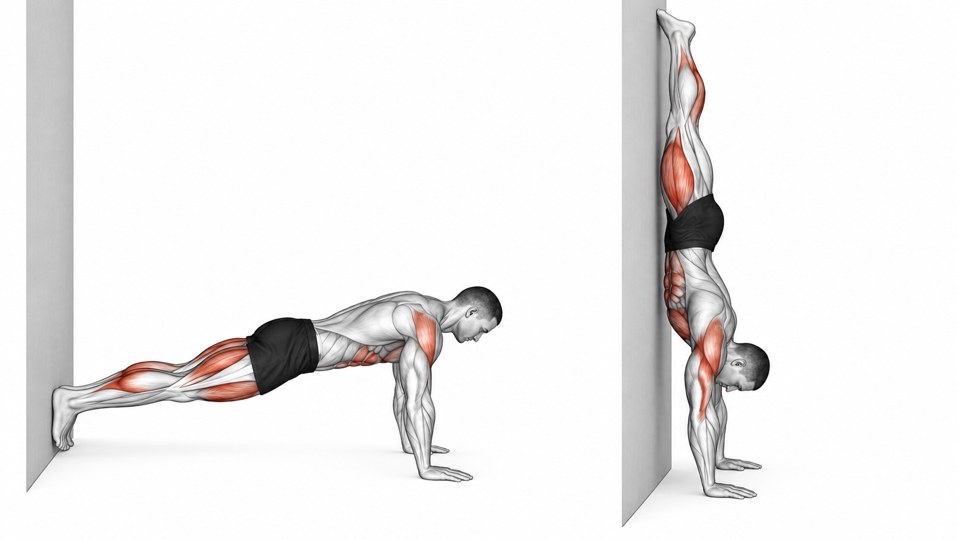
A wall walk starts face down with the feet near a wall. You walk your feet upward and your hands toward the wall into a chest-facing handstand, then reverse the movement back to the floor.
How do you perform a wall walk?
Set up
- Clear the floor beside a solid wall and use a surface your hands and feet will not slip on. Choose a stopping point that you can return from.
- Lie face down with feet at the wall and hands near the shoulders. Press into the top of a push-up with your body held straight.
Execution
- Place one foot on the wall, then the other, and begin moving them upward while taking small hand steps toward the wall.
- Keep the elbows straight as you travel, keeping enough distance from the wall that you can balance and breathe. Stop at your planned point before losing control.
- Reverse with small hand steps away from the wall while walking the feet downward. Keep supporting yourself with the arms until both feet reach the floor.
- Lower your body to the start with control before repeating.
Common mistakes
Walking too close before you can return
Choose a partial walk with a clear turnaround point.
Sliding the feet down while the hands stay still
Reverse the coordinated steps so you can support the descent.
Where it fits in a session
Practice this movement while you can control the required positions and finish each repetition deliberately.
Treat each repetition as an ascent and a descent. Turn around while you still have the strength and balance to reverse the steps.
Muscles worked
Primary
Secondary
- None listed in this guide
Schematic surface view. Some muscles are partly visible or not shown.
Variations
- Partial wall walk — Turns around earlier on the wall to limit the angle and distance.
Frequently asked questions
Do I need to reach the wall with my hands?
No. Start with a distance you can control in both directions. A competition workout may set a particular start and finish mark; check those rules separately.
How can I scale a wall walk?
Walk only partway up the wall or practise elevated pike holds and small hand steps. Choose a variation with a return you can perform deliberately.
Sources
- Betts et al. Anatomy and Physiology 2e. OpenStax, 2022. https://openstax.org/books/anatomy-and-physiology-2e/pages/11-5-muscles-of-the-pectoral-girdle-and-upper-limbs